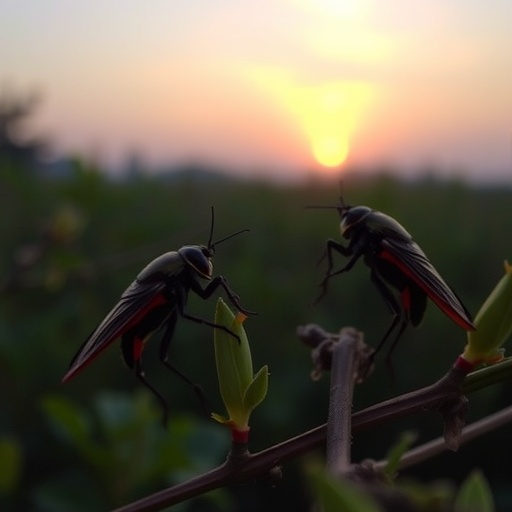

In the serene moments before sunrise, as the sky transitions from night to day, a remarkable natural phenomenon unfolds unnoticed by many. Cicadas, those familiar summer heralds, initiate their powerful and synchronized morning choruses not arbitrarily but with astonishing precision. Recent research has shed light on how these insects begin their collective singing at an exact threshold of ambient light during civil twilight, revealing a surprising example of photometric decision-making in the natural world.
A groundbreaking study published in Physical Review E reveals that cicadas commence their dawn serenades when the sun lies precisely 3.8 degrees below the horizon—a moment defined by civil twilight, the phase of early morning light just before the sun breaches the horizon. This discovery marks the first quantification of how cicadas tune their behavior to an exact light intensity level, demonstrating an exquisite natural synchronization that surpasses prior understanding of animal responses to environmental cues.
The international research team, comprising scientists from India, the United Kingdom, and Israel, conducted extensive field recordings over several weeks in two distinct locations near Bangalore, India. These data collections allowed the researchers to analyze cicada chorus patterns with unprecedented temporal resolution. Intriguingly, the cicada gatherings were not merely random but followed a consistent pattern centered around precise solar angles rather than fixed clock times, underscoring the role of environmental light cues over simple circadian rhythms.
.adsslot_kPCo4ifT2L{width:728px !important;height:90px !important;}
@media(max-width:1199px){ .adsslot_kPCo4ifT2L{width:468px !important;height:60px !important;}
}
@media(max-width:767px){ .adsslot_kPCo4ifT2L{width:320px !important;height:50px !important;}
}
ADVERTISEMENT
To dissect the mechanisms behind this synchronization, the team applied concepts traditionally belonging to physics, particularly those involved in phase transitions observed in magnetic materials. By modeling cicada decision-making akin to interacting magnetic spins that align with both external fields and neighboring units, the researchers offered a fresh lens through which collective insect behavior could be understood. This analogy suggests that cicadas gauge not only ambient light but also the acoustic presence of nearby singing individuals, creating a self-reinforcing chorus.
Professor Raymond Goldstein, co-author and renowned physicist at Cambridge University, expressed fascination over these findings, noting that while it has long been understood that animals react to broad light changes such as sunrise or seasonal shifts, this study uniquely quantifies the precision with which cicadas respond to a narrowly defined photometric threshold. The cicadas’ ability to synchronize within a margin of only 25% variation in light intensity during their short transitional period is a testament to sophisticated environmental sensing and social communication.
Further examination revealed that the crescendo of the cicada chorus—a characteristic surge in volume familiar to anyone waking in spring or summer—builds rapidly, typically over the course of just one minute. The midpoint of this crescendo reliably occurs at the same solar angle, irrespective of slight daily variations in sunrise timing. This adaptation likely offers evolutionary advantages, optimizing energy expenditure and enhancing the efficacy of communal signaling.
To explain these observations quantitatively, the study employed a mathematical framework inspired by magnetism, where individual units (spins) interact both with an external field and with each other. Translating this into biological terms, each cicada is posited to modulate its singing based on measured light intensity and the singing activity of its neighbors. This dual input mechanism fosters a collective decision process manifesting as a highly synchronized dawn chorus, a phenomenon echoing broader principles of collective behavior found across biological systems.
Co-author Professor Nir Gov from the Weizmann Institute highlighted the significance of these local interactions, revealing how relatively simple individual decision rules can generate coherent group patterns without centralized coordination. Such emergent behavior provides insights into the complex dynamics governing animal communication, where subtle environmental signals and social feedback loops intertwine to produce remarkably orchestrated actions.
The high-fidelity field recordings, instrumental to this research’s success, were made possible by Bangalore-based engineer Rakesh Khanna, who pursues cicada acoustics as a passionate avocation. His collaboration with Cambridge researchers, including Goldstein and Dr. Adriana Pesci, facilitated a multidisciplinary approach combining field biology, physics, and applied mathematics to unravel these intricate natural processes.
This study not only advances our understanding of insect ethology but also contributes broadly to the science of collective behavior and decision-making in complex systems. By identifying the precise light conditions that trigger cicada chorus initiation and elucidating the interplay between environmental cues and social interactions, the research opens new avenues for exploring how natural systems exploit physical laws and collective dynamics.
Moreover, the study’s findings have broader implications that extend beyond entomology. Understanding how animals integrate multiple environmental inputs to make coordinated group decisions can inform disciplines ranging from robotics to neuroscience, where designing systems capable of autonomous synchronized behavior remains a forefront challenge. The cicada’s timing strategy exemplifies nature’s efficiency and resilience in collective signal processing.
Funded partly by the Complex Systems Fund at the University of Cambridge, this investigatory work underscores the fruitful intersection between physics and biology. Professor Goldstein, the Alan Turing Professor of Complex Physical Systems and a Fellow of Churchill College, Cambridge, emphasizes the importance of interdisciplinary collaboration in unlocking the secrets of seemingly simple yet profoundly complex biological phenomena such as the dawn cicada chorus.
As the sun inches toward the horizon and the first faint light bathes the earth, cicadas prepare their famous symphony at an exact photometric threshold. This discovery not only enriches our appreciation of these common insects but also highlights the sophistication inherent in natural systems that harness environmental signals and social feedback to orchestrate collective action with breathtaking precision.
Subject of Research: Collective behavior and photometric decision-making in cicadas during dawn choruses
Article Title: Photometric decision making during the dawn choruses of cicadas
News Publication Date: 1-Aug-2025
Web References:
Physical Review E Article
Keywords
Insects, Animal communication, Ethology, Sunlight, Physics
Tags: ambient light thresholds in naturecicada research study findingscicada species and habitatcicadas and environmental cuescicadas dawn chorus behaviorcicadas field recordings analysiscivil twilight and cicadasearly morning animal behaviornatural synchronization in animalsphotometric decision-making in insectsscientific study of cicadassynchronized cicada singing