Credit: Photo courtesy Catherine Dana
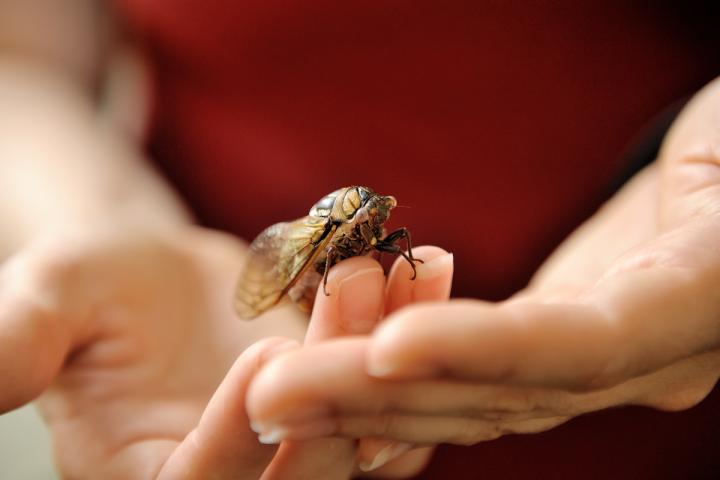
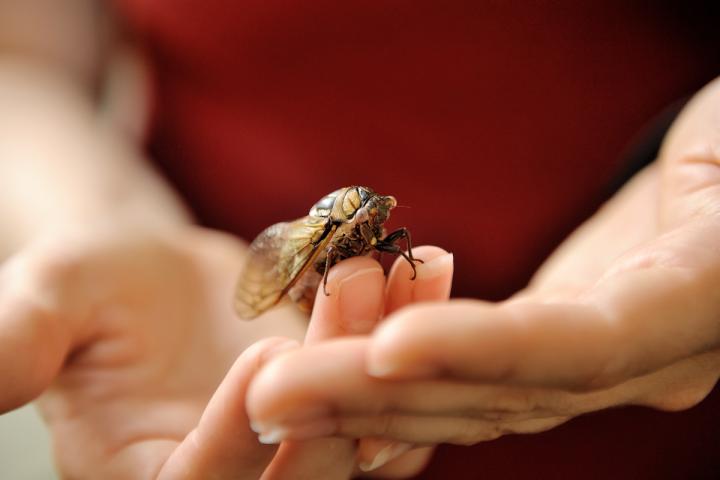
CHAMPAIGN, Ill. — Researchers are looking to insects – specifically cicadas – for insight into the design of artificial surfaces with de-icing, self-cleaning and anti-fogging abilities.
Their wings allow cicadas to fly, of course, but they also are good at repelling water – a condition that humans can appreciate, too.
"Our work with cicadas is letting us explore a field called bioinspiration," said Nenad Miljkovic, a University of Illinois mechanical science and engineering professor who co-led a new study of cicada wings.
"We are learning as much as we can from the natural design of cicada wings to engineer artificial objects that are useful to humans."
The study, published in the journal Applied Materials and Interfaces, focused on the water-repelling ability of cicada wings. The research team of engineers and entomologists used high-speed microscopic photography to study the wings' ability to repel water.
"The property that allows a surface to repel water is called hydrophobicity and it causes water to bead up and roll away," Miljkovic said. "Superhydrophobicity is simply an extreme form of this property and cicada wings that have this feature have a rough nanotexture that creates open spaces around water droplets, allowing surface tension to force the droplets to jump off of the wings."
A video related to this research can be found here.
Past cicada-wing studies have focused on a single species. However, nature is variable, and the team wanted to take a comparative approach to represent this variability.
"Traditionally, the idea would be to collect cicadas that live in wetlands to study wing hydrophobicity," said Marianne Alleyne, an entomology research scientist and a co-lead on this study. Such studies are based on the assumption that wetland-dwelling cicadas have the most water-repellant wings.
"We wanted to test this hypothesis, so we collected four different species – one found in wetlands, one from forests, one from prairie lands – all annual cicadas – and one periodic seventeen-year cicada," Alleyne said.
"We expected to find that the specimens from drier habitats would lack superhydrophobicity," said Catherine Dana, an entomology graduate student and study co-author. "We were surprised to find the opposite, and that habitat is not a good predictor of this extreme water-repelling ability of the cicada wings."
It turns out that other factors may be better predictors of superhydrophobicity, such as differences in species life cycles – annual versus perennial varieties, for example – and species relatedness.
"This is something that we, as engineers, probably would not have figured out on our own," said Junho Oh, a mechanical engineering graduate student and study co-author. "Working with biologists allows us to get a better understanding of how cicadas live and evolve, which better informs us of how to truly bioinspire for mechanical engineering applications."
"This research is an excellent example of the strength of bringing together disparate fields to study and understand natural systems," said Don Cropek, an analytical chemist from the Energy Research Development Center-Construction Engineering Research Lab, who is a co-leader of this research project. "We have a great multidisciplinary team from analytical chemistry, mechanical engineering, entomology and materials science that promises to replicate natural structures like insect wings to make surfaces with enhanced properties."
###
This is the first of several cicada-wing bioinspiration studies to be conducted in collaboration with ERDC-CERL. The work is supported by the Army Basic Research Program. Je Won Hong and Jonah Nguyen from U. of I. and Kyoo Jo, Jessica Roman, and Sungmin Hong from ERDC-CERL are also co-authors of this work.
Media Contact
Lois E Yoksoulian
[email protected]
217-244-2788
@NewsAtIllinois
http://www.illinois.edu
Original Source
https://news.illinois.edu/blog/view/6367/537912 http://dx.doi.org/10.1021/acsami.7b07060