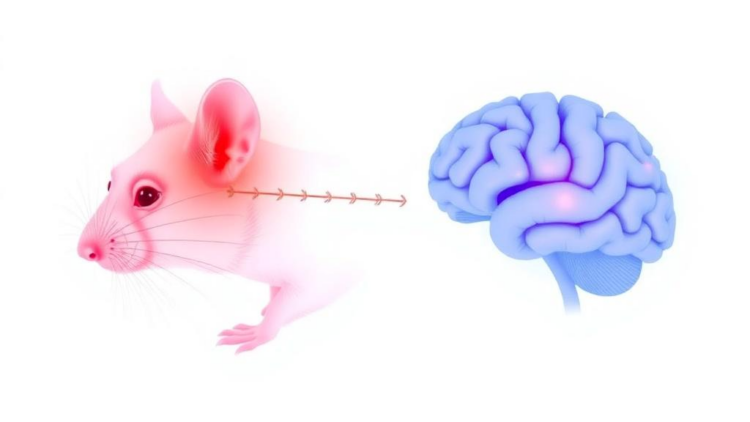
Chronic pain has long been described as a matter of raw sensation, a persistent alarm that the body cannot switch off. But a new study in rats suggests that sustained pain signals do something subtler and arguably more disruptive: they rewire the way the brain’s cortex filters information in the first place. Researchers led by Nermin Tepe of Balıkesir University and Hayrunnisa Bolay of Gazi University report in BMC Neuroscience that a sustained nociceptive input, produced by injecting the inflammatory irritant capsaicin, breaks down a fundamental timing-dependent mechanism known as sensory gating in the rat primary somatosensory cortex. The finding offers a mechanistic window into why people living with pain often struggle with temporal discrimination, hypersensitivity, and the sensation that ordinary touch has become intrusive.
Sensory gating is one of the nervous system’s most economical tricks. When two identical stimuli arrive in quick succession, the brain’s response to the second is normally dampened relative to the first, a phenomenon measured by the ratio of the second response to the first. This suppression is not fixed; it depends heavily on the interstimulus interval, the gap between the two pulses. At very short intervals the cortical circuitry is still recovering and the second response is strongly attenuated, while at longer intervals the response gradually rebounds. The pattern reflects the recovery dynamics of thalamocortical synapses and local inhibitory circuits, and it allows the cortex to emphasize novel input while suppressing redundant input. In clinical settings, disturbances of sensory gating have been linked to a range of conditions, from migraine to schizophrenia, making the mechanism a sensitive readout of brain health.
To test how sustained pain reshapes this system, the team applied paired-pulse electrical stimulation to the median nerve of anesthetized rats, delivering two pulses separated by interstimulus intervals of 35, 50, 80, 140, and 500 milliseconds. Evoked potentials were recorded directly from the primary somatosensory cortex, the cortical region that receives and processes touch and proprioceptive information from the body. The researchers then injected capsaicin, the pungent compound in chili peppers that activates TRPV1 receptors on nociceptive C-fibers, into the territory served by the nerve. Capsaicin produces a well-characterized model of sustained peripheral nociceptive input: it does not destroy the nerve, but it drives a prolonged barrage of pain-related signals from the periphery into the central nervous system. Recordings were repeated at 60 and 120 minutes after the injection, allowing the team to track how the cortical response evolved as the pain signal persisted.
The results were striking in their asymmetry. Compared with vehicle-treated controls, capsaicin significantly increased the amplitude and the area under the curve of the first response, S1, while simultaneously decreasing the S2/S1 amplitude ratio across the entire two-hour recording window. In other words, the cortex responded more vigorously to the initial stimulus, but the relative suppression of the second stimulus deepened. At first glance that combination may seem paradoxical, but the authors interpret it as a change in response gain: the whole input-output function of the cortical circuit was scaled up, so the first response grew while the recovery-dependent second response failed to keep pace. Crucially, this effect appeared to be independent of the interstimulus interval. In the normal brain, the degree of gating varies systematically with the gap between pulses; after capsaicin, that orderly interval-dependent structure was largely lost, replaced by a flattened, interval-insensitive profile.
The study went beyond conventional evoked potentials by examining high-frequency oscillations, or HFOs, the fast rhythmic components superimposed on somatosensory evoked responses. These oscillations are thought to arise from distinct neuronal generators, with early components reflecting activity in inhibitory interneuron networks and later components tied to thalamocortical relay activity. When the researchers decomposed the evoked responses into frequency bands, they found that both the early and late components of the S1 response were significantly increased in the 50 to 150 Hz domain after capsaicin. Even more notably, the early component of the area under the S1 response increased prominently in the 400 to 800 Hz band, an extremely fast range that is rarely accessible in routine human recordings but can be resolved with direct cortical electrodes in animal models.
These frequency-specific changes carry physiological weight. The 50 to 150 Hz range overlaps with gamma-band activity, which is associated with local cortical processing and has been implicated in pain-related cortical dynamics in both animal and human studies. The 400 to 800 Hz bursts, sometimes called very high-frequency oscillations, are believed to index the firing of populations of inhibitory interneurons in the superficial layers of the cortex. A disproportionate amplification of the early, very high-frequency component of S1 suggests that sustained nociceptive input acts at the earliest stages of cortical sensory processing, altering the excitability of the local inhibitory network before the signal is even relayed through the canonical cortical columns. The authors propose that capsaicin-induced nociceptive drive modified the response gain of the cortex while simultaneously abolishing the normal interval-dependent recovery function, a dual insult that degrades the brain’s ability to temporally parse incoming sensory information.
Why does this matter for understanding chronic pain? Temporal discrimination, the ability to distinguish two stimuli that arrive close together in time, depends on precisely the gating mechanism the study measured. Patients with neuropathic pain and other chronic pain conditions frequently report allodynia, hyperalgesia, and difficulty separating simultaneous sensations, symptoms that could plausibly arise from a cortex whose gain has been turned up and whose interval-dependent filter has been disabled. The current findings provide an electrophysiological substrate for those clinical observations: sustained peripheral nociceptive input does not merely add a painful signal on top of normal processing, it reorganizes the processing itself. The disproportionate effect on S1, the initial cortical response, points to early sensory processing as a key site of pain-related plasticity, rather than the higher-order associative regions that have traditionally attracted most attention.
The methodology deserves attention as well. By sampling five interstimulus intervals spanning more than a fourteenfold range, from 35 to 500 milliseconds, and by recording at two time points after the nociceptive challenge, the experiment captured both the temporal structure and the time course of the gating disruption. The finding that capsaicin’s effects did not vary meaningfully with interval values was itself an important negative result: the authors state that they could not clearly detect a significant contribution of ISI values to capsaicin’s effects on sensory processing regulation. That absence of interval dependence is precisely what one would expect if sustained nociceptive input had overwritten the recovery dynamics of the thalamocortical circuit, replacing a tuned filter with a uniformly amplified, uniformly suppressed regime.
There are, of course, limits to what an anesthetized rat model can tell us about human pain perception. Capsaicin injection is an acute model of sustained nociception rather than a true chronic pain state, and cortical responses recorded under anesthesia may differ in important ways from those in a behaving, conscious animal. The authors also note that the study was conducted without external funding, and the work was approved by the Gazi University Local Ethics Committee for Animal Experiments. Nevertheless, the model has strong translational precedent, and the electrophysiological markers identified here, particularly the S2/S1 ratio and the high-frequency oscillation profile, have direct analogues in human somatosensory evoked potential recordings, raising the possibility of biomarkers for pain-related cortical dysfunction.
The broader lesson is that pain is not just a sensation; it is a modulator of sensation. By driving a sustained stream of nociceptive traffic into the thalamocortical system, a persistent pain source appears to hijack the gain control and temporal filtering that the cortex relies on to organize all incoming sensory information. If confirmed in further studies, this mechanism could help explain the sensory chaos that many chronic pain patients describe, and it suggests that therapies aimed at restoring normal cortical gating, rather than simply blocking pain signals at their source, might offer a route to relieving the full burden of the condition. For now, the rat cortex has delivered a clear message: when pain will not stop talking, the brain stops listening properly to everything else.
Subject of Research: Effects of sustained peripheral nociceptive input on sensory gating in the rat primary somatosensory cortex
Article Title: Sustained peripheral nociceptive input disrupts interstimulus-interval-dependent sensory gating in the rat primary somatosensory cortex
Article References: Tepe, N., Boran, H. E., Geduk, S., Dileköz, E., Sara, Y., & Bolay, H. (2026). Sustained peripheral nociceptive input disrupts interstimulus-interval-dependent sensory gating in the rat primary somatosensory cortex. BMC Neuroscience. https://doi.org/10.1186/s12868-026-01053-y
Image Credits: AI Generated
DOI: 10.1186/s12868-026-01053-y
Keywords: sensory gating, chronic pain, capsaicin, somatosensory cortex, high-frequency oscillations, interstimulus interval, nociception, thalamocortical pathway, evoked potentials, neurophysiology, TRPV1, BMC Neuroscience
Cite Scienmag News
APA
MLA
Chicago
Cassandra Pierce. (September 30, 2026). Chronic Pain Signals Scramble the Brain’s Sensory Filter, Rat Study Shows. Scienmag. https://scienmag.com/chronic-pain-signals-scramble-the-brains-sensory-filter-rat-study-shows/
Cassandra Pierce. “Chronic Pain Signals Scramble the Brain’s Sensory Filter, Rat Study Shows.” Scienmag, 30 September 2026, https://scienmag.com/chronic-pain-signals-scramble-the-brains-sensory-filter-rat-study-shows/. Accessed 30 September 2026.
Cassandra Pierce. “Chronic Pain Signals Scramble the Brain’s Sensory Filter, Rat Study Shows.” Scienmag. September 30, 2026. https://scienmag.com/chronic-pain-signals-scramble-the-brains-sensory-filter-rat-study-shows/
Copy citation
Download RIS
Tags: BMC Neurosciencecapsaicinchronic painchronic pain and brain sensory processingcortical rewiring due to persistent paindisruption of sensory filteringeffects of capsaicin on brain functionevoked potentialshigh-frequency oscillationshypersensitivity in chronic painimpact of inflammation on neural circuitsinterstimulus intervalneural basis of intrusive touch sensationsneurophysiologynociceptionnociceptive signal transmissionpain-induced changes in somatosensory cortexrat models of chronic painsensory gatingsensory gating mechanism in the cortexsomatosensory cortextemporal discrimination deficitsthalamocortical pathwayTRPV1