


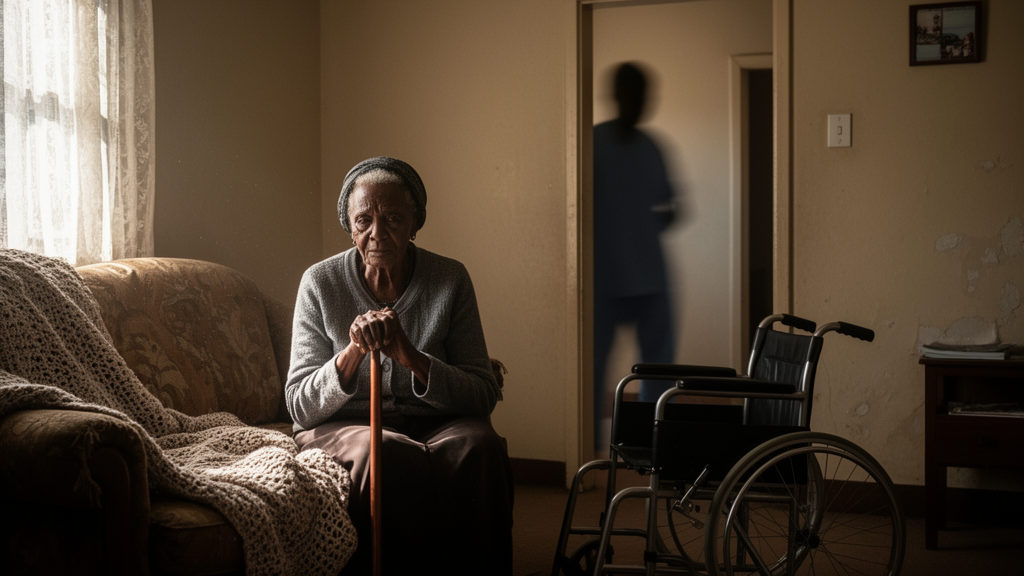
The study, led by Sbonelo Chamane of the Human Sciences Research Council, drew on the sixth South African National HIV Prevalence, Incidence and Behaviour Survey conducted in 2022 and applied a generalized structural equation model to untangle how chronic illness, functional limitation and psychological distress intertwine in later life. Its central finding is stark: older adults with at least one self-reported non-communicable disease had significantly higher odds of psychological distress, and those with a disability had significantly higher odds of reporting a chronic condition, suggesting the three burdens reinforce one another rather than operating in isolation.
The survey behind the analysis was a cross-sectional, population-based stratified household survey using a two-stage stratified cluster random sampling design. Researchers first sampled 1,000 small area layers stratified by province, locality type and race group, then added 1,144 more layers to allow oversampling at district level, for a total of 2,144 primary sampling units. Within each layer, 15 visiting points were sampled systematically, yielding 32,160 visiting points of which 91.7 percent were valid. Households participated at a rate of 80 percent, and data were collected electronically on tablets using structured questionnaires. From this national sample, the study focused on 7,897 respondents aged 60 years and older who answered questions on psychological distress, chronic conditions and disability.
The sample profile matters for interpreting the results. Most participants were women, at 57.6 percent, and 60.6 percent were aged 60 to 69, with 27.8 percent aged 70 to 79 and 11.6 percent aged 80 or above. About two-thirds, 65.7 percent, identified as Black African, while the remaining third were grouped as White, Coloured, or Indian/Asian under a single ‘Other races’ category. A large majority, 83.4 percent, had ever been married, and 86.7 percent were unemployed. Nearly half, 46.6 percent, had only primary or no formal education, while 37.8 percent had secondary schooling and 15.7 percent had tertiary education. Urban areas were home to 65.5 percent of respondents, with 30.0 percent in rural informal, or tribal, areas and 4.5 percent in rural formal farm areas. Gauteng contributed the largest provincial share at 23.0 percent, followed by KwaZulu-Natal at 15.6 percent and the Eastern Cape at 14.1 percent.
Three outcomes were measured with established instruments. Psychological distress was assessed with the Kessler Psychological Distress Scale, known as the K10, which asks about ten non-specific symptoms of anxiety and depression experienced over the previous four weeks, including nervousness, hopelessness, restlessness, depression and worthlessness. A total score of 20 or above was classified as psychological distress. Chronic disease status was binary: respondents reporting at least one of hypertension, diabetes, cancer, heart disease, other cardiovascular conditions, asthma, chronic lung disease or chronic liver disease were counted as having a physiological non-communicable disease. Disability was measured with the Washington Group Short Set on Functioning, covering six domains: seeing even with glasses, hearing even with a hearing aid, walking or climbing steps, remembering or concentrating, self-care such as washing or dressing, and communicating in usual language. Anyone reporting some difficulty or more in any domain was classified as having a disability, a deliberately broad threshold that captures less severe limitations.
The headline prevalence figures were 3.1 percent for psychological distress, 59.7 percent for non-communicable diseases and 64.1 percent for disability. The low distress figure deserves scrutiny. The authors note that although the K10 has discriminated levels of non-specific psychological distress in South African populations before, it has not been specifically validated among adults aged 60 and older in this setting, so the observed prevalence may underestimate the true burden. Under-recognition and under-reporting of mental illness among older adults, potentially driven by stigma, generational attitudes towards mental health, the overlap of psychological symptoms with physical conditions and limited recognition in routine healthcare, may compound that underestimation. The measure was interpreted as psychological distress, not as a diagnosis of any specific mental disorder.
Descriptive comparisons revealed sharp sociodemographic gradients. Women reported significantly higher prevalence of both disability, at 69.8 percent versus 56.4 percent in men, and chronic disease, at 65.8 percent versus 51.4 percent. Adults aged 70 to 79 and those 80 and older showed disability prevalence of 72.6 percent, and chronic disease prevalence of 70.1 percent among women and 65.3 percent among men in the 70 to 79 band, well above the 53.9 percent chronic disease and 58.6 percent disability seen among those aged 60 to 69. Black African respondents reported higher distress, 3.8 percent versus 1.8 percent, and higher disability, 66.8 percent versus 59.3 percent, than other race groups, yet lower chronic disease prevalence, 54.7 percent versus 68.7 percent. Education showed an inverse pattern for distress and disability: those with no or only primary schooling had the highest distress at 4.1 percent and the highest disability at 71.4 percent, while adults with secondary schooling had the highest chronic disease prevalence at 64.0 percent. Unemployed respondents reported more disability and chronic disease than the employed, and urban residents had higher chronic disease prevalence, 63.5 percent, than rural informal residents at 52.0 percent. Province mattered too: Mpumalanga and the Eastern Cape recorded the highest distress at 6.4 and 6.1 percent, the Western Cape the highest chronic disease prevalence at 70.2 percent, and disability peaked in the Eastern Cape at 72.6 percent and KwaZulu-Natal at 70.9 percent.
The multivariable analysis, a generalized structural equation model fitted in Stata with survey weights, province as stratification variable and small area layer as primary sampling unit, modelled each outcome as binary with a logit link and included 7,101 participants with less than 10 percent missing information. Because the model estimates log-odds rather than odds ratios, the coefficients describe direction and statistical significance of associations. Having at least one chronic condition raised the odds of psychological distress, with a log-odds of 0.43 and a p-value of 0.028. Disability in turn raised the odds of reporting a chronic condition, with a log-odds of 0.53 and a p-value below 0.001. The reverse path, from disability to distress, was positive but not statistically significant, at a log-odds of 0.42 with a p-value of 0.064. Women did not differ from men on distress but had significantly higher odds of chronic disease, log-odds 0.70, and disability, log-odds 0.51, both with p-values below 0.001. Adults aged 70 to 79 likewise had higher odds of both chronic disease, log-odds 0.53, and disability, log-odds 0.55, compared with those aged 60 to 69.
Other associations were more surprising. Compared with Black African participants, those from other racial groups had significantly lower odds of distress, log-odds of minus 0.84 with a p-value of 0.008, but higher odds of reporting a chronic condition, log-odds 0.53 with a p-value of 0.001. The authors flag this chronic disease discrepancy as contrary to national mortality data showing that Black Africans carry the highest non-communicable disease death toll, and suggest it may reflect differences in diagnosis, healthcare access, health information and self-reporting, while cautioning that these explanations were not directly examined. Relative to primary or no schooling, secondary education was associated with lower odds of distress, log-odds minus 0.61, and disability, log-odds minus 0.42, but slightly higher odds of chronic disease, log-odds 0.26. Tertiary education was protective only against disability, with a log-odds of minus 0.72 and a p-value below 0.001. Unemployment was linked to higher odds of chronic disease, log-odds 0.57 with a p-value of 0.006, while never-married respondents and residents of rural informal areas had lower odds of chronic disease, log-odds of minus 0.35 and minus 0.40 respectively, with no significant differences for the other outcomes. Rural formal residents showed no significant associations on any outcome.
The authors are explicit about the limits of causal language. The cross-sectional design prevents any inference about temporal direction, so the links between chronic disease, disability and distress are associations only, and the joint modelling does not automatically eliminate omitted-variable or simultaneity bias. Aggregating White, Coloured, Asian/Indian and other respondents into a single ‘Other’ category may obscure group-specific disparities, self-reported chronic conditions may be underestimated among undiagnosed individuals, and the Stata implementation of survey-adjusted generalized structural equation modelling provides no conventional global fit statistic, with variance estimates potentially differing across software. The chronic disease variable captured presence or absence of any condition rather than multimorbidity, so findings should be read as relating to reported status rather than the burden of individual diseases. Even so, the authors argue the pattern supports differentiated, community-based primary health programmes that combine chronic disease management, mental health support and social services, an approach echoed by the World Health Organization’s global strategy on ageing and health and South Africa’s own national policies on older persons and non-communicable disease control. The context is pressing: the global population aged 60 and older is projected to more than double from 1 billion in 2020 to over 2.1 billion by 2050, and South Africa’s life expectancy has climbed from around 54 years in the early 2000s to roughly 65 years by 2023, though a sex gap persists with men averaging 62 years and women 68. As more people survive into older age, the study suggests, health systems that treat the body, the mind and functional ability in separate silos will keep missing the connections that shape how those extra years are actually lived.
Subject of Research: Cross-sectional associations among psychological distress, non-communicable diseases and disability in South African adults aged 60 and older
Article Title: Sociodemographic patterns of psychological distress, non-communicable diseases, and disability among south Africans 60 years and older: a generalized structural equation modelling approach
Article References: Chamane, S., Mnyandu, S., Makola, L., Mabaso, M., Essack, Z., Sewpaul, R., Jooste, S., Moyo, S., Zungu, N., & Zuma, K. (2026). Sociodemographic patterns of psychological distress, non-communicable diseases, and disability among south Africans 60 years and older: a generalized structural equation modelling approach. Frontiers in Aging, 7, Article 1983741. https://doi.org/10.3389/fragi.2026.1983741
Image Credits: AI Generated
DOI: 10.3389/fragi.2026.1983741
Keywords: South Africa, ageing, psychological distress, non-communicable diseases, disability, Kessler K10, Washington Group Short Set, structural equation modelling, national survey, health inequalities, older adults, public health
News Source: Beatrice Stafford. (October 29, 2026). Chronic Disease, Disability and Distress Interlock in Older South Africans. Scienmag.



