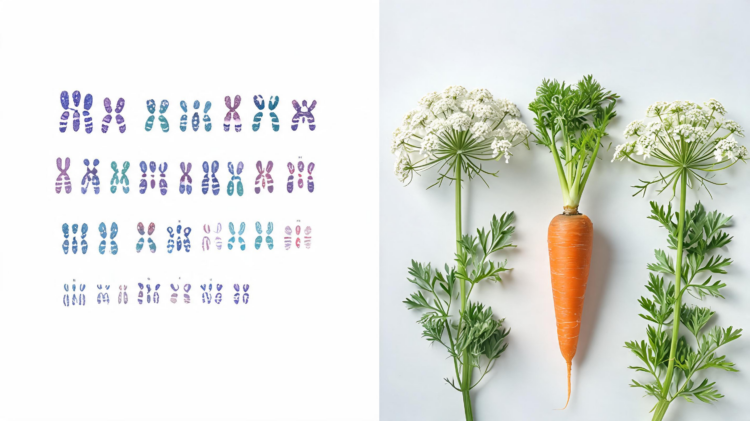
Deep in the mountains and arid plains of Iran, a quiet revolution in plant science is taking shape under the microscope. A new cytogenetic investigation has charted the chromosomes of thirty species spanning sixteen genera of Apioideae, the largest and most familiar subfamily of the carrot family Apiaceae, all native to or occurring within Iran. The study, published in Plant Biosystems, delivers the first chromosome counts ever recorded for five species and reveals that several others carry chromosome numbers that clash with earlier reports. The result is one of the most detailed karyological portraits yet assembled for Southwest Asian Umbelliferae, and it carries significant implications for how botanists classify, compare, and conserve this remarkably diverse lineage.
The carrot family is a botanical superstar in more ways than one. Beyond the carrot itself, Apiaceae includes celery, parsley, fennel, cumin, coriander, and dill, along with a wealth of aromatic and medicinal species rich in secondary metabolites. The subfamily Apioideae, in particular, dominates the family in species richness and economic importance. Iran sits at a global hotspot for this group, hosting hundreds of species across genera such as Ferula, Prangos, Bunium, Elwendia, and Zeravschania, many of them endemic to the Iranian plateau and neighboring regions of Southwest Asia. Yet despite decades of botanical exploration, the chromosomal architecture of many Iranian taxa remained poorly documented, leaving a substantial gap in the cytotaxonomic record.
Chromosome numbers and karyotype characteristics have long served as powerful tools in plant taxonomy. Because chromosome complements tend to be stable within species and often conserved within related groups, they can help confirm species boundaries, reveal hybrid origins, expose polyploid lineages, and inform hypotheses about evolutionary relationships. In the new study, researchers applied standard cytogenetic techniques to mitotic metaphase spreads prepared from germinating seeds and root tips collected across Iranian populations. From these preparations, they counted chromosomes, constructed karyotype formulas describing the position of centromeres on each chromosome pair, and built idiograms, the schematic diagrams that visualize chromosome size and morphology. They also calculated a suite of karyotype asymmetry indices, quantitative measures that reflect how unequally sized the chromosomes are within a complement and how far the centromeres sit from the median position, both of which are considered signals of evolutionary specialization.
The headline findings concern five species whose chromosome counts are reported here for the first time. Ferula cupularis was found to carry 2n = 18 chromosomes, Prangos acaulis 2n = 20, Prangos calligonoides 2n = 22, Prangos crossoptera 2n = 44, and Zeravschania aucheri 2n = 30. Each of these counts fills a blank space on the cytotaxonomic map, and several carry immediate evolutionary interest. The contrast between the diploid counts of Prangos acaulis and Prangos calligonoides on one hand and the tetraploid count of Prangos crossoptera on the other highlights the role of whole-genome duplication in shaping diversity within a single genus. Polyploidy, the possession of more than two complete chromosome sets, is one of the most important drivers of plant diversification, often enabling rapid speciation, ecological expansion, and shifts in morphology and physiology.
Equally intriguing are the discrepancies between the new counts and previously published numbers. The study recorded chromosome numbers differing from earlier reports in several taxa, including Elwendia persica, Ferula assa-foetida, Ferula flabelliloba, Ferula stenocarpa, and Anisotaenia subvelutina. Such mismatches can arise for several reasons: misidentification of material in earlier studies, true intraspecific variation in which different populations carry different cytotypes, or even aneuploid changes involving the gain or loss of individual chromosomes. Asafoetida, Ferula assa-foetida, is Iran’s most famous medicinal resin plant, and intraspecific karyomorphological and genome size variation has previously been documented in Iranian accessions of the species. The revised count adds to a growing picture of Ferula as a genus in which chromosomal evolution has been particularly dynamic.
Across the full sample, chromosome numbers ranged from 2n = 10 to 2n = 44, an impressive spread that underscores the karyological breadth of Iranian Apioideae. Within that range, the researchers documented interspecific variation in karyotype formulas, asymmetry indices, and ploidy levels. Several distinct cytotypes were identified, meaning that some taxa exist in multiple chromosomal races, a phenomenon that can complicate species delimitation but also offers a window into ongoing speciation. Cytotype diversity is increasingly recognized as a hidden engine of plant evolution: populations with different ploidy levels are often reproductively isolated from one another, and chromosome rearrangements such as fusions and fissions can suppress recombination and promote local adaptation, effectively sealing off lineages genetically even before morphological differences become obvious.
Karyotype asymmetry adds another analytical layer. Under classical ideas of chromosomal evolution proposed by G. Ledyard Stebbins, more symmetric karyotypes, with chromosomes of similar size and metacentric or submetacentric centromere positions, are generally considered ancestral, while increasing asymmetry is interpreted as a derived, specialized state. The new study outlines variation in karyotype symmetry among the examined Iranian groups, providing baseline data that can be compared with molecular phylogenies to test whether karyological trends track lineage divergence. Recent higher-level nuclear phylogenomic work on the carrot family, together with updated lineage-based tribal classifications with special focus on Iranian genera, now offers exactly the evolutionary framework into which these cytological data can be mapped. Chromosome counts thus become not merely descriptive records but characters that can be interpreted in a phylogenetic context.
The practical value of the dataset extends beyond pure systematics. Baseline cytogenetic information is essential for breeding programs, germplasm conservation, and biodiversity assessment. Many Iranian Apioideae are economically or medicinally important, from cumin and ajwain relatives to the resin-producing Ferula species prized since antiquity. Knowing the ploidy level and karyotype structure of wild relatives guides breeders in making compatible crosses and informs ex situ conservation strategies, since cytotypes often warrant separate collection and management. For endemic species with narrow ranges, chromosome data also help prioritize populations that represent unique evolutionary lineages. As the authors note, the findings provide baseline cytogenetic data for taxonomic and comparative studies and contribute to the understanding of chromosomal diversity in Southwest Asian Apiaceae more broadly.
The research also fits into a larger renaissance in plant cytotaxonomy. Modern cytogenetics increasingly combines classical chromosome counting with molecular cytogenetic landmarks, genome size estimation, and phylogenomics, allowing researchers to trace how karyotypes have been reshaped over millions of years. In Apiaceae, model systems such as carrot have yielded centromeric repeat markers and detailed karyotype analyses that now serve as reference points for the wider family. Studies like this one on Iranian Apioideae extend that toolkit into a biodiversity hotspot, ensuring that the remarkable chromosomal variety of the region’s umbellifers is documented before habitat loss and climate change further compress their ranges.
For now, the study stands as a milestone for Iranian botanical cytogenetics and a call to action for broader sampling. With five species cytologically characterized for the first time, several counts corrected or revised, and a rich catalog of karyotype features assembled across sixteen genera, the work demonstrates how much hidden diversity remains encoded in the chromosomes of even familiar plant families. As comparative datasets grow, the chromosome complement, that most fundamental of biological archives, will continue to illuminate the evolutionary stories written into Iran’s fields, slopes, and steppes, one metaphase spread at a time.
The analytical conventions underpinning the study have deep roots in cytological practice. Centromere positions were classified according to the long-standing nomenclature introduced by Levan and colleagues in 1964, which remains the standard vocabulary for describing chromosomes as metacentric, submetacentric, acrocentric, or telocentric. Asymmetry indices likewise draw on a rich methodological literature, including formulations refined by later workers who criticized earlier measures for conflating chromosome size differences with centromere displacement. By applying these quantitative tools consistently across all sixteen genera, the authors produced values that are directly comparable both within the sample and with published karyological data from other regions, an important consideration given how sensitive asymmetry statistics can be to measurement choices.
Iran has a surprisingly long tradition of chromosome documentation for its flora. National inventories of plant chromosome numbers compiled in Tehran have accumulated counts over decades, and regional studies from neighboring countries such as Jordan, Turkey, and Afghanistan provide comparative context for the Iranian material. Much of the early cytological work on Umbelliferae dates to the classical surveys of the mid-twentieth century, when chromosome counting was among the few characters available for testing morphological classifications. The new counts therefore join a historical archive, and the discrepancies they reveal with older reports illustrate how revisiting a group with fresh material from documented wild populations can refine a record built partly on cultivated or poorly localized specimens.
The subfamily’s cytological literature also records curiosities beyond standard complements, such as supernumerary B-chromosomes reported in ajwain, Trachyspermum ammi, a reminder that chromosome counts alone can understate the full genomic variation within a lineage. Databases dedicated to Southwest Asian Umbelliferae biodiversity have long emphasized the need for cytological coverage of the region’s genera, and the present dataset responds directly to that gap. Because many Iranian Apioideae occupy mountainous or arid habitats where populations are fragmented, cytotype differences among populations may reflect historical isolation during climatic fluctuations of the Pleistocene, a hypothesis that future paired sampling of chromosomes and molecular markers could test. In the meantime, the idiograms and karyotype formulas published here give researchers a concrete reference for identifying material in breeding lines, herbarium-backed studies, and conservation assessments alike.
Subject of Research: Chromosome numbers and karyotype diversity in Iranian Apioideae (Apiaceae) and their cytotaxonomic implications
Article Title: New insights into chromosome counts and karyotype diversity in Iranian Apioideae (Apiaceae): cytotaxonomic implications
Article References: Khazaei, Z., Bagheri, A., Lyskov, D., Harpke, D., & Blattner, F. R. (2026). New insights into chromosome counts and karyotype diversity in Iranian Apioideae (Apiaceae): cytotaxonomic implications. Plant Biosystems, 160(5), Article 263. https://doi.org/10.1007/s44473-026-00253-y
Image Credits: AI Generated
DOI: 10.1007/s44473-026-00253-y
Keywords: cytotaxonomy, chromosome counts, karyotype asymmetry, polyploidy, cytotype diversity, Apioideae, Apiaceae, Umbelliferae, Iran, endemic species, speciation, Ferula
Cite Scienmag News
APA MLA Chicago
Alan Morgan. (September 10, 2026). Chromosome Sleuthing Reveals Hidden Karyotype Diversity in Iran’s Carrot Family. Scienmag. https://scienmag.com/chromosome-sleuthing-reveals-hidden-karyotype-diversity-in-irans-carrot-family/
Alan Morgan. “Chromosome Sleuthing Reveals Hidden Karyotype Diversity in Iran’s Carrot Family.” Scienmag, 10 September 2026, https://scienmag.com/chromosome-sleuthing-reveals-hidden-karyotype-diversity-in-irans-carrot-family/. Accessed 10 September 2026.
Alan Morgan. “Chromosome Sleuthing Reveals Hidden Karyotype Diversity in Iran’s Carrot Family.” Scienmag. September 10, 2026. https://scienmag.com/chromosome-sleuthing-reveals-hidden-karyotype-diversity-in-irans-carrot-family/
Copy citation Download RIS
Tags: ApiaceaeApiaceae chromosome diversityApioideaebotanical taxonomy and classificationchromosome countschromosome number variation in Apiaceaecytotaxonomycytotype diversityendemic Iranian plant speciesendemic speciesFerulaIranIranian carrot family specieskaryotype analysis of Apioideaekaryotype asymmetrymedicinal and aromatic plant cytogeneticsplant chromosome countsplant conservation geneticsPlant cytogeneticsplant evolutionary studies in IranPolyploidySouthwest Asian UmbelliferaespeciationUmbelliferae