Analytical chemists have engineered an electrochemical sensing platform based on a newly synthesized organometallic coordination complex to achieve the simultaneous quantification of cadmium, mercury, and manganese ions across environmental waters and agricultural food matrices. The sensor utilizes a glassy carbon electrode modified with tetraaqua-bis(2,4-dichlorophenoxyacetato)chromium(III) chloride monohydrate, designated chemically as [Cr(DCPA)2(H2O)4]Cl·H2O, which integrates a redox-active trivalent chromium metallic core with functionalized phenoxyacetate ligands. Operating through differential pulse anodic stripping voltammetry, the modified electrode capitalizes on coordinated surface preconcentration followed by discrete anodic stripping to distinguish each target metal at distinct oxidation potentials. Experimental assessments carried out across spiked drinking water, commercial fruit juices, and raw cow milk demonstrated that the hybrid electrode successfully resolves individual stripping peaks without mutual signal suppression. By combining accessible precursor reagents with robust interfacial electron transport kinetics, the developed analytical methodology presents an adaptable screening tool engineered to monitor toxic and regulated heavy metals within complex real-world samples.
Environmental dispersion of non-biodegradable heavy metals represents an enduring ecological hazard due to their persistence, mobility across biogeochemical compartments, and capacity to bioaccumulate throughout food webs. Metallic elements with densities exceeding five grams per cubic centimeter are categorized as essential micronutrients or nonessential toxic contaminants. While manganese participates in carbohydrate, amino acid, and cholesterol metabolism, excessive environmental exposure induces airway damage and a debilitating neurological disorder termed manganism. Conversely, nonessential metals such as cadmium and mercury display severe toxicity and carcinogenicity even at trace concentrations, damaging vital renal, endocrine, and nervous systems. The World Health Organization has established strict permissible drinking water thresholds of 0.001 milligrams per liter for mercury, 0.003 milligrams per liter for cadmium, and 0.4 milligrams per liter for manganese. While standard laboratory spectroscopic techniques such as atomic absorption spectroscopy and inductively coupled plasma mass spectrometry provide sensitive quantification, routine field screening remains constrained by high operational costs, complex sample preparation, and bulky equipment.
To address these operational constraints, the researchers synthesized the coordination complex [Cr(DCPA)2(H2O)4]Cl·H2O via a two-step reaction pathway. The initial phase reacted 2,4-dichlorophenoxyacetic acid with sodium hydroxide in an ethanol-water solution, yielding crystalline sodium 2,4-dichlorophenoxyacetate at an 87.5 percent yield. Subsequently, the isolated sodium salt was refluxed with hydrated chromium(III) chloride in ethanol at 80 degrees Celsius for five hours, affording the target grayish-blue coordination product at an 88.5 percent recovery yield. Gravimetric furnace ignition confirmed an experimental chromium fraction of 7.72 percent, matching theoretical calculations of 7.88 percent. Molar conductivity in methanol registered 41 Siemens square centimeters per mole, establishing a 1:1 electrolytic nature. Ultraviolet-visible absorption spectroscopy demonstrated the disappearance of chromium d-d transitions in the visible region due to increased ligand field splitting. Infrared spectra verified carboxylate deprotonation and chromium-oxygen coordination at 484 reciprocal centimeters, while thermal analysis confirmed four coordinated water molecules and one lattice water molecule.
Electrode modification began with mechanical preparation of the glassy carbon substrate to ensure an active, reproducible surface. The bare electrode was polished successively using alumina slurries with particle sizes of 1.0, 0.3, and 0.05 micrometers on a micro-cloth pad until obtaining a mirror finish, followed by ultrasonic cleaning in ultrapure water and ethanol. Electrodeposition was conducted potentiostatically across a potential range from negative 1.8 to positive 2.2 volts at 100 millivolts per second in a basic 0.1 molar sodium hydroxide electrolyte. Immobilization proceeded through non-covalent physisorption governed by pi-pi electronic stacking and hydrophobic interactions between the aromatic rings of coordinated 2,4-dichlorophenoxyacetate ligands and the sp2-hybridized graphitic network of the carbon substrate. Evaluating electrodeposition across 5, 10, 15, and 20 cycles established that current responses peaked at 10 cycles before declining due to excessive film thickness. This non-covalent approach securely anchored the electroactive complex layer without requiring chemical cross-linking agents.
Electrochemical characterization of the modified interface was performed using cyclic voltammetry and electrochemical impedance spectroscopy in a ferricyanide/ferrocyanide redox probe system. Impedance Nyquist plots revealed that complex deposition substantially lowered charge transfer resistance from 1690 ohm square centimeters on bare glassy carbon to 365.13 ohm square centimeters on the modified surface. Concurrently, the heterogeneous electron transfer rate constant accelerated from 6.05 × 10⁻⁷ centimeters per second to 1.35 × 10⁻⁵ centimeters per second. Applying the Randles-Sevcik equation demonstrated that effective electroactive surface area expanded from 0.026 square centimeters on the bare electrode to 0.054 square centimeters following modification. In comparative evaluations against electrodes modified separately with sodium ligand or chromium salt, the organometallic complex produced an enhanced anodic peak current of 42.85 microamperes, exceeding the individual components. This kinetic facilitation and doubled surface area provided abundant active coordination sites that markedly accelerated interfacial electron transfer during subsequent metal determination.
Systematic optimization of operational parameters was conducted to achieve maximal sensitivity during differential pulse anodic stripping voltammetry. Parameter evaluations established optimal instrumental settings comprising a conditioning period of 0.05 seconds, a deposition potential of negative 1.2 volts, an accumulation time of 120 seconds, a voltage increment and pulse width of 0.002 volts, a pulse amplitude of 0.2 volts, and a pulse period of 0.004 seconds. Solution pH within an acetate buffer system exerted a decisive influence across the tested range of 3.0 to 8.0, with peak currents for all three target metals maximizing at pH 6.0. Below pH 6.0, elevated hydronium ion concentrations competed with metal cations for active surface sites, decreasing preconcentration efficiency. Above pH 6.0, stripping currents diminished as hydroxide competition, cation hydrolysis, and insoluble hydroxide precipitation took place. Regulating cell conditions at pH 6.0 prevented proton interference and minimized hydrogen evolution while promoting stable surface coordination.
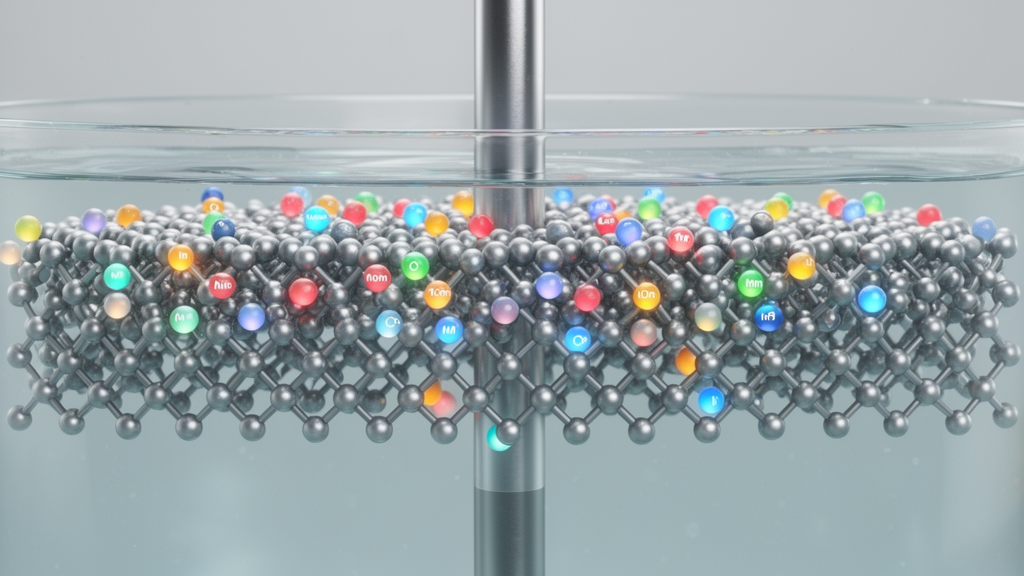
The analytical mechanism functions through a three-stage sequence combining interfacial preconcentration, cathodic deposition, and selective anodic stripping. During initial preconcentration, target cadmium, mercury, and manganese cations migrate to the electrode interface, interacting with Lewis-basic carboxylate groups, ether oxygens, and chlorine donor sites through surface complexation, ion exchange, and electrostatic trapping. In the subsequent accumulation stage at negative 1.2 volts, preconcentrated cations undergo in situ electrochemical reduction, depositing as zero-valent metals directly upon the modified electrode surface. During the ensuing positive potential scan, these reduced metallic deposits selectively re-oxidize back into solution at discrete thermodynamic stripping potentials. Anodic stripping peaks emerge at approximately negative 0.78 volts for cadmium, positive 0.24 volts for mercury, and positive 0.65 volts for manganese against the silver/silver chloride reference electrode. Because these thermodynamic oxidation peaks remain widely separated along the potential axis, the sensor prevents competitive peak overlap and suppression during concurrent multianalyte monitoring.
Under optimized voltammetric conditions, the platform exhibited linear dynamic responses during simultaneous multielement testing across a concentration range of 0.2 to 10 milligrams per liter for all three metals. Linear regression equations demonstrated high correlation coefficients, recorded as Ipa = 48.16 CCd + 27.82 with an R² of 0.9914 for cadmium, Ipa = 31.89 CHg + 8.55 with an R² of 0.9923 for mercury, and Ipa = 7.26 CMn + 15.8 with an R² of 0.9941 for manganese. Respective analytical sensitivities reached 48.16, 31.89, and 7.26 microamperes per milligram per liter. Based on standard deviation calculations from blank trials, detection limits for simultaneous analysis were 0.0511 milligrams per liter for cadmium, 0.0615 milligrams per liter for mercury, and 0.0556 milligrams per liter for manganese, with quantification limits of 0.1686, 0.2029, and 0.1852 milligrams per liter. Individual calibration trials spanning up to 40 milligrams per liter yielded individual detection limits of 0.0041, 0.0189, and 0.0885 milligrams per liter, confirming consistent electrocatalytic sensitivity.
Precision metrics, storage stability, and anti-interference behavior were evaluated to ensure operational reproducibility in complex analytical matrices. Operational repeatability assessed over seven consecutive stripping cycles using 10 milligrams per liter target solutions yielded relative standard deviations of 0.41 percent for cadmium, 0.82 percent for mercury, and 0.13 percent for manganese, demonstrating resilient surface resistance against fouling and passivation. Sensor reproducibility evaluated across four independently fabricated electrodes exhibited relative standard deviations of 3.14 percent, 4.72 percent, and 0.086 percent, respectively. Storage stability evaluated over seven days in acetate buffer at 4 degrees Celsius retained 90.22 percent of initial current response for cadmium, 88.98 percent for mercury, and 87.25 percent for manganese, confirming that the chromium core restricted hydrolytic degradation. Furthermore, introducing tenfold excess concentrations of glucose, sucrose, potassium nitrate, and magnesium nitrate caused minor current changes below 6.01 percent without producing secondary stripping peaks, establishing reliable selectivity against co-existing species.
Practical applicability was validated by quantifying spiked concentrations in commercial bottled drinking water, packaged fruit juices, and raw cow milk acquired in Gondar, Ethiopia. Digestion protocols using nitric acid and hydrogen peroxide successfully mineralized organic matter prior to analysis. Unspiked real samples exhibited natural endogenous manganese concentrations of 1.92 milligrams per liter in raw milk, 1.92 milligrams per liter in Hyper juice, and 1.96 milligrams per liter in Bin mango juice, while baseline cadmium and mercury remained below detection limits. Recovery rates across all spiked matrices ranged from 80.00 to 114.58 percent, falling within standard analytical benchmarks. While the detection limit for manganese satisfies World Health Organization drinking water criteria, detection limits for cadmium and mercury remain above permissible drinking guidelines. Consequently, the platform is tailored for screening heavily contaminated industrial effluents and agricultural runoffs. Future investigations will incorporate high-surface-area nanomaterials, protective membranes, and covalent chemisorption to lower detection limits to microgram-per-liter levels for continuous monitoring applications.
Subject of Research: Simultaneous electrochemical detection of heavy metals using a chromium complex modified electrode
Article Title: Synthesis and electrochemical applications of tetraaqua-bis (2,4-dichlorophenoxyacetato) chromium(III) chloride monohydrate modified glassy carbon electrode for simultaneous detection of Cd, Hg, and Mn in environmental samples
Article References: Kassa, A., Mehari, B., Abebe, A., Ejigu, A., & Tefera, M. (2026). Synthesis and electrochemical applications of tetraaqua-bis (2,4-dichlorophenoxyacetato) chromium(III) chloride monohydrate modified glassy carbon electrode for simultaneous detection of Cd, Hg, and Mn in environmental samples. Talanta Open, 14, Article 100677. https://doi.org/10.1016/j.talo.2026.100677
Image Credits: AI Generated
DOI: 10.1016/j.talo.2026.100677
Keywords: heavy metals, electrochemical detection, glassy carbon electrode, chromium complex, differential pulse anodic stripping voltammetry, cadmium, mercury, manganese, environmental pollution, cyclic voltammetry, electrochemical impedance spectroscopy, preconcentration, charge transfer resistance, food safety, water quality, real sample analysis, limit of detection, recovery assessment
News Source: Bethany Barker. (November 23, 2026). Chromium Complex Modified Electrode Simultaneously Detects Cadmium Mercury And Manganese. Scienmag.