“Natural” foods are trendy, and proponents claim that little or no processing helps preserve the food’s inherent flavor. Research now published in ACS’ Journal of Agricultural and Food Chemistry shows that, at least for certain artisanal, bean-to-bar chocolates, this could indeed be the case. The team reports that unroasted, “raw” chocolate features certain compounds responsible for fruity flavors and sour tastes that are lost when the cacao beans are processed at high temperatures.
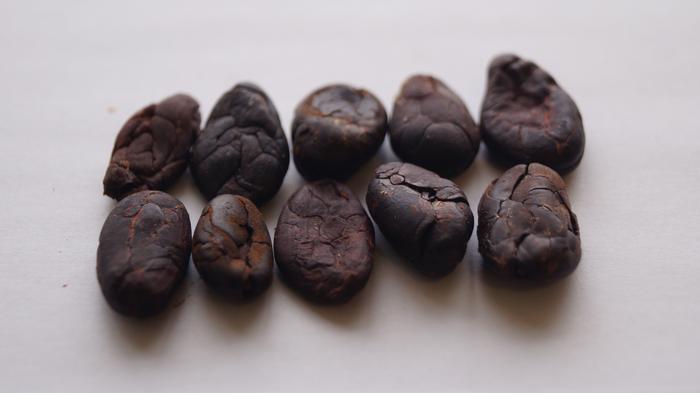
Credit: Marlon Ac-Pangan
“Natural” foods are trendy, and proponents claim that little or no processing helps preserve the food’s inherent flavor. Research now published in ACS’ Journal of Agricultural and Food Chemistry shows that, at least for certain artisanal, bean-to-bar chocolates, this could indeed be the case. The team reports that unroasted, “raw” chocolate features certain compounds responsible for fruity flavors and sour tastes that are lost when the cacao beans are processed at high temperatures.
Chocolate is made from cacao beans, which are fermented, roasted and processed into cacao nibs. These bits can be eaten on their own, or melted down and sweetened to form the chocolate products found on grocery or boutique store shelves. Similar to wines, the environmental conditions, or “terroir,” where the cacao is grown provide a unique flavor profile to the bean. However, when the beans are roasted during processing, these subtle flavors can be hidden or destroyed.
To preserve the terroir and potential health benefits of cacao beans, some chocolatiers are now interested in creating minimally processed products by skipping the roasting step. Although these bars and chips are often called “raw,” some people say that this is a misnomer because chemical changes have already occurred during fermentation. But regardless of the terminology, exactly which flavor compounds are potentially lost during this process is not well understood. So, Marlon Ac-Pangan, Nicki Engeseth and Keith Cadwallader wanted to investigate how the aroma and sensory characteristics of chocolate change during high-temperature roasting.
The team made two groups of nibs from the same set of cacao beans. One was roasted, and the other was not, and then both groups were molded into chocolates. Using solvent-assisted flavor evaporation and aroma extract dilution analysis, the researchers found that volatile flavor compounds, including the “hazelnut-like” 2- or 3-methylbutanoic acid and the “caramel-like” HDMF were more pronounced in the roasted samples. But the process masked other volatiles — including the “bell pepper-like” 2-isobutyl-3-methoxypyrazine — which were more noticeable in the unroasted chocolate, along with others that have fruity or flowery aromas. Additionally, a trained sensory panel found that these unroasted samples tasted sourer and sweeter. The researchers say that this is probably because the vinegary flavors produced during fermentation were allowed to shine, instead of being masked by the more pronounced, “roasty” flavors. So, while roasting does change the flavor profile and may make it more “chocolatey,” it may also hide some of the subtler flavors and sourness from the raw cacao beans.
The authors acknowledge funding from the National Institute of Food and Agriculture and the U.S. Department of Agriculture.
The American Chemical Society (ACS) is a nonprofit organization chartered by the U.S. Congress. ACS’ mission is to advance the broader chemistry enterprise and its practitioners for the benefit of Earth and all its people. The Society is a global leader in promoting excellence in science education and providing access to chemistry-related information and research through its multiple research solutions, peer-reviewed journals, scientific conferences, eBooks and weekly news periodical Chemical & Engineering News. ACS journals are among the most cited, most trusted and most read within the scientific literature; however, ACS itself does not conduct chemical research. As a leader in scientific information solutions, its CAS division partners with global innovators to accelerate breakthroughs by curating, connecting and analyzing the world’s scientific knowledge. ACS’ main offices are in Washington, D.C., and Columbus, Ohio.
To automatically receive news releases from the American Chemical Society, contact [email protected].
Follow us: Twitter | Facebook | LinkedIn | Instagram
Journal
Journal of Agricultural and Food Chemistry
DOI
10.1021/acs.jafc.3c01366
Article Title
“Identification of Important Aroma Components and Sensory Profiles of Minimally Processed (Unroasted) and Conventionally Roasted Dark Chocolates”
Article Publication Date
12-Jun-2023