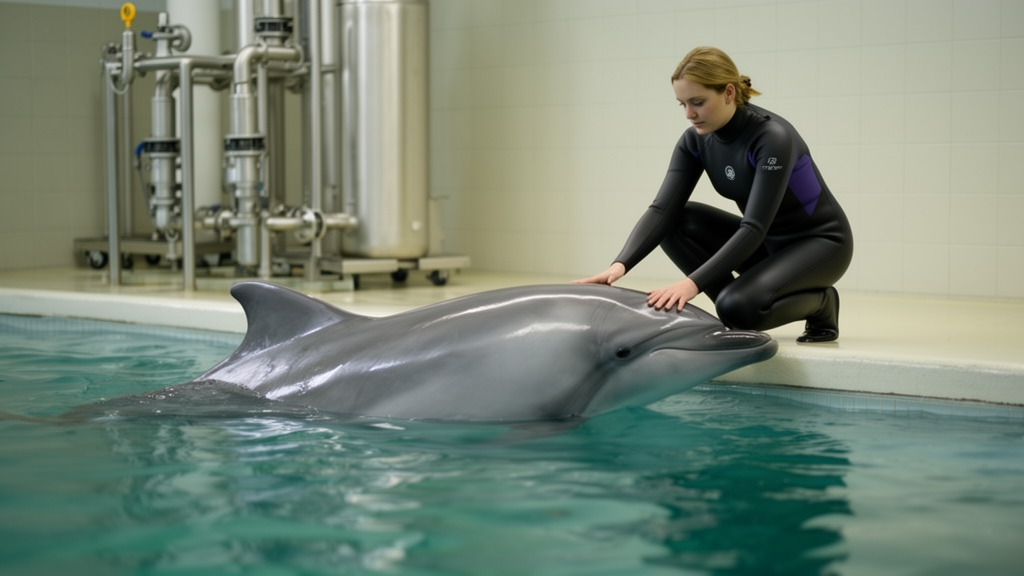
Dolphins living in chlorinated tanks carry a markedly different community of skin bacteria from their free-swimming relatives, according to a new study that compared the skin microbiomes of 91 dolphins across aquariums, enclosed lagoons, and open bays. The research, published in Frontiers in Microbiology, found that common bottlenose dolphins housed in chlorinated tanks had the most diverse skin microbiomes of any habitat type, a surprising result that contradicts what studies on human swimmers might have predicted. Those tank-dwelling dolphins also showed significantly higher levels of Staphylococcus, a genus that includes strains resistant to chlorine and known to cause skin infections in dolphins, while a genus called Enhydrobacter, normally dominant on cetacean skin, was nearly absent.
Dolphin skin is a constantly renewed barrier in an unforgiving medium. The animals shed and replace their outermost skin layer every two to three hours, roughly 8.5 times faster than humans, which means their skin surfaces undergo continuous bacterial decolonization and recolonization. Because cetaceans are permanently immersed in water teeming with microorganisms, their skin microbiome represents a first line of defense against environmental stressors and potential pathogens. Some bacteria can cause skin diseases and ulcerating wounds, while previous observational work in South Texas has suggested that high water temperature, salinity, and pH are associated with lower wound rates and faster scar healing in dolphins.
The researchers predicted, based on a study showing that human skin loses microbial diversity after just one hour in a chlorinated swimming pool, that dolphins in chlorinated tanks would have the least diverse skin microbiomes. Instead, the opposite occurred. Dolphins in chlorinated tanks showed the highest Shannon diversity, driven largely by significantly greater Pielou evenness, meaning their bacterial communities were more evenly distributed among species. The authors suggest this may reflect continuous, intermediate disturbance of the skin’s microbial ecosystem: chlorine suppresses the commensal bacteria that would normally dominate, while frequent skin turnover keeps reshuffling the community. The free chlorine concentration in the study tanks, about 0.8 ppm, was roughly one third of that used in human swimming pools, which may have softened the impact.
One of the clearest signals in the data involved Enhydrobacter, a bacterial genus previously found among the most abundant on the skin of wild bottlenose dolphins in Sarasota Bay, Florida. In this study, Enhydrobacter dominated the skin microbiomes of dolphins in enclosed lagoons, where it made up 70.7 percent of reads, and open bays, where it accounted for 58.4 percent, and was detected in every sampled animal from those habitats. In chlorinated tanks, however, its mean relative abundance collapsed to just 0.9 percent. The genus was also rare in tank water, and the authors note that its functional role in aquatic skin microbiomes remains unknown, though its commensal nature and documented resistance to pollutants have led researchers to speculate it may help outcompete pathogens.
Staphylococcus told the opposite story. Its relative abundance and prevalence were significantly higher on the skin of tank-dwelling dolphins than on those in lagoons or bays, supporting the team’s prediction that chlorine-resistant bacteria would flourish in chlorinated habitats. Of the fifteen bacterial genera known to contain chlorine-resistant strains, tank dolphins had higher mean relative abundances for ten. Not every result fit the prediction, however: Pseudomonas and Sphingomonas were significantly more abundant on open bay dolphins, and Vibrio peaked in enclosed lagoon dolphins. Legionella was lowest in open bays. The authors caution that their 16S rRNA method cannot distinguish chlorine-resistant strains from chlorine-sensitive ones within the same genus, and that proportional shifts in relative abundance do not necessarily reflect changes in absolute bacterial numbers.
Most of the chlorine-resistant genera detected on tank dolphins’ skin were absent from the tank water itself, appearing only at low levels or not at all. The researchers propose that bacteria may survive chlorination by forming biofilms on tank surfaces, colonizing dolphin skin through direct contact with enclosure walls, netting, and other objects. Self-rubbing behavior is common among human-managed cetaceans, and free-swimming Indo-Pacific bottlenose dolphins are known to rub against coral and sponges in ways that appear to medicate their skin. Staphylococcus delphini has previously been associated with skin infections in common bottlenose dolphins, and the authors argue that isolating and identifying the specific strains colonizing dolphins in chlorinated water is necessary before any pathogenic risk can be assessed.
Free-swimming dolphins were sampled in polyhaline Redfish Bay and hypersaline Upper Laguna Madre in spring and summer, with water temperatures climbing from around 27 degrees Celsius in spring to above 30 degrees in summer, and pH rising accordingly. Mycobacterium, a genus associated with slow-healing cutaneous wounds in dolphins, showed an approximately tenfold decrease in mean relative abundance in summer compared with spring in both bays, though the researchers could not statistically verify this pattern because the genus’s prevalence fell below their 30 percent threshold for testing. Streptococcus prevalence dropped significantly between spring and summer in Upper Laguna Madre, from 100 percent of sampled dolphins to 11.1 percent. In Redfish Bay, by contrast, Streptococcus and Vibrio increased in summer, a pattern the authors link to possible differences in nutrient loads, noting that Redfish Bay shows signs of water quality degradation from stormwater runoff and wastewater effluent.
Statistical modeling of the open bay data retained salinity and temperature as significant variables associated with skin microbiome composition, while pH added no explanatory power once temperature was included, as the two were nearly collinear. The authors emphasize that their findings are associations, not demonstrations of causation. Unmeasured variables such as animal density, social contact frequency, water turnover rate, and the demography of wild dolphins could confound the results, and human-cared and free-swimming dolphins were sampled on different body areas, the ventrum versus the region below the dorsal fin. Facility alone explained 43.5 percent of the variation in skin microbiome composition among dolphins under human care, underscoring how strongly shared water, diet, air, and husbandry practices shape these communities. Age and duration in human care, once facility was accounted for, had negligible effects.
The study also confirmed that dolphin skin communities are distinct from the surrounding water, sharing most genera but largely different sequence variants within them, and that rough-toothed dolphins housed in the same recirculating water as bottlenose dolphins maintained significantly different skin microbiomes, consistent with the species-specific nature of cetacean skin communities. The authors frame their results as a baseline for improving dolphin husbandry and conservation, suggesting that identifying dominant commensals and potential opportunists could inform health assessments and, eventually, topical probiotics for managed animals and rehabilitation programs. They call for metagenomic analyses, culture-based assays, and absolute quantification methods such as qPCR to determine whether chlorine-resistant strains truly proliferate under chlorinated conditions, and for future studies that hold environmental parameters and husbandry constant to tease apart causal relationships from the associations documented here.
Subject of Research: How water chlorination and environmental factors such as temperature, salinity, and pH are associated with the skin microbiome diversity and composition of bottlenose and rough-toothed dolphins across managed and wild habitats.
Article Title: Water chlorination and environmental factors are associated with dolphin skin microbiome diversity and composition
Article References: Fiori, L., Lin, Y., Gu, S., Sánchez-Contreras, G. J., Walker, K., & Orbach, D. N. (2026). Water chlorination and environmental factors are associated with dolphin skin microbiome diversity and composition. Frontiers in Microbiology, 17, Article 1934395. https://doi.org/10.3389/fmicb.2026.1934395
Image Credits: AI Generated
DOI: 10.3389/fmicb.2026.1934395
Keywords: dolphin skin microbiome, common bottlenose dolphin, rough-toothed dolphin, chlorination, 16S rRNA metabarcoding, Staphylococcus, Enhydrobacter, Mycobacterium, water temperature, salinity, pH, animal husbandry
News Source: Morgan Morrow. (October 29, 2026). Chlorinated Tanks Reshape the Skin Microbes of Captive Dolphins. Scienmag.