• HOME
  • NEWS
  • EXPLORE
    • CAREER
      • Companies
      • Jobs
    • EVENTS
    • iGEM
      • News
      • Team
    • PHOTOS
    • VIDEO
    • WIKI
  • BLOG
  • COMMUNITY
    • FACEBOOK
    • INSTAGRAM
    • TWITTER
Saturday, June 27, 2026
BIOENGINEER.ORG
No Result
View All Result
  • Login
  • HOME
  • NEWS
  • EXPLORE
    • CAREER
      • Companies
      • Jobs
        • Lecturer
        • PhD Studentship
        • Postdoc
        • Research Assistant
    • EVENTS
    • iGEM
      • News
      • Team
    • PHOTOS
    • VIDEO
    • WIKI
  • BLOG
  • COMMUNITY
    • FACEBOOK
    • INSTAGRAM
    • TWITTER
  • HOME
  • NEWS
  • EXPLORE
    • CAREER
      • Companies
      • Jobs
        • Lecturer
        • PhD Studentship
        • Postdoc
        • Research Assistant
    • EVENTS
    • iGEM
      • News
      • Team
    • PHOTOS
    • VIDEO
    • WIKI
  • BLOG
  • COMMUNITY
    • FACEBOOK
    • INSTAGRAM
    • TWITTER
No Result
View All Result
Bioengineer.org
No Result
View All Result
Home NEWS Science News Chemistry

Chiral amines synthesized by nickel-catalysed asymmetric reductive hydroalkylation

Bioengineer by Bioengineer
March 8, 2021
in Chemistry
Reading Time: 2 mins read
0
IMAGE
Share on FacebookShare on TwitterShare on LinkedinShare on RedditShare on Telegram

IMAGE

Credit: WANG Jiawang

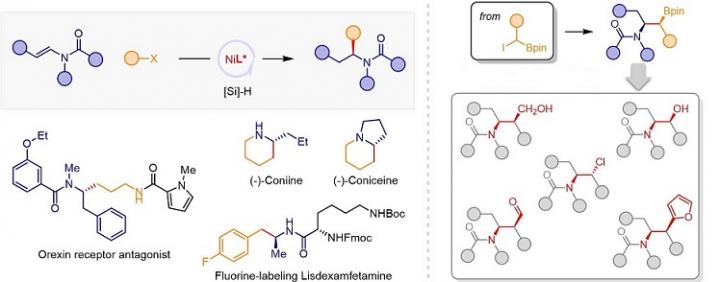
Recently, research group, led by Prof. FU Yao and associate research fellow LU Xi From Hefei National Laboratory for Physical Sciences at the Microscale and School of Chemistry and Materials Science of the University of Science and Technology of China (USTC), has made significant achievements in the field of synthesis of chiral amines. They developed a mild and general nickel-catalysed asymmetric reductive hydroalkylation and realized the modular synthesis of chiral aliphatic amines.

Results were published in Nature Communications on Feb. 26, 2021.

Chiral amines are important chiral auxiliaries and key synthetic intermediates of pharmaceuticals and natural products. It is an important direction to develop efficient and convenient synthesis of chiral amines in organic synthetic chemistry. However, conventional catalytic synthesis methods, such as imine and enamine hydrogenation, imine alkylation, olefin hydroamination and others, have limited substrate structure in the synthesis of dialkyl substituted chiral aliphatic amines.

The research group proposed the concept of olefin reductive coupling and developed a cheap nickel catalytic system to realize carbon carbon coupling under mild conditions by replacing equivalent metal reagents with olefins.

In this work, they combined saturated carbon couple, and successfully realized the asymmetric hydroalkylation of enamides catalyzed by Ni MH. In addition, the asymmetric hydroalkylation of enamide with α-borate halide can be realized to prepare β-aminoborate with two chiral centers. Tandem conversion of organic boron compounds will contribute to the development of amine chiral molecules with complex structures.

This work is a complement and breakthrough for the structural limitations of conventional chiral amine synthesis strategies.

###

Media Contact
Jane FAN Qiong
[email protected]

Related Journal Article

http://dx.doi.org/10.1038/s41467-021-21600-x

Tags: Atomic/Molecular/Particle PhysicsBiochemistryChemistry/Physics/Materials SciencesMaterials
Share12Tweet8Share2ShareShareShare2

Related Posts

AI and Physics Collaborate to Design Advanced Hydrogen Storage Materials

June 25, 2026

International Team Including Dresden Scientists Develops Novel Designer Proteins for Advanced Study of Living Tissue

June 25, 2026

New Study Uncovers Key Factors Driving Water Chemistry in Nanoscale Environments

June 25, 2026

Plasma Technology Extends Catalyst Lifespan in Hydrogen Production

June 24, 2026
Please login to join discussion

POPULAR NEWS

  • Saying Goodbye to PGY-6: Pediatric Fellowship Realities

    103 shares
    Share 41 Tweet 26
  • Multi-Hospital Study Reveals Long Covid Burden Is Twice as High as Current Estimates

    92 shares
    Share 36 Tweet 23
  • Detection of EDCs in Breast Milk and Infant Urine Up to Six Months Highlights Early Exposure Risks

    77 shares
    Share 31 Tweet 19
  • New Drug Candidate Developed at McMaster Shows Potential for Treating Brain Cancer

    58 shares
    Share 23 Tweet 15

About

We bring you the latest biotechnology news from best research centers and universities around the world. Check our website.

Follow us

Recent News

Tracking Lanthanide-Labeled Microplastics in Plants

POSTECH Researchers Slash Cost of Reconstituted Cell-Free Systems by 95%

AI and Physics Collaborate to Design Advanced Hydrogen Storage Materials

Subscribe to Blog via Email

Success! An email was just sent to confirm your subscription. Please find the email now and click 'Confirm' to start subscribing.

Join 82 other subscribers
  • Contact Us

Bioengineer.org © Copyright 2023 All Rights Reserved.

Welcome Back!

Login to your account below

Forgotten Password?

Retrieve your password

Please enter your username or email address to reset your password.

Log In
No Result
View All Result
  • Homepages
    • Home Page 1
    • Home Page 2
  • News
  • National
  • Business
  • Health
  • Lifestyle
  • Science

Bioengineer.org © Copyright 2023 All Rights Reserved.