


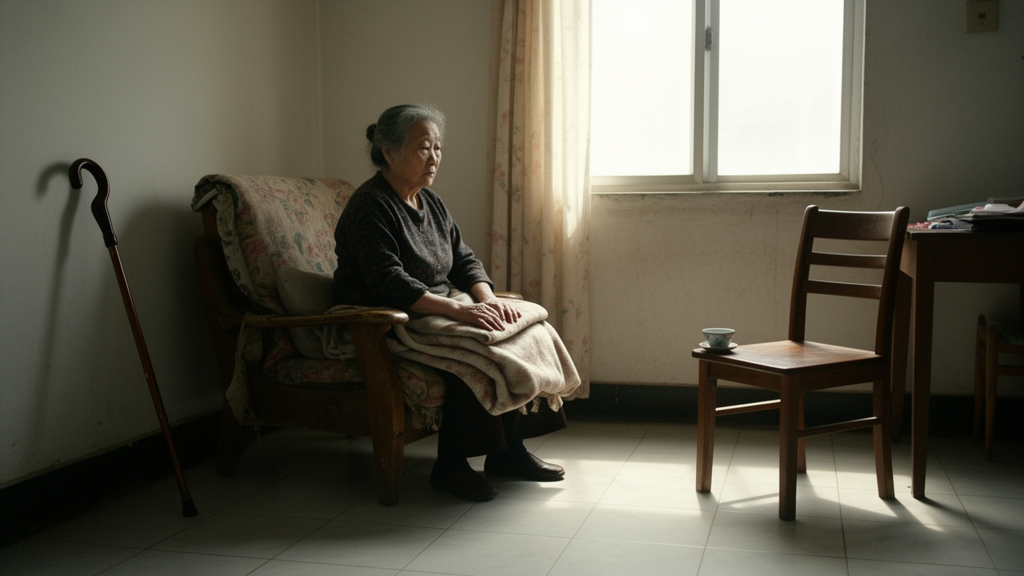
Chinese people aged 60 are expected to spend an average of 2.02 years of their remaining lives with unmet long-term care needs, according to a new study drawing on nationally representative survey data. That figure represents roughly one-third of their total life expectancy with care needs, which the researchers estimate at 6.44 years.
The study, published in the European Journal of Ageing, investigates the determinants of and disparities in life expectancy with unmet long-term care needs among older people in China. Its data come from four waves of the China Health and Retirement Longitudinal Study (CHARLS), a nationally representative survey conducted between 2013 and 2020 covering 42,480 participants.
Methodologically, the researchers combined continuous time multi-state Markov modelling with the life table approach. This allowed them to estimate not only total life expectancy but also the expected duration of life spent with met care needs and with unmet care needs, distinguishing between older people whose care requirements are satisfied and those whose requirements go unaddressed.
The headline estimate conceals substantial disparities across population groups. Life expectancy with unmet needs was significantly longer among women, among single people, among older people with a lower level of education, and among those living in rural areas. Each of these characteristics marks a group expected to spend a greater share of its later years without the care it needs.
The gap between the most and least disadvantaged groups was particularly striking. The duration of unmet needs over the remaining lifetime was estimated to be more than three times longer among the most disadvantaged group than among the most advantaged group of older people: 3.40 years compared with 1.07 years.
These estimates matter because unmet care needs capture more than the presence of disability or illness. They reflect whether an older person’s daily care requirements are actually being met, and therefore speak directly to quality of life in later years rather than simply to its length.
The authors argue that life expectancy with unmet needs provides important information about older people’s quality of life and, like healthy and unhealthy life expectancy measures, can be used for health economic evaluations and to monitor the performance of a health and care system. In other words, the measure offers policymakers a way to track not just how long people live, but how well their care needs are covered across the remaining lifespan.
On the basis of the findings, the study concludes that targeted policies and interventions designed to support disadvantaged groups are essential to reduce the lifetime disparities in unmet needs. Given that women, single older people, those with lower education, and rural residents all face longer expected durations of unmet care, such groups represent clear priorities for any policy response.
The study is being shared early as a peer-reviewed, accepted, open access article with a permanent DOI; this version remains subject to further edits before the final Version of Record is published. As with any modelling study, the estimates are projections based on survey waves through 2020, and the figures describe expected durations at the population level rather than guarantees for any individual. Even so, the work adds a quantitative dimension to a growing body of research on unmet care needs among older adults in China, translating survey observations into lifetime measures that can inform both health economics and long-term care policy.
Subject of Research: Life expectancy with unmet long-term care needs among older people in China
Article Title: Determinants of life expectancy with unmet needs in the Chinese older population (revision 1)
Article References: Wang, H., & Hu, B. (2026). Determinants of life expectancy with unmet needs in the Chinese older population (revision 1). European Journal of Ageing. https://doi.org/10.1007/s10433-026-00943-8
Image Credits: AI Generated
DOI: 10.1007/s10433-026-00943-8
Keywords: life expectancy, unmet care needs, long-term care, China, CHARLS, older adults, multi-state modelling, health disparities, rural health, ageing, Determinants, life
News Source: Beatrice Stafford. (October 30, 2026). Chinese Older Adults Face Years of Unmet Long-Term Care Needs. Scienmag.



