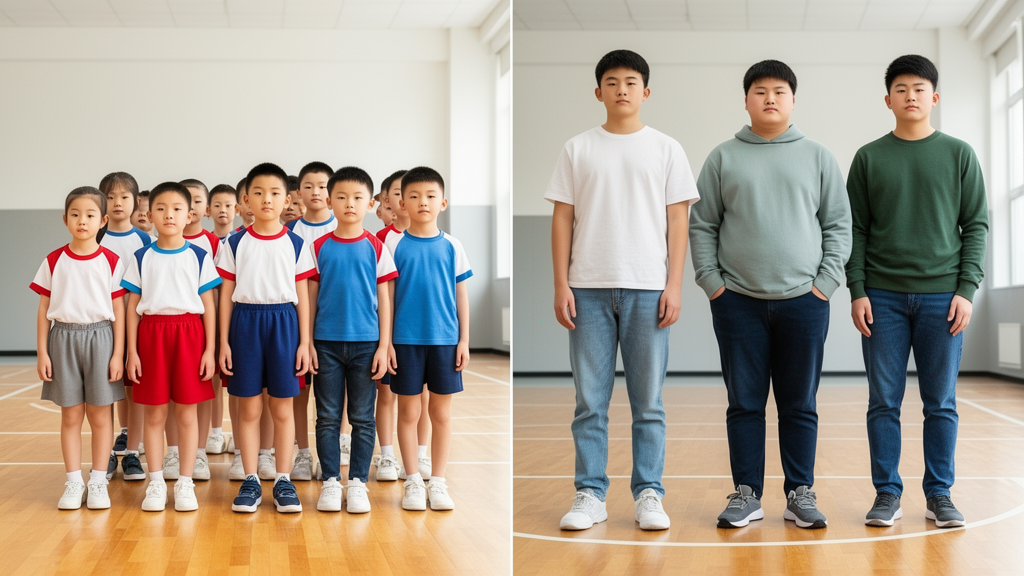
A large observational study published in Frontiers in Pediatrics reveals a diverging trend in the weight status of Chinese children and adolescents. Between 2010 and 2022, the prevalence of obesity declined among the youngest children in the sample, yet rose significantly among older adolescents. This shift suggests that public health interventions may be more effective in early childhood, while the risk of abnormal weight gain accelerates as children enter puberty. The findings, based on 27,755 person-observations from the China Family Panel Studies, highlight the need for targeted strategies that address the specific developmental stages where weight issues are most likely to emerge.
The research team, led by Haodong Zhong, Tao Tao, and Zhiyuan Hei, analyzed data from seven survey waves conducted between 2010 and 2022. The study focused on children and adolescents aged 7 to 15, a period that spans late childhood and early to mid-adolescence. By using a rotating panel design, the researchers were able to track changes in body mass index and weight status across multiple years. This approach allowed for a detailed examination of how BMI trends differ by sex and age group, providing a more nuanced picture than single-year cross-sectional surveys.
Overweight and obesity were classified using the sex- and age-specific BMI cut-offs established in the Chinese Guidelines for Weight Management (2024 Edition). These guidelines provide specific thresholds for screening weight status in children and adolescents, ensuring that the classification is appropriate for different developmental stages. The study utilized descriptive statistics to summarize mean BMI and assessed trends using Spearman correlation between survey year and mean BMI. Prevalence differences were compared using chi-square tests, while mean annual percentage-point changes were calculated to illustrate the speed of change between adjacent survey years.
The results indicate that overall BMI at ages 7 to 15 did not show a significant linear trend across the entire period. However, when stratified by sex and age, distinct patterns emerged. Among boys, BMI showed a significant upward trend starting at age 10, with the increase becoming particularly pronounced in the 12 to 15 age group. For girls, the significant upward trend began slightly later, at age 11, and was most substantial in the 13 to 15 age group. This timing difference aligns with the known differences in the onset of puberty between males and females.
Prevalence of overweight also varied by age and sex. Among boys, the rate of overweight rose markedly at ages 8 and 13 to 15. For instance, the overweight rate for 13-year-old boys increased from 5.6% in 2010 to 14.2% in 2022. Among girls, a significant upward trend in overweight prevalence was observed only at age 15, where the rate rose from 4.2% to 12.0% over the same period. These findings suggest that the issue of overweight is becoming increasingly prominent among male adolescents, with the risk spreading from younger to older age groups.
In contrast, the trends in obesity prevalence were more complex. Among younger boys aged 7 and 8, the obesity rate showed a significant downward trend, falling from 23.8% to 13.6% for 7-year-olds and from 20.0% to 12.6% for 8-year-olds. Similarly, the obesity rate for 7-year-old girls decreased from 31.0% to 23.2%. However, among older adolescents, obesity rates rose significantly. For boys, the rate increased from 4.7% to 12.6% at age 12, and from 0.8% to 4.7% at age 13. For girls, the increase was even more pronounced, with the obesity rate at age 13 jumping from 4.3% to 16.1%.
The analysis of average annual percentage-point changes revealed that most age groups experienced a peak in positive growth between 2016 and 2018. For example, the annual increase in overweight rates among 10- to 12-year-old boys reached 5.10 percentage points during this period. Following this peak, obesity rates among younger age groups declined significantly between 2018 and 2020. This pattern may reflect the impact of public health policy interventions implemented during that time, such as the Implementation Plan for Comprehensive Prevention and Control of Myopia Among Children and Adolescents, which encouraged outdoor activities and regulated screen time.
The study authors suggest that the improvement in obesity rates among younger children may be attributed to systematic policy interventions, including the Rural Compulsory Education Student Nutrition Improvement Program and enhanced health education in early elementary grades. However, these measures have not yet been able to effectively prevent childhood obesity from persisting into adolescence. Once children enter puberty, factors such as increased academic pressure, reduced physical activity, and changes in dietary habits contribute to a concentrated release of previously accumulated obesity risks.
The researchers note that the observational design of the study precludes causal inference. The trends reported reflect associations rather than direct causal effects of specific policies or behavioral changes. Additionally, the study has several limitations, including the potential for measurement error in height and weight data, selection bias due to the rotating panel design, and the lack of examination of specific determinants such as diet and physical activity. The prevalence estimates may also not be strictly nationally representative due to the absence of sampling weights.
Despite these limitations, the study provides valuable insights into the dynamic evolution of BMI among Chinese children and adolescents. The findings underscore the importance of shifting intervention efforts from young children to the upper elementary and junior high school years. The authors recommend that weight management strategies be differentiated by sex and age, with a particular focus on adolescent boys, who show the most significant increases in BMI and overweight prevalence. By addressing the specific risks associated with different developmental stages, public health initiatives can more effectively curb the rise in obesity among children and adolescents.
To construct the analytical cohort, investigators applied strict screening criteria to the initial 30,659 child-year records extracted across the seven waves. They excluded 2,904 entries due to missing demographic or physical values, or measurements outside plausible ranges of 0.8 to 2.2 meters for height or 15 to 150 kilograms for weight. The resulting analytical sample comprised 27,755 valid person-observations, including 13,346 male records (48.09%) and 14,409 female records (51.91%). Because the survey operates as an unbalanced rotating panel rather than tracking a fixed group continuously, observations were analyzed as repeated cross-sections across the survey years.
Detailed cohort metrics illustrate the divergence in body mass index trajectories across the study period. Mean body mass index among 14-year-old boys rose from 17.92 kg/m² in 2010 to 19.61 kg/m² in 2022, and 15-year-old boys climbed from 18.45 kg/m² to 19.47 kg/m². Conversely, 7-year-old girls experienced a slight but statistically significant decline from 17.33 kg/m² to 16.76 kg/m², whereas 15-year-old girls increased from 18.24 kg/m² to 20.28 kg/m². Under the 2024 guidelines, screening cutoffs at age 15 are 22.9 kg/m² for overweight and 26.6 kg/m² for obesity in boys, and 23.2 kg/m² and 26.6 kg/m² in girls. Obesity prevalence also expanded among older adolescent girls beyond age 13: rates rose from 3.6% to 7.3% at age 14 and from 1.6% to 5.4% at age 15. Among boys, overweight prevalence increased from 6.8% to 9.7% at age 8 and from 6.6% to 13.1% at age 14.
Annual percentage-point calculations revealed that velocity varied substantially across consecutive surveys. Among girls aged 10 to 12, obesity prevalence increased by 4.35 percentage points annually between 2018 and 2020, even as obesity among boys aged 7 to 9 fell by 4.00 percentage points per year during the same period. The researchers contextualized this adolescent weight acceleration alongside shifting living environments in China. From 2015 to 2018, online food delivery consumers grew from fewer than 100 million to 400 million, while nationwide mobile internet users exceeded one billion by 2018. Widespread meal deliveries and digital entertainment likely contributed to greater consumption of high-fat foods, increased screen time, and reduced physical activity.
Biological timing and behavioral dynamics further help explain why male adolescents exhibited earlier, steeper increases in body mass index. Cited developmental studies show that boys reach peak height growth velocity around age 12, whereas girls peak around age 10. Because boys achieve a higher peak velocity two years later, they experience an extended pubertal window for rapid weight accumulation. In addition, adolescent girls report greater sensitivity toward body shape and frequently diet even when normal weight, whereas adolescent boys demonstrate less awareness of overweight status and consume more sugary beverages and energy-dense snacks. The authors also highlight neurological evidence showing that children with excess weight display altered function in brain regions governing reward processing and self-control, with boys exhibiting heightened neural responses to food cues.
To address these adolescent risks, the study recommends coordinated interventions across educational, municipal, and healthcare systems. The authors propose integrating dedicated nutrition and physical activity curricula into junior high schools, establishing three-tiered coordination among school nurses, homeroom teachers, and parents, opening free community sports facilities on weekends, and restricting food delivery marketing aimed at youth. Finally, the authors note several study constraints beyond unweighted analyses and rotating panel attrition. Height and weight data relied partly on self-reported or proxy-reported measurements rather than uniform clinical evaluations, while behavioral disruptions during the 2020 COVID-19 pandemic may have influenced survey results during that specific wave.
Subject of Research: Trends in BMI and overweight prevalence among Chinese children and adolescents aged 7-15 from 2010 to 2022
Article Title: Trends in body mass index among Chinese children and adolescents aged 7–15, 2010–2022
Article References: Zhong, H., Tao, T., & Hei, Z. (2026). Trends in body mass index among Chinese children and adolescents aged 7–15, 2010–2022. Frontiers in Pediatrics, 14, Article 1976436. https://doi.org/10.3389/fped.2026.1976436
Image Credits: AI Generated
DOI: 10.3389/fped.2026.1976436
Keywords: BMI trends, childhood obesity, adolescent health, China Family Panel Studies, weight management, public health policy, puberty, overweight prevalence, observational study, pediatric nutrition, Trends, body
News Source: Harold Sullivan. (November 10, 2026). Chinese Adolescent BMI Rises While Younger Children Improve. Scienmag.