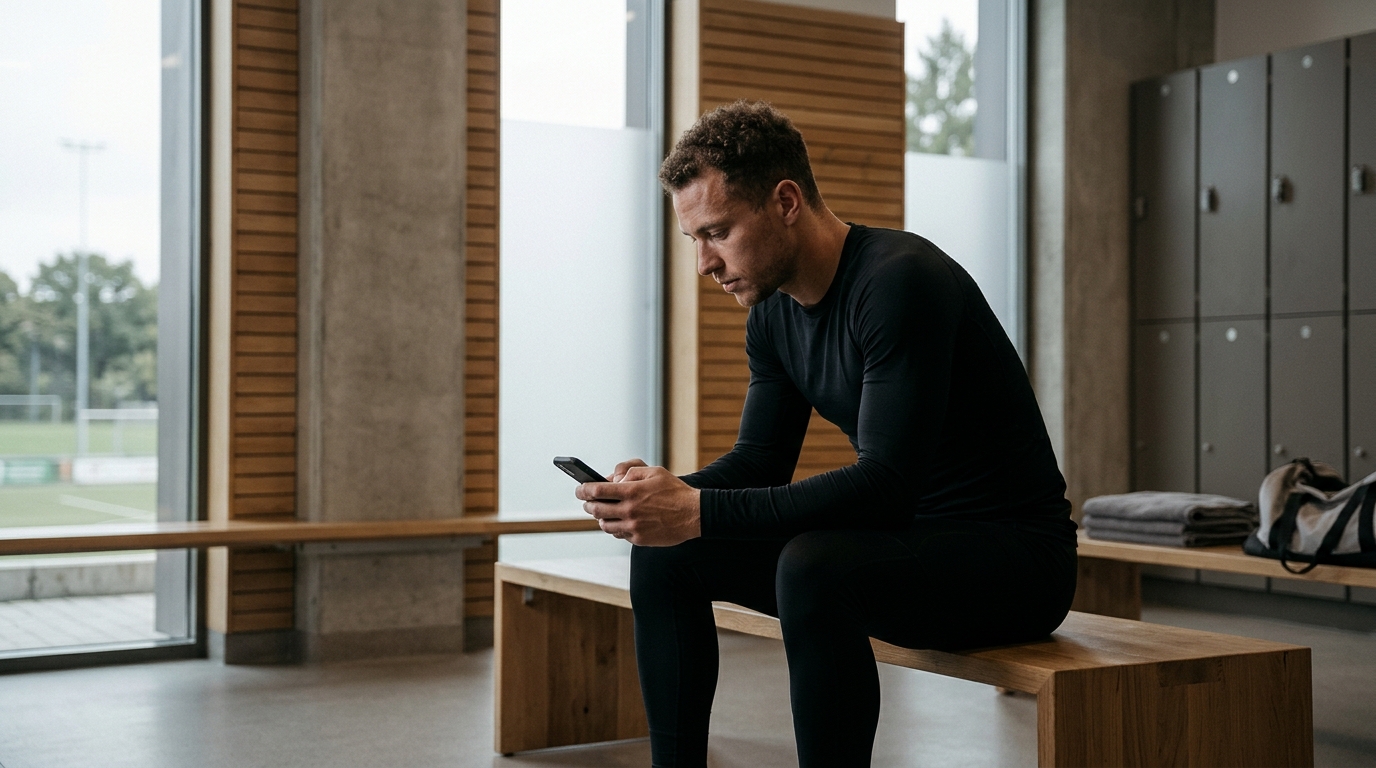
Researchers have released the study protocol for a randomized clinical trial evaluating whether a voice-based conversational artificial intelligence agent analyzing speech in real time can deliver psychological skills training to reduce competitive state anxiety among elite athletes. Developed by investigators Joung Hwan Back and Bo-Young Youn of Daejeon University alongside Wonjun Choi of Korea International School Jeju Campus, the project targets competitive state anxiety, which impairs both athletic performance and mental health.
The research design comprises two structured stages, beginning with Phase I to develop the conversational agent and evaluate its content validity and usability against prespecified performance thresholds. Phase II follows as a parallel-group, attention-matched active-controlled randomized trial conducted entirely in a decentralized, fully online environment. Because all outcome measures are self-reported by unblinded participants, the trial protocol does not include blinding for outcome assessors. Instead, methodological blinding is strictly maintained for the trial data manager and the statistician conducting the final evaluations.
The Phase II evaluation plans to enroll 86 elite competitors registered with the Korean Sport and Olympic Committee, randomizing them in an equal one-to-one ratio across two four-week study arms. The intervention group receives voice-based artificial intelligence coaching delivered across three sessions each week, with each session lasting 20 minutes or longer, while the active control group receives a wordless relaxation recording with delayed access to the coaching agent. The study arms match on dosage, session frequency, and digital delivery method; however, they do not match on interactivity, content variety, technical platform, or participant expectancy. Consequently, the investigators frame the investigation to estimate the incremental benefit of the full conversational agent over a non-interactive comparator rather than isolating voice adaptation alone, while measuring and modeling credibility, expectancy, and adherence across both arms.
The primary clinical endpoint is the change from baseline to week four in cognitive anxiety measured by the Competitive State Anxiety Inventory-2, which participants must complete within 24 hours before an index athletic competition nominated for each evaluation window. Measurements for somatic anxiety and self-confidence follow in a fixed assessment sequence. Secondary outcome instruments capture broader psychological indicators, including the Generalized Anxiety Disorder-7, Patient Health Questionnaire-9, Perceived Stress Scale-10, World Health Organization-Five Well-Being Index, and the 12-Item Short Form Survey, alongside exploratory evaluations utilizing the System Usability Scale and an experimental artificial intelligence voice-based anxiety index.
Outcome assessments are scheduled at fixed intervals relative to each participant’s first intervention session, taking place at baseline prior to randomization, within seven days following the four-week intervention period, and at a final follow-up two weeks later, supported by prespecified procedural contingencies should an index competition be canceled or postponed. Primary analyses will apply linear mixed models following an intention-to-treat principle. The authors report that the trial is powered for an effect size of d = 0.60 on the primary contrast, functioning as an estimation study alongside hypothesis testing. Registered under identifier KCT0012076 with the Clinical Research Information Service in the Republic of Korea, the trial represents one of the earliest randomized investigations to test real-time speech-analyzing conversational artificial intelligence for athlete psychological coaching.
Addressing the methodological scope, the researchers emphasized that the decentralized format and dose-matched active control are major strengths of the trial framework.
The protocol, published in the Digital Mental Health section of Frontiers in Digital Health following formal trial registration in June 2026, is structured around both estimation and formal hypothesis testing.
Subject of Research: A randomized trial protocol testing conversational artificial intelligence coaching for competitive state anxiety in elite athletes.
Article Title: Development and validation of a voice-based conversational artificial intelligence coaching agent to reduce competitive state anxiety in elite athletes: study protocol for a randomized, analyst-blinded, attention-matched active-controlled trial
Article References: Back, J. H., Choi, W., & Youn, B.-Y. (2026). Development and validation of a voice-based conversational artificial intelligence coaching agent to reduce competitive state anxiety in elite athletes: study protocol for a randomized, analyst-blinded, attention-matched active-controlled trial. Frontiers in Digital Health, 8, Article 1962543. https://doi.org/10.3389/fdgth.2026.1962543
Image Credits: AI Generated
DOI: 10.3389/fdgth.2026.1962543
Keywords: artificial intelligence, competitive state anxiety, conversational agent, digital mental health, elite athletes, psychological skills training, randomized controlled trial, Development, validation, voice-based, conversational, artificial
News Source: Glenn Wilkins. (November 11, 2026). Randomized Trial Protocol Tests Conversational AI for Elite Athlete Anxiety. Scienmag.