


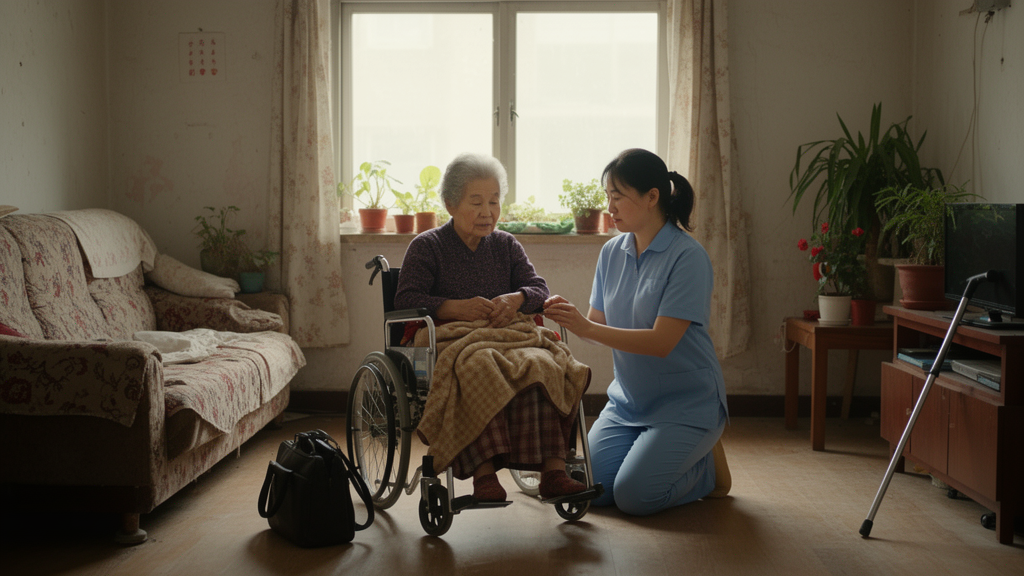
China’s long-term care insurance pilots have brought formal home-based care into the lives of thousands of older adults, but a new qualitative study from Guangzhou shows that the program’s real-world value depends on policy details that often go unnoticed. Researchers interviewed 24 people—six older adults receiving home and community-based services and 18 of their family members—about their lived experiences with the insurance scheme. Their accounts, published in the European Journal of Ageing, reveal four policy mechanisms that eased unmet care needs and three design flaws that left gaps in support.
The study is grounded in the convoy of care framework, which treats older adults’ well-being as shaped by the structure, support, and quality of their care networks. These networks include both professional caregivers and family members, and their composition, the level of care exchanged, and the subjective quality of that care are all influenced by personal characteristics and situational factors such as policy and culture. Rather than providing services directly, long-term care insurance shapes unmet needs indirectly by altering these networks. The researchers used reflexive thematic analysis, guided deductively by this framework, to identify which policy components mattered most to respondents.
China launched long-term care insurance pilots in 15 cities, including Guangzhou and Shanghai, in 2016. The program aims to improve access to affordable formal care from public or private institutions, with the central government recommending a reimbursement rate of 70 percent of eligible expenses. Guangzhou introduced its scheme in August 2017, covering all residents aged 18 and above enrolled in local social health insurance programs. While all adult residents are eligible to apply, the program primarily targets older adults, particularly those aged 85 and above. Benefits encompass both home and community-based services and institutional care, with recipients able to choose between in-kind services from agency-designated caregivers or cash benefits used mainly to hire caregivers, including relatives and domestic helpers.
The first mechanism respondents identified was the activation of formal care through insurance enrollment. One 67-year-old male recipient described how his wife had cared for him until she hurt her back and needed surgery, while his son had to work. After applying for the insurance, an agency sent a care worker who cut his hair, shaved him, and helped him wash. This illustrates how the program enabled access to formal support precisely when family members were no longer able to provide it, filling a structural gap in the care network that would otherwise have gone unaddressed.
The second mechanism was flexibility in choosing caregivers. Respondents emphasized active involvement in selecting who provided their care rather than accepting agency assignments. One 67-year-old daughter explained that her family stayed with their domestic helper because she matched her mother’s preferences—getting along with her, speaking Cantonese, and cooking local dishes. However, this flexibility was constrained by an age limit of 65 for caregivers enforced by care agencies, regardless of actual capabilities. A 91-year-old husband whose caregiver was patient and strong enough to lift and turn his wife in bed expressed frustration that whenever she took leave, everything fell apart, and he wished the government would let her work longer. The researchers describe this as a mismatch between caregiver preferences and policy constraints that threatens continuity of care.
The third mechanism involved agency nurses, who emerged as crucial members of care convoys. During home visits, nurses collaborated with caregivers and families by monitoring health conditions such as blood pressure, offering tailored guidance, and supervising services. One 53-year-old son described how a nurse noticed his father’s digestion issues and taught the family practical dietary adjustments—switching from foxtail millet to a different rice, adding sweet potato and vegetables, and mashing everything for easier eating—after which his father felt better. Nurses also provided emotional support; one 69-year-old recipient said that when the nurse came, she felt really happy and wanted to talk more, because she could not go out to chat with other people. The researchers identify nurses’ contributions as an additional mechanism beyond the instrumental support emphasized in prior quantitative literature.
The fourth mechanism was training for caregivers, which respondents said improved care quality and alleviated unmet needs. A 55-year-old son working as a paid family caregiver reflected that before training he would simply give his mother meals without noting her needs, but afterward he learned massage for pain relief and began focusing more on her mental well-being. The authors note that such programs enhance caregivers’ skills, reduce their distress and care burden, and are associated in prior research with delayed institutionalization and improved well-being for older adults. Countries like Germany and South Korea have adopted caregiver-training policies to ensure service quality.
Against these strengths, respondents identified three suboptimal policy features that left needs unmet. The first was the inadequacy of benefits, particularly for urban and rural residents who receive lower reimbursement rates and face more constrained financial resources than urban employees. Urban employees often found the costs of hiring professional caregivers manageable because their pensions helped offset out-of-pocket expenses. One family member reported that after the insurance covered four hours of daily care, the caregiver could only do the basics, so the family doubled care to eight hours at a cost of 3,500 RMB per month, covered by a combined pension of 8,000 RMB. In contrast, a daughter of urban residents without pensions described receiving only 700 RMB monthly while urban employees received 2,000 RMB plus pensions around 4,000 RMB, saying the insurance just makes the welfare gap wider. To cope, older recipients relied primarily on financial contributions from adult children or hired family members as caregivers.
The second gap was a lack of program information that delayed or prevented utilization. Most respondents reported difficulties obtaining information about the insurance, relying on television, friends, and residents’ committees, and describing the process as happening by chance. One recipient learned about the program only when agency nurses handed out masks on the street during Covid-19. Even when nurses proactively promoted the insurance, many respondents found it hard to trust them due to unfamiliarity, with some mistakenly perceiving them as financial scammers or insurance salespeople, which led them to hesitate to apply and delayed access to timely services. Respondents also wanted more information about care-related goods; one 71-year-old woman discovered too late that the program allowed renting adjustable beds and home adaptations, saying no one had told them so they bought these items themselves.
The third gap concerned limited access to individualized care-related goods. Several respondents described certain items, such as crutches and wheelchairs, as redundant because they already possessed similar items, while others found goods like GPS-tracking watches irrelevant for bedridden recipients. One 67-year-old recipient said he was too old to use rehabilitation devices because his hands were too weak. The government offered only a limited catalog of items from which recipients had to choose, and many desired greater flexibility, suggesting an expanded list including balm, incontinence briefs, and support for social health insurance premiums. An 86-year-old recipient who could not really move around wished the government could help with pain relief balm or patches. The authors suggest that targeted allocation could prevent waste while expanding the catalog would better serve individualized needs. They caution that findings may not transfer to older adults receiving institutional care, that the small sample of older recipients means perspectives came predominantly from family members, and that limited dyads prevented discerning discrepancies between the two groups’ views.
Subject of Research: How long-term care insurance policy features relate to unmet care needs among older adults and their families in Guangzhou, China
Article Title: Long-term care insurance and unmet needs in China: perspectives of older adults and family members
Article References: Zhang, J., Chan, W. K., Hu, B., & Gao, J. (2026). Long-term care insurance and unmet needs in China: perspectives of older adults and family members. European Journal of Ageing, 23(1), Article 34. https://doi.org/10.1007/s10433-026-00938-5
Image Credits: AI Generated
DOI: 10.1007/s10433-026-00938-5
Keywords: long-term care insurance, unmet care needs, older adults, Guangzhou, China, home and community-based services, caregivers, agency nurses, convoy of care, qualitative interviews, policy design, family caregivers
News Source: Ophelia Keating. (October 30, 2026). China’s long-term care insurance leaves gaps, say older adults and families. Scienmag.



