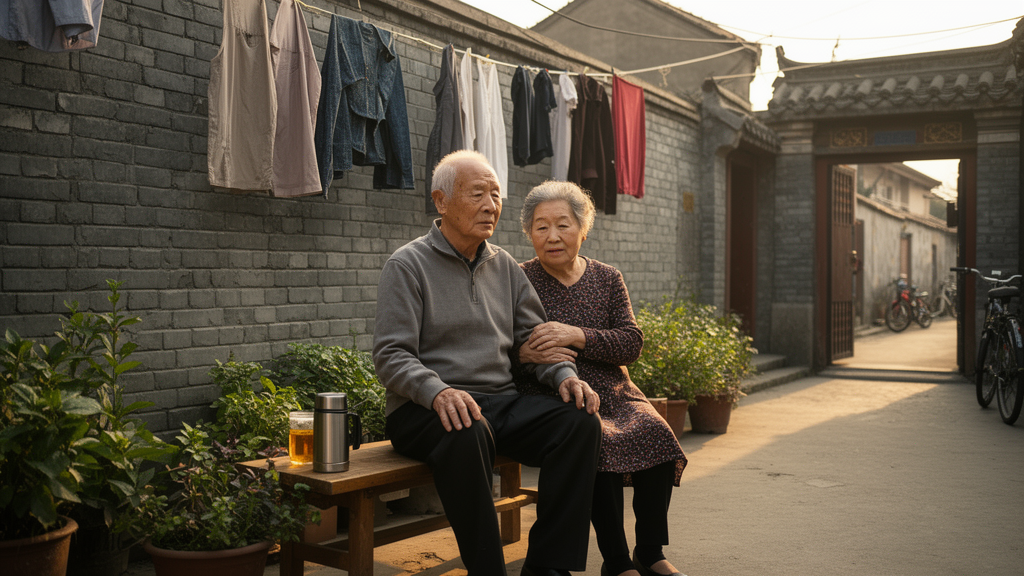
In the coastal city of Wenzhou, a quiet demographic experiment is underway. China is aging faster than almost any society in history, and the mental well-being of its 60-plus population has become a pressing scientific and policy question. A new study published in BMC Geriatrics suggests that the answer may hinge on something most Western readers have never heard of: hukou, China’s household registration system. The research, led by Xuan-Yu Chen of Flinders University and colleagues, found that this decades-old bureaucratic classification, which divides citizens into agricultural and non-agricultural categories, appears to change how the psychological resources of old age translate into life satisfaction and depression.
The study surveyed 508 community-dwelling adults aged 60 and above in Wenzhou, a port city in Zhejiang province where rapid economic development has blurred, but not erased, the boundaries between rural and urban life. Rather than treating resilience as a single trait, the researchers measured it across six ecological domains: psychological, family, community, social, cultural, and environmental. Psychological status was captured with two well-validated instruments, the Satisfaction with Life Scale and the Center for Epidemiologic Studies Depression Scale, alongside the Lubben Social Network Scale for measuring social ties. The team then used hierarchical regression and moderation analyses with the SPSS PROCESS macro to test whether hukou status altered the strength of the links between these resources and mental health outcomes.
The headline finding is deceptively simple but statistically striking. Hukou status moderated the association between family harmony and life satisfaction: the link was stronger among non-agricultural hukou holders, meaning that for urban-registered elders, a harmonious family life carried more weight in how satisfied they felt with life overall. The reverse pattern emerged for filial support, the traditional Confucian expectation that children care for aging parents. Among agricultural hukou holders, filial support was more strongly tied to life satisfaction, suggesting that rural elders rely more heavily on their children’s support when evaluating their own well-being.
Even more unexpected were the results for depression. Hukou status also moderated the associations of psychological resilience and social networks with depressive symptoms, and the direction of the effects diverged sharply between the two registration categories. Among agricultural hukou holders, higher psychological resilience and larger social networks were associated with more depressive symptoms, in contrast to the patterns observed among non-agricultural hukou holders. This counterintuitive result challenges the widespread assumption that resilience and social connectedness are universally protective against depression in later life.
How can more resilience predict more depression? The authors offer a cautious interpretation rather than a definitive mechanism. One possibility is that resilience operates differently across social contexts: for rural-registered elders, who may face persistent structural disadvantage in pension coverage, healthcare access, and social welfare, psychological hardiness and dense social networks may reflect prolonged exposure to adversity rather than protection from it. In other words, the very resources that help people survive hardship may be markers of the hardship itself. Another interpretation is that social networks in rural settings may carry obligations and strains that urban networks do not, so a larger network could mean more demands on limited resources rather than more support.
The technical architecture of the analysis matters here. Moderation analysis tests whether the slope of a relationship between two variables changes across levels of a third variable, and that is precisely what the PROCESS macro was used to detect. The six resilience domains were entered as predictors, life satisfaction and depressive symptoms as outcomes, and hukou status as the moderator. The fact that moderation emerged for family harmony, filial support, psychological resilience, and social networks, but not for every domain, indicates that the ecological resources of resilience are not uniformly sensitive to registration status. Some resources appear to function similarly across hukou categories, while others are channeled through the structural divides the system creates.
Why would family harmony matter more for urban elders while filial support matters more for their rural counterparts? The researchers point to the cultural and economic logic embedded in each setting. Non-agricultural hukou holders, typically more integrated into urban welfare systems, may experience family harmony as a broader emotional climate that colors their overall life evaluation, with less dependence on any single form of support. Agricultural hukou holders, who historically have had thinner institutional safety nets, may lean more directly on their children’s material and practical care, making filial support a more consequential ingredient of life satisfaction. The hukou system, originally designed to control internal migration, thus appears to shape not just access to resources but the psychological meaning of those resources.
The study’s limitations are important to keep in view. As a cross-sectional survey, it captures a single moment in time and cannot establish causal direction: it is possible that depressed elders perceive their resources differently, or that unmeasured variables drive both resilience and depression. The sample was drawn from community settings in a single city, and the authors themselves recommend further research using longitudinal designs and broader sampling to validate the associations. The moderation effects, while statistically meaningful, describe associations rather than mechanisms, and the counterintuitive depression findings in particular require replication before firm conclusions can be drawn about why resilience and social networks behave differently across hukou categories.
Nevertheless, the policy implications are substantial. The authors argue that policies aimed at reducing hukou-based welfare disparities and strengthening family- and community-based support may help address differences in how resilience resources are linked to older adults’ psychological outcomes. China has already begun reforming the hukou system, relaxing restrictions in many cities and expanding rural social insurance, and this study adds a mental health dimension to that ongoing debate. If the psychological dividends of family, community, and social resources depend on registration status, then welfare reform is not merely an economic issue but a geriatric mental health intervention.
For a global audience, the Wenzhou findings carry a broader lesson about the ecology of resilience. Psychologists increasingly understand resilience not as an individual trait but as a property distributed across families, communities, cultures, and institutions, and this study shows that the institutional layer can rewire the entire network. What protects mental health in one registration category may not protect it, or may even correlate with distress, in another. As countries worldwide grapple with aging populations and entrenched administrative divides between urban and rural citizens, the Wenzhou study offers a vivid reminder that the bureaucracy on a person’s file can shape the psychology inside their head.
Subject of Research: Hukou moderation of resilience-related resources and psychological status in older adults: a wenzhou study
Article Title: Hukou moderation of resilience-related resources and psychological status in older adults: a wenzhou study
Article References: Chen, X.-Y., Zheng, J., Yin, X., Maclaren, H., Jin, T., Zheng, Y., & Zhang, H. (2026). Hukou moderation of resilience-related resources and psychological status in older adults: a wenzhou study. BMC Geriatrics. https://doi.org/10.1186/s12877-026-08506-3
Image Credits: AI Generated
DOI: 10.1186/s12877-026-08506-3
Keywords: Hukou, moderation, resilience-related, resources, psychological, status, older, adults, wenzhou, scientific research
News Source: Glenn Wilkins. (October 18, 2026). China’s Hukou System Shapes How Resilience Protects Older Adults’ Mental Health. Scienmag.