• HOME
  • NEWS
  • EXPLORE
    • CAREER
      • Companies
      • Jobs
    • EVENTS
    • iGEM
      • News
      • Team
    • PHOTOS
    • VIDEO
    • WIKI
  • BLOG
  • COMMUNITY
    • FACEBOOK
    • INSTAGRAM
    • TWITTER
Saturday, February 7, 2026
BIOENGINEER.ORG
No Result
View All Result
  • Login
  • HOME
  • NEWS
  • EXPLORE
    • CAREER
      • Companies
      • Jobs
        • Lecturer
        • PhD Studentship
        • Postdoc
        • Research Assistant
    • EVENTS
    • iGEM
      • News
      • Team
    • PHOTOS
    • VIDEO
    • WIKI
  • BLOG
  • COMMUNITY
    • FACEBOOK
    • INSTAGRAM
    • TWITTER
  • HOME
  • NEWS
  • EXPLORE
    • CAREER
      • Companies
      • Jobs
        • Lecturer
        • PhD Studentship
        • Postdoc
        • Research Assistant
    • EVENTS
    • iGEM
      • News
      • Team
    • PHOTOS
    • VIDEO
    • WIKI
  • BLOG
  • COMMUNITY
    • FACEBOOK
    • INSTAGRAM
    • TWITTER
No Result
View All Result
Bioengineer.org
No Result
View All Result
Home NEWS Science News Biology

Chimpanzees react faster to cooperate than make selfish choices

Bioengineer by Bioengineer
October 29, 2018
in Biology
Reading Time: 2 mins read
0
Share on FacebookShare on TwitterShare on LinkedinShare on RedditShare on Telegram
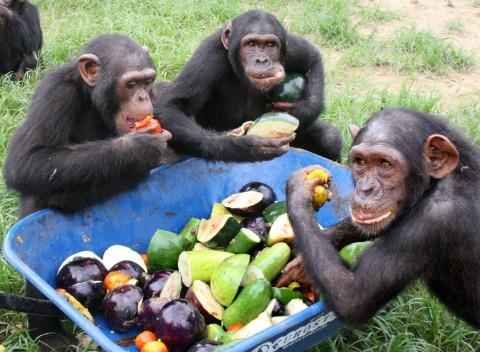
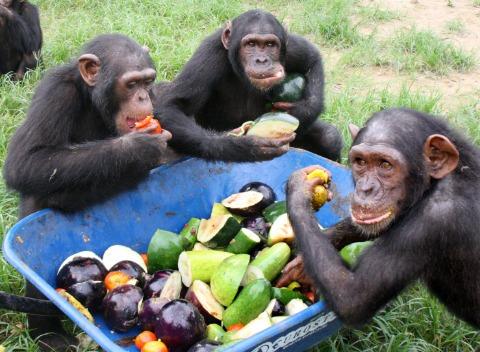
IMAGE

Credit: © the Jane Goodall Institute / By Fernando Turmo

ANN ARBOR–When it comes to cooperation, there's no monkey business in how some chimpanzees respond.

These primates often make decisions faster that benefits others than themselves, according to a newly published University of Michigan study.

For decades, social scientists and biologists have sought to study primates because they are humans' closest living relatives. Chimpanzees can also be very cooperative in the wild–forming alliances with friends or hunting together in groups.

"Chimpanzees are an important comparative model for human cooperation," said Alexandra Rosati, U-M assistant professor of psychology and anthropology.

Rosati, the study's lead author, and colleagues at Harvard University examined how chimpanzees from the Republic of Congo think about cooperative decisions and the response time in situations involving prosocial behavior, which involves how one's actions benefit others, such as giving time, effort or resources.

The 40 chimpanzees completed tasks that assessed cooperation and self-control, including:

Donation task: The chimpanzee could provide food to both himself and a partner at no cost, or choose to only get food for himself. Chimpanzees were more likely to pick the prosocial option if they made a fast choice–as though their gut reaction was to cooperate with the partner. If they took longer to decide, however, they were more likely to keep the food for themselves.

Helping task: The chimpanzee could give a partner an object that was out of reach. Individual chimpanzees that were more likely to lend a hand were also the fastest to respond to their partner's problem. In general, this supports situations in which cooperative individuals tend to make prosocial choices faster than selfish people.

Punishment task: The chimpanzee could stop a thief from taking a stolen resource by collapsing a table so the thief couldn't get food. Like in the helping study, the chimpanzees who were most reactive to unfairness tended to collapse the table more quickly.

Thus, in both reward and punishment contexts, the chimpanzees made prosocial choices more rapidly than those benefiting themselves.

"Ultimately, our results show that chimpanzee cooperation involves several cognitive mechanisms that parallel those seen in humans," the researchers wrote.

###

The study's other authors were Harvard researchers Lauren DiNicola and Joshua Buckholtz. The findings appear in the current issue of Psychological Science.

Media Contact

Jared Wadley
[email protected]
@umich

http://www.umich.edu/

Share12Tweet8Share2ShareShareShare2

Related Posts

New Study Uncovers Mechanism Behind Burn Pit Particulate Matter–Induced Lung Inflammation

New Study Uncovers Mechanism Behind Burn Pit Particulate Matter–Induced Lung Inflammation

February 6, 2026

DeepBlastoid: Advancing Automated and Efficient Evaluation of Human Blastoids with Deep Learning

February 6, 2026

Navigating the Gut: The Role of Formic Acid in the Microbiome

February 6, 2026

AI-Enhanced Optical Coherence Photoacoustic Microscopy Revolutionizes 3D Cancer Model Imaging

February 6, 2026
Please login to join discussion

POPULAR NEWS

  • Robotic Ureteral Reconstruction: A Novel Approach

    Robotic Ureteral Reconstruction: A Novel Approach

    82 shares
    Share 33 Tweet 21
  • Digital Privacy: Health Data Control in Incarceration

    63 shares
    Share 25 Tweet 16
  • Study Reveals Lipid Accumulation in ME/CFS Cells

    57 shares
    Share 23 Tweet 14
  • Breakthrough in RNA Research Accelerates Medical Innovations Timeline

    53 shares
    Share 21 Tweet 13

About

We bring you the latest biotechnology news from best research centers and universities around the world. Check our website.

Follow us

Recent News

Exploring Decision-Making in Dementia Caregivers’ Mobility

Succinate Receptor 1 Limits Blood Cell Formation, Leukemia

Palmitoylation of Tfr1 Drives Platelet Ferroptosis and Exacerbates Liver Damage in Heat Stroke

Subscribe to Blog via Email

Enter your email address to subscribe to this blog and receive notifications of new posts by email.

Join 73 other subscribers
  • Contact Us

Bioengineer.org © Copyright 2023 All Rights Reserved.

Welcome Back!

Login to your account below

Forgotten Password?

Retrieve your password

Please enter your username or email address to reset your password.

Log In
No Result
View All Result
  • Homepages
    • Home Page 1
    • Home Page 2
  • News
  • National
  • Business
  • Health
  • Lifestyle
  • Science

Bioengineer.org © Copyright 2023 All Rights Reserved.