• HOME
  • NEWS
  • EXPLORE
    • CAREER
      • Companies
      • Jobs
    • EVENTS
    • iGEM
      • News
      • Team
    • PHOTOS
    • VIDEO
    • WIKI
  • BLOG
  • COMMUNITY
    • FACEBOOK
    • INSTAGRAM
    • TWITTER
Monday, June 8, 2026
BIOENGINEER.ORG
No Result
View All Result
  • Login
  • HOME
  • NEWS
  • EXPLORE
    • CAREER
      • Companies
      • Jobs
        • Lecturer
        • PhD Studentship
        • Postdoc
        • Research Assistant
    • EVENTS
    • iGEM
      • News
      • Team
    • PHOTOS
    • VIDEO
    • WIKI
  • BLOG
  • COMMUNITY
    • FACEBOOK
    • INSTAGRAM
    • TWITTER
  • HOME
  • NEWS
  • EXPLORE
    • CAREER
      • Companies
      • Jobs
        • Lecturer
        • PhD Studentship
        • Postdoc
        • Research Assistant
    • EVENTS
    • iGEM
      • News
      • Team
    • PHOTOS
    • VIDEO
    • WIKI
  • BLOG
  • COMMUNITY
    • FACEBOOK
    • INSTAGRAM
    • TWITTER
No Result
View All Result
Bioengineer.org
No Result
View All Result
Home NEWS Science News Health

Chemicals for pharmaceuticals could be made cheaper and greener by new catalysts

Bioengineer by Bioengineer
October 1, 2019
in Health
Reading Time: 3 mins read
0
IMAGE
Share on FacebookShare on TwitterShare on LinkedinShare on RedditShare on Telegram

IMAGE

Credit: University of Warwick

High value chemicals used to make pharmaceuticals could be made much cheaper and quicker thanks to a series of new catalysts made by scientists at the University of Warwick in collaboration with GoldenKeys High-Tech Co., Ltd. in China.

The process of making high-value chemicals for uses such as the pharmaceutical or electronics chemical industry requires many years of work and a very high financial investment, with a large amount of side products going to waste.

However, in research published in the ACS journal Organic Letters, the paper: ‘Probing the Effects of Heterocyclic Functionality in [(Benzene) Ru (TsDPENR)CI] Catalysts for Asymmetric Transfer Hydrogenation’, shows how scientists are able to tailor conditions in the catalyst to make the molecule required.

The research project between the University of Warwick and the GoldenKeys High-Tech Materials Co., Ltd., a Speciality Material Company led by Dr. Yingjian Xu FRSC in China, has resulted in the development of a series of new catalysts for the asymmetric synthesis of alcohols which could be used for high value chemicals such as pharmaceuticals and electronics chemicals, potentially making it faster, cheaper and more environmentally sustainable as less chemicals are required under the catalytic conditions.

Researchers were able to make the catalyst by making the molecules’ ligands – which act as building blocks, bind to the metal ruthenium.
This means that scientists can pick and choose which molecules to bind together to make a catalyst and in turn make the chemical required in a much faster and more sustainable way.

In some cases the ligands are ‘bidentate’ – meaning they form two bonds to the metal, and in other cases they are ‘tridentate’ – forming three bonds to the metal. Knowing how each ligand will bind also helps the identification of the optimal active form and the conditions required for the target application.

Professor Martin Wills from the Department of Chemistry at the University of Warwick comments:

“The ability to make high-value chemicals through our new series of catalysts using ruthenium metal means that they can be made much more sustainably.

Dr. Yingjian Xu of GoldenKeys High-Tech Materials Co., Ltd. adds:

“If this method is used in the pharmaceutical and electronics chemical industries for example then products and intermediates can potentially be made more cheaply and quickly with higher purity for consumers and reduce waste as less material is needed to make the catalyst, unlike traditional stoichiometric methods.”

###

NOTES TO EDITORS

Image of researchers available at: https://warwick.ac.uk/services/communications/medialibrary/images/september2019/jbr_mw_yx_2018.jpg

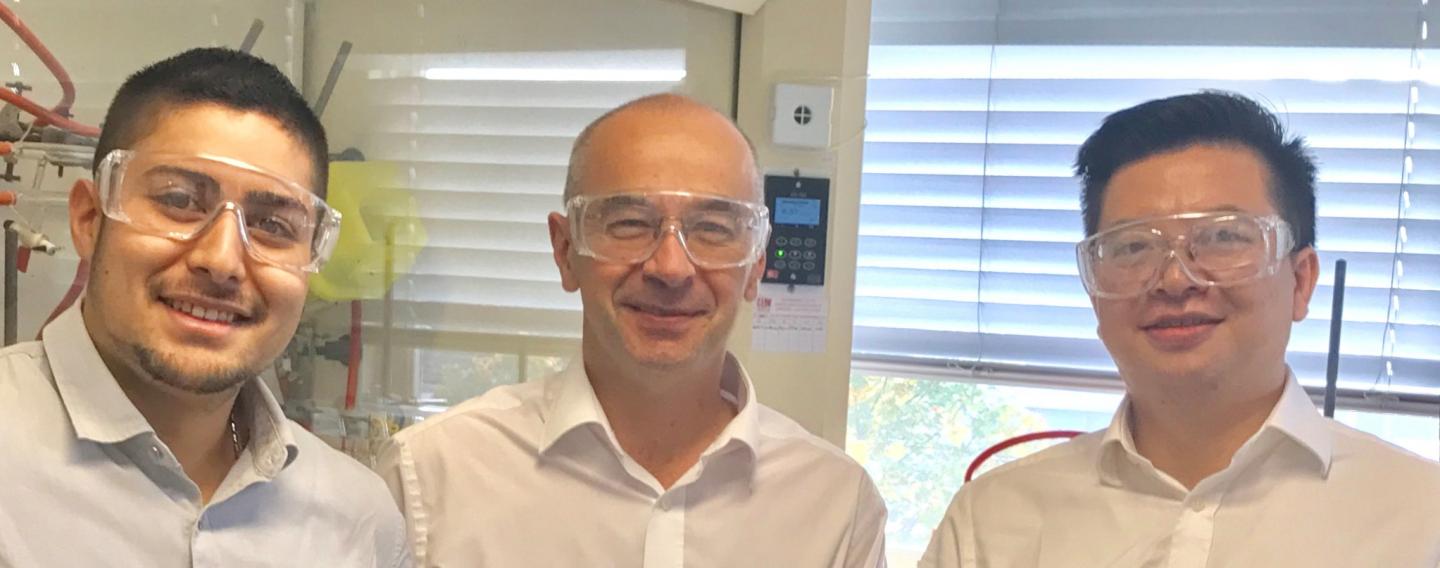
Credit: University of Warwick. Caption: Researchers from left to right: Jonathan Barrios-Rivera, Martin Wills, Yingjian Xu

Paper available to view at: https://pubs.acs.org/toc/orlef7/21/18?ai=6562

For further information please contact:

Alice Scott

Media Relations Manager – Science

University of Warwick

Tel: +44 (0) 2476 574 255 or +44 (0) 7920 531 221

E-mail: [email protected]

Media Contact
Alice Scott
[email protected]

Original Source

https://warwick.ac.uk/newsandevents/pressreleases/high_value_chemicals

Related Journal Article

http://dx.doi.org/10.1021/acs.orglett.9b02339

Tags: BiochemistryBiomedical/Environmental/Chemical EngineeringChemistry/Physics/Materials SciencesIndustrial Engineering/ChemistryPharmaceutical ChemistryPharmaceutical SciencePharmaceutical SciencesPharmaceutical/Combinatorial Chemistry
Share12Tweet8Share2ShareShareShare2

Related Posts

Dental Care Gaps Linked to Systemic Diseases in Homebound Patients

June 8, 2026

Predicting Lung Risks After Hip Fracture Surgery

June 7, 2026

Complex Intervention Boosts Medication Adequacy in Older Adults

June 7, 2026

9 mg Mazdutide for Effective Weight Loss in Chinese Adults with Obesity

June 7, 2026
Please login to join discussion

POPULAR NEWS

  • ESMO 2025: mRNA COVID Vaccines Enhance Efficacy of Cancer Immunotherapy

    323 shares
    Share 129 Tweet 81
  • Multi-Hospital Study Reveals Long Covid Burden Is Twice as High as Current Estimates

    89 shares
    Share 35 Tweet 22
  • Saying Goodbye to PGY-6: Pediatric Fellowship Realities

    83 shares
    Share 33 Tweet 21
  • Common Food Preservatives Associated with Elevated Blood Pressure and Increased Heart Disease Risk

    58 shares
    Share 23 Tweet 15

About

We bring you the latest biotechnology news from best research centers and universities around the world. Check our website.

Follow us

Recent News

How Intergenerational Stress Shapes Allergy Risk

Lightweight X-Ray Aprons: A Breakthrough to Prevent Chronic Pain in Health-Care Workers

Machine Learning Predicts Power Converter Lifespan

Subscribe to Blog via Email

Enter your email address to subscribe to this blog and receive notifications of new posts by email.

Join 82 other subscribers
  • Contact Us

Bioengineer.org © Copyright 2023 All Rights Reserved.

Welcome Back!

Login to your account below

Forgotten Password?

Retrieve your password

Please enter your username or email address to reset your password.

Log In
No Result
View All Result
  • Homepages
    • Home Page 1
    • Home Page 2
  • News
  • National
  • Business
  • Health
  • Lifestyle
  • Science

Bioengineer.org © Copyright 2023 All Rights Reserved.