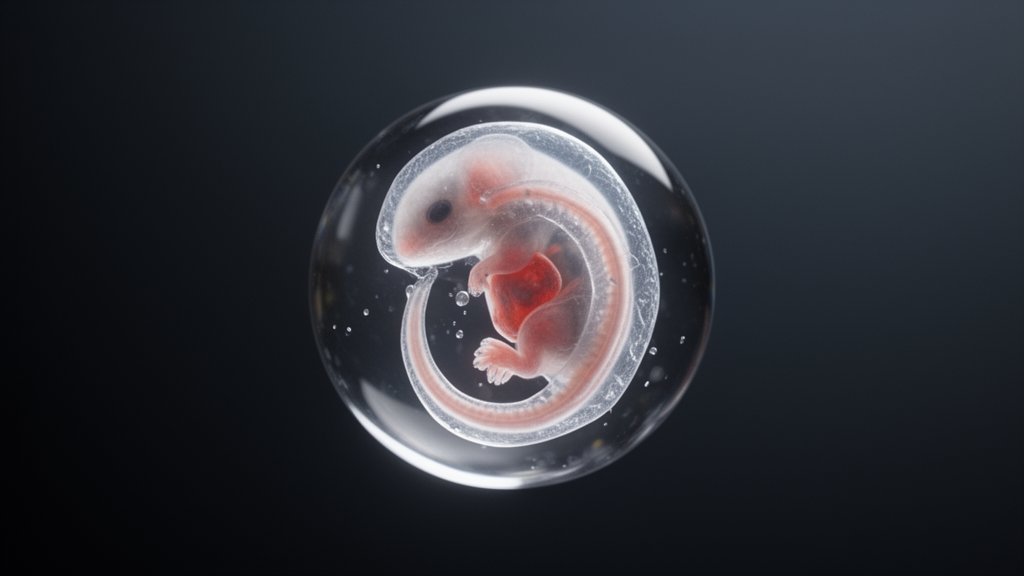
Researchers have developed transgene-free mouse embryo models using chemical reprogramming methods that progress through early organogenesis, equivalent to embryonic days 8.5 to 8.75. As highlighted by Xiu Yu and Jichang Wang in Cell Regeneration, two independent studies published in Cell and Cell Stem Cell overcome historical limitations by generating complete synthetic embryos exclusively from stem cell populations.
In the first investigation, Li and colleagues implemented a purely chemical strategy to reprogram mouse embryonic stem cells into induced embryo founder cells. These reprogrammed cells, termed iEFCs, demonstrated the capacity to self-assemble into complete embryo models known as iEFC-EMs without requiring exogenous genetic modifications.
In parallel work, Yilmaz and colleagues demonstrated the transgene-free generation of post-gastrulation models, named TF-SEMs, derived from naive mouse embryonic stem cells and induced pluripotent stem cells using a comparable chemical cocktail. Both experimental systems faithfully recapitulated pivotal developmental milestones, including gastrulation, neural tube formation, cardiogenesis, and somitogenesis.
The authors conclude that these efficient platforms provide valuable systems for dissecting early mammalian development, investigating congenital defects, and screening for embryotoxicity. Extending the developmental window and functional completeness of these chemically induced models remains a key objective for future applications in regenerative medicine and disease modeling.
In their research highlight published in Cell Regeneration, Xiu Yu and Jichang Wang emphasize that embryo models derived from pluripotent stem cells have become powerful tools for dissecting mammalian embryonic development and advancing regenerative medicine. The two featured investigations in Cell and Cell Stem Cell represent major advances by overcoming limitations that restricted prior systems, enabling complete embryo formation solely from stem cell types rather than requiring exogenous genetic interventions. In the first approach, Li and colleagues devised a purely chemical strategy to reprogram mouse embryonic stem cells into induced embryo founder cells, which possess the developmental capacity to form complete embryo models known as iEFC-EMs. Simultaneously, Yilmaz and colleagues demonstrated the transgene-free generation of post-gastrulation models, designated as TF-SEMs, starting from naive mouse embryonic stem cells as well as induced pluripotent stem cells through the application of a similar chemical cocktail.
Both experimental platforms successfully replicate development up to early organogenesis, corresponding to embryonic days 8.5 to 8.75 in mouse development. The authors note that each model faithfully recapitulates critical developmental events that define this post-gastrulation window. These coordinated milestones include gastrulation, neural tube formation, cardiogenesis, and somitogenesis, confirming that purely chemical reprogramming can orchestrate key structural transitions without genetic manipulation. By reaching this stage of developmental progression, the models provide tangible evidence that stem cell populations can self-organize into complete embryo models under chemical induction alone.
These breakthroughs establish efficient platforms for investigating early mammalian development, modeling congenital defects, and assessing embryotoxicity in laboratory studies. Yu and Wang observe that these advances not only deepen fundamental understanding of developmental biology but also pave the way for future applications in disease modeling and regenerative medicine. Nonetheless, the authors highlight clear boundaries regarding current capabilities. Extending the developmental window beyond early organogenesis and establishing functional completeness remain critical technical requirements before these transgene-free systems can be translated into broader basic and biomedical applications.
Subject of Research: Transgene-free chemical reprogramming of mouse embryo models
Article Title: Transgene-free mouse embryo models from chemical reprogramming reach early organogenesis
Article References: Yu, X., & Wang, J. (2025). Transgene-free mouse embryo models from chemical reprogramming reach early organogenesis. Cell Regeneration, 14(1), Article 37. https://doi.org/10.1186/s13619-025-00259-5
Image Credits: AI Generated
DOI: 10.1186/s13619-025-00259-5
Keywords: mouse embryo models, chemical reprogramming, early organogenesis, pluripotent stem cells, embryonic stem cells, induced pluripotent stem cells, induced embryo founder cells, post-gastrulation models, gastrulation, neural tube formation, cardiogenesis, somitogenesis, embryonic day 8.5, disease modeling, regenerative medicine, embryotoxicity, congenital defects, transgene-free models
News Source: Gregory Coleman. (November 14, 2026). Chemically Reprogrammed Mouse Embryo Models Advance to Early Organogenesis Without Transgenes. Scienmag.