• HOME
  • NEWS
  • EXPLORE
    • CAREER
      • Companies
      • Jobs
    • EVENTS
    • iGEM
      • News
      • Team
    • PHOTOS
    • VIDEO
    • WIKI
  • BLOG
  • COMMUNITY
    • FACEBOOK
    • INSTAGRAM
    • TWITTER
Monday, May 11, 2026
BIOENGINEER.ORG
No Result
View All Result
  • Login
  • HOME
  • NEWS
  • EXPLORE
    • CAREER
      • Companies
      • Jobs
        • Lecturer
        • PhD Studentship
        • Postdoc
        • Research Assistant
    • EVENTS
    • iGEM
      • News
      • Team
    • PHOTOS
    • VIDEO
    • WIKI
  • BLOG
  • COMMUNITY
    • FACEBOOK
    • INSTAGRAM
    • TWITTER
  • HOME
  • NEWS
  • EXPLORE
    • CAREER
      • Companies
      • Jobs
        • Lecturer
        • PhD Studentship
        • Postdoc
        • Research Assistant
    • EVENTS
    • iGEM
      • News
      • Team
    • PHOTOS
    • VIDEO
    • WIKI
  • BLOG
  • COMMUNITY
    • FACEBOOK
    • INSTAGRAM
    • TWITTER
No Result
View All Result
Bioengineer.org
No Result
View All Result
Home NEWS Science News Biology

Chemical innovation stabilizes best-performing perovskite formulation

Bioengineer by Bioengineer
October 1, 2020
in Biology
Reading Time: 2 mins read
0
IMAGE
Share on FacebookShare on TwitterShare on LinkedinShare on RedditShare on Telegram

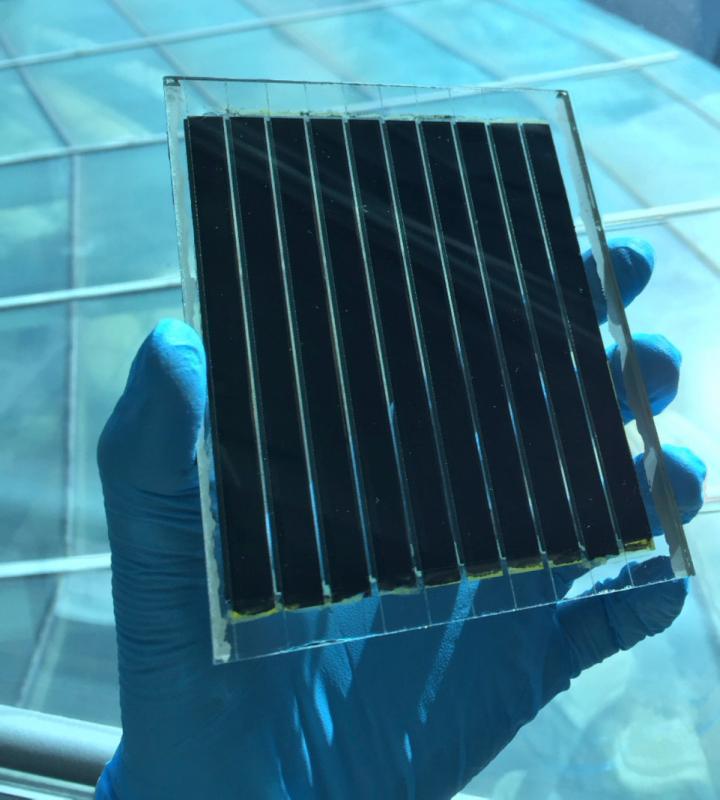
IMAGE

Credit: Nripan Mathews NTU, Singapore

Perovskites are a class of materials made up of organic materials bound to a metal. Their fascinating structure and properties have propelled perovskites into the forefront of materials’ research, where they are studied for use in a wide range of applications. Metal-halide perovskites are especially popular, and are being considered for use in solar cells, LED lights, lasers, and photodetectors.

For example, the power-conversion efficiency of perovskite solar cells (PSCs) have increased from 3.8% to 25.5% in only ten years, surpassing other thin-film solar cells – including the market-leading, polycrystalline silicon.

Perovskites are usually made by mixing and layering various materials together on a transparent conducting substrate., which produces thin, lightweight films. The process, known as “chemical deposition”, is sustainable and relatively cost-effective.

But there is a problem. Since 2014, metal halide perovskites have been made by mixing cations or halides with formamidinium (FAPbI3). The reason is that this recipe results in high power-conversion efficiency in perovskite solar cells. But at the same time, the most stable phase of FAPbI3 is photoinactive, meaning that it does not react to light – the opposite of what a solar power harvester ought to do. In addition, solar cells made with FAPbI3 show long-term stability issues.

Now, researchers led by Michael Grätzel and Anders Hafgeldt at EPFL, have developed a deposition method that overcomes the formamidinium issues while maintaining the high conversion of perovskite solar cells. The work has been published in Science.

In the new method, the materials are first treated with a vapor of methylammonium thiocyanate (MASCN) or formamidinium thiocyanate FASCN. This innovative tweak turns the photoinactive FAPbI3 perovskite films to the desired photosensitive ones.

The scientists used the new FAPbI3 films to make perovskite solar cells. The cells showed more than 23% power-conversion efficiency and long-term operational and thermal stability. They also featured low (330 mV) open-circuit voltage loss and a low (0.75 V) turn-on voltage of electroluminescence.

###

Professor Michael Grätzel’s lab and Professor Anders Hgfeldt’s lab are part of EPFL’s Institute of Chemical Science and Engineering (ISIC), situated in the School of Basics Sciences.

Other contributors

EPFL Laboratory of Computational Chemistry and Biochemistry,

EPFL Laboratory of Magnetic Resonance

Shanghai Synchrotron Radiation Facility (SSRF)

Swiss Federal Laboratories for Materials Science and Technology

Fudan University

Reference

Haizhou Lu, Yuhang Liu, Paramvir Ahlawat, Aditya Mishra, Wolfgang R. Tress, Felix T. Eickemeyer, Yingguo Yang, Fan Fu, Zaiwei Wang, Claudia E. Avalos, Brian I. Carlsen, Anand Agarwalla, Xin Zhang, Xiaoguo Li, Yiqiang Zhan, Shaik M. Zakeeruddin, Lyndon Emsley, Ursula Roethlisberger, Lirong Zheng, Anders Hagfeldt, Michael Graetzel. Vapor-assisted deposition of highly efficient, stable black-phase FAPbI3 perovskite solar cells. Science 369, eabb8985, 2 October 2020.

Media Contact
Nik Papageorgiou
[email protected]

Tags: Biomedical/Environmental/Chemical EngineeringChemistry/Physics/Materials SciencesEnergy SourcesEnergy/Fuel (non-petroleum)Materials
Share12Tweet8Share2ShareShareShare2

Related Posts

From Complexity to Clarity: Unraveling the “Topological Laws” Governing Cell Death — Biology

From Complexity to Clarity: Unraveling the “Topological Laws” Governing Cell Death

May 11, 2026
New Classification Framework Identifies Tumor-Associated Bacterial Effectors as Crucial Drivers of Tumor Biology and Immune Response — Biology

New Classification Framework Identifies Tumor-Associated Bacterial Effectors as Crucial Drivers of Tumor Biology and Immune Response

May 11, 2026

HIV-1 Strains Reveal Varied Paths to Antibody Escape

May 11, 2026

CRISPRi Screening Identifies Fungal-Specific Drug Targets

May 11, 2026
Please login to join discussion

POPULAR NEWS

  • Research Indicates Potential Connection Between Prenatal Medication Exposure and Elevated Autism Risk

    841 shares
    Share 336 Tweet 210
  • New Study Reveals Plants Can Detect the Sound of Rain

    728 shares
    Share 290 Tweet 182
  • Salmonella Haem Blocks Macrophages, Boosts Infection

    62 shares
    Share 25 Tweet 16
  • Breastmilk Balances E. coli and Beneficial Bacteria in Infant Gut Microbiomes

    57 shares
    Share 23 Tweet 14

About

We bring you the latest biotechnology news from best research centers and universities around the world. Check our website.

Follow us

Recent News

Innovative Dense Eutectic Zr-Ta-O/YSZ Core-Shell Double-Layer Coating Boosts CMAS Resistance Through Dynamic Sealing and Self-Removal

BESSY II Reveals How Intrinsic Oxygen Reduces the Lifespan of Solid-State Batteries

Unveiling Dark Matter Through Molecular Insights

Subscribe to Blog via Email

Enter your email address to subscribe to this blog and receive notifications of new posts by email.

Join 82 other subscribers
  • Contact Us

Bioengineer.org © Copyright 2023 All Rights Reserved.

Welcome Back!

Login to your account below

Forgotten Password?

Retrieve your password

Please enter your username or email address to reset your password.

Log In
No Result
View All Result
  • Homepages
    • Home Page 1
    • Home Page 2
  • News
  • National
  • Business
  • Health
  • Lifestyle
  • Science

Bioengineer.org © Copyright 2023 All Rights Reserved.