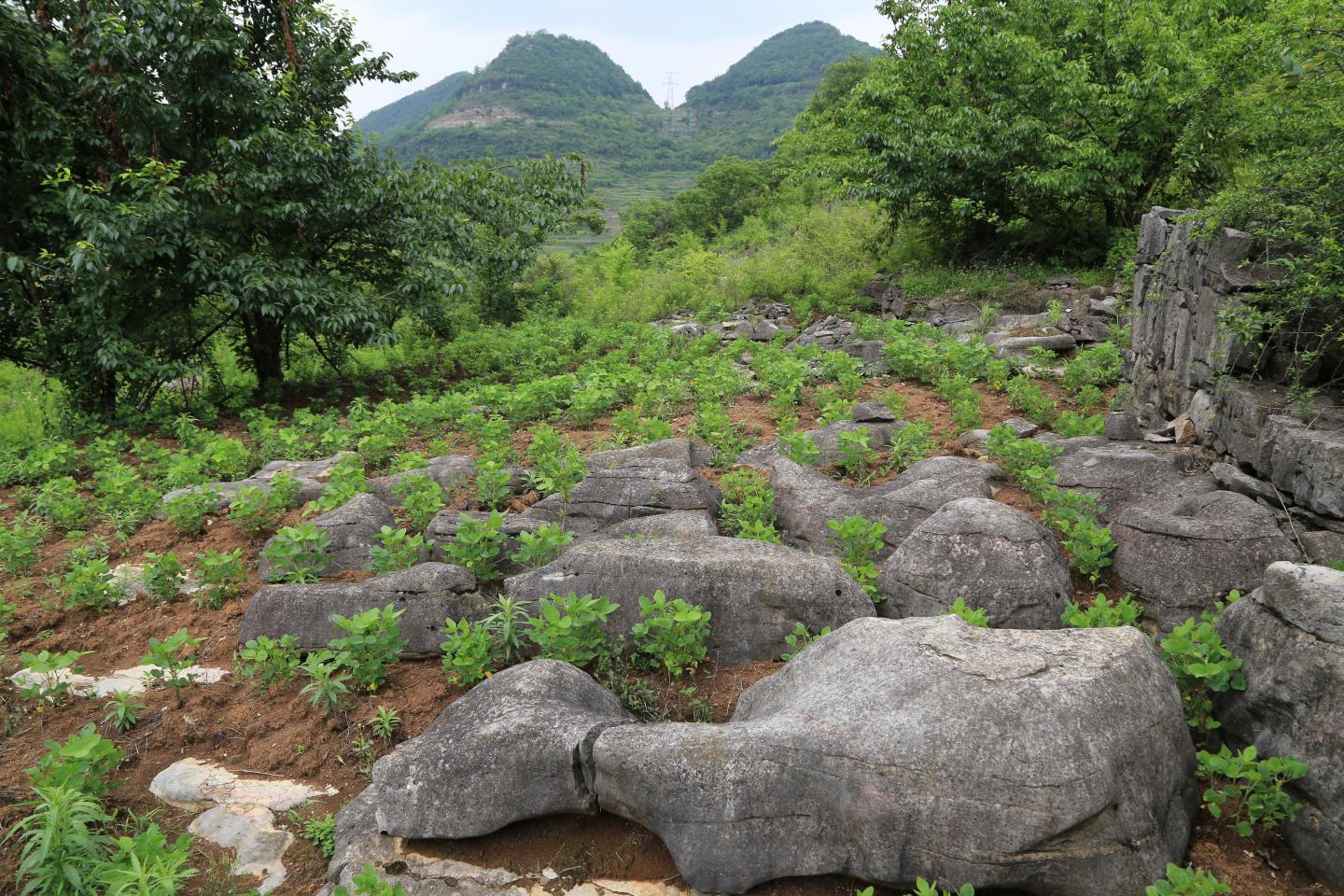
Credit: University of Exeter
Scientists have revealed the critical role that the chemical composition of bedrock plays in limiting vegetation growth in some of the world’s most barren and rocky terrains.
A team of international scientists, including Professor Tim Quine from the University of Exeter, has conducted pioneering new research into vegetation productivity in a karst region of Southwest China.
Covering around 15 per cent of the Earth’s land surface, karst terrains are usually characterised as being barren, rocky ground – usually with caves and sinkholes – and an absence of surface lakes and streams.
Crucially, the areas have well-jointed, dense limestone found near the surface, and a moderate to heavy rainfall – with the water being able to percolate away through the rock, dissolving and removing the limestone as it goes.
While this topography is known to hinder vegetation productivity, the role that geochemistry of the bedrock – that is its chemical composition – plays in reducing plant growth has not been extensively studied.
In the new study, the research team used a ‘critical zone approach’ – studying an area that extends from the base of the weathered bedrock to the top of the vegetation canopy – across a typical karst region of southwest china.
They found significant variations in the chemical composition of the bedrock across the region, which influenced both the amount and the distribution of soil. They discovered that this, in turn, also played a pivotal role in controlling plant growth.
The researchers showed not only that plant productivity is controlled not by both the soil and the bedrock’s ability to retain water, but also this in turn is controlled by bedrock’s geochemistry.
The research team believe this is especially important when water is in short supply – the hottest driest months of the year – and during droughts.
They also believe that the findings offer a pivotal tool in helping authorities to optimise land use, as well as assessing ecosystem resilience and sensitivity to climate change climate.
The study is published in Nature Communications on Wednesday, May 13th 2020.
Professor Quine said: “Our international team and interdisciplinary critical zone approach have given us invaluable insight into bedrock controls on vegetation growth in the iconic landscapes of China’s Karst zone. We have been able to show that bedrock chemistry provides us with a valuable quantitative measure of the capacity of ecosystems to retain the water that is essential to sustain plant growth through dry seasons and droughts.”
Professor Hongyan Liu of Peking University, and principle investigator, said: “Our research also shows the global significance of the bedrock influence on vegetation productivity. We selected 12 of the main karst regions in the world, 10 of which show significant differences in vegetation productivity due to bedrock geochemistry”.
Professor Meersmans of the University of Liege said: “This study highlights the importance of interdisciplinary research across the boundaries of soil-, plant- and geosciences in order to unravel the impact and interplay of various key factors determining primary production in karst regions. Moreover, the present study offers a basis for future research assessing the resilience of these fragile ecosystems when facing climate change and other environmental threats.”
The research was carried out as part of the UK-China (NERC-NSFC) SPECTRA project, called Soil Processes and Ecological Services in the Karst Critical Zone of Southwest China, which aims to enhance the sustainable development of one of the poorest regions of China, Guizhou.
The Guizhou karst region, with a population of 35 million, is one of the poorest regions in China with a GDP less than 50% of the national average. In response to the environmental deterioration and changing social conditions in the Guizhou karst region, the Chinese government has intervened to promote the abandonment of the most degraded cultivated land and its succession to grassland, shrub and forest.
The SPECTRA project is designed to identify the biological controls on nutrient availability, soil formation and loss, and their response to perturbation, providing the rich evidence base needed to inform land management decision-making in the Guizhou province.
###
Bedrock geochemistry influences vegetation growth by regulating the regolith water holding capacity” is published in Nature Communications.
Media Contact
Duncan Sandes
[email protected]
Related Journal Article
http://dx.