• HOME
  • NEWS
  • EXPLORE
    • CAREER
      • Companies
      • Jobs
    • EVENTS
    • iGEM
      • News
      • Team
    • PHOTOS
    • VIDEO
    • WIKI
  • BLOG
  • COMMUNITY
    • FACEBOOK
    • INSTAGRAM
    • TWITTER
Sunday, May 10, 2026
BIOENGINEER.ORG
No Result
View All Result
  • Login
  • HOME
  • NEWS
  • EXPLORE
    • CAREER
      • Companies
      • Jobs
        • Lecturer
        • PhD Studentship
        • Postdoc
        • Research Assistant
    • EVENTS
    • iGEM
      • News
      • Team
    • PHOTOS
    • VIDEO
    • WIKI
  • BLOG
  • COMMUNITY
    • FACEBOOK
    • INSTAGRAM
    • TWITTER
  • HOME
  • NEWS
  • EXPLORE
    • CAREER
      • Companies
      • Jobs
        • Lecturer
        • PhD Studentship
        • Postdoc
        • Research Assistant
    • EVENTS
    • iGEM
      • News
      • Team
    • PHOTOS
    • VIDEO
    • WIKI
  • BLOG
  • COMMUNITY
    • FACEBOOK
    • INSTAGRAM
    • TWITTER
No Result
View All Result
Bioengineer.org
No Result
View All Result
Home NEWS Science News Chemistry

Charting the expansion history of the universe with supernovae

Bioengineer by Bioengineer
May 14, 2021
in Chemistry
Reading Time: 2 mins read
0
IMAGE
Share on FacebookShare on TwitterShare on LinkedinShare on RedditShare on Telegram

IMAGE

Credit: NAOJ

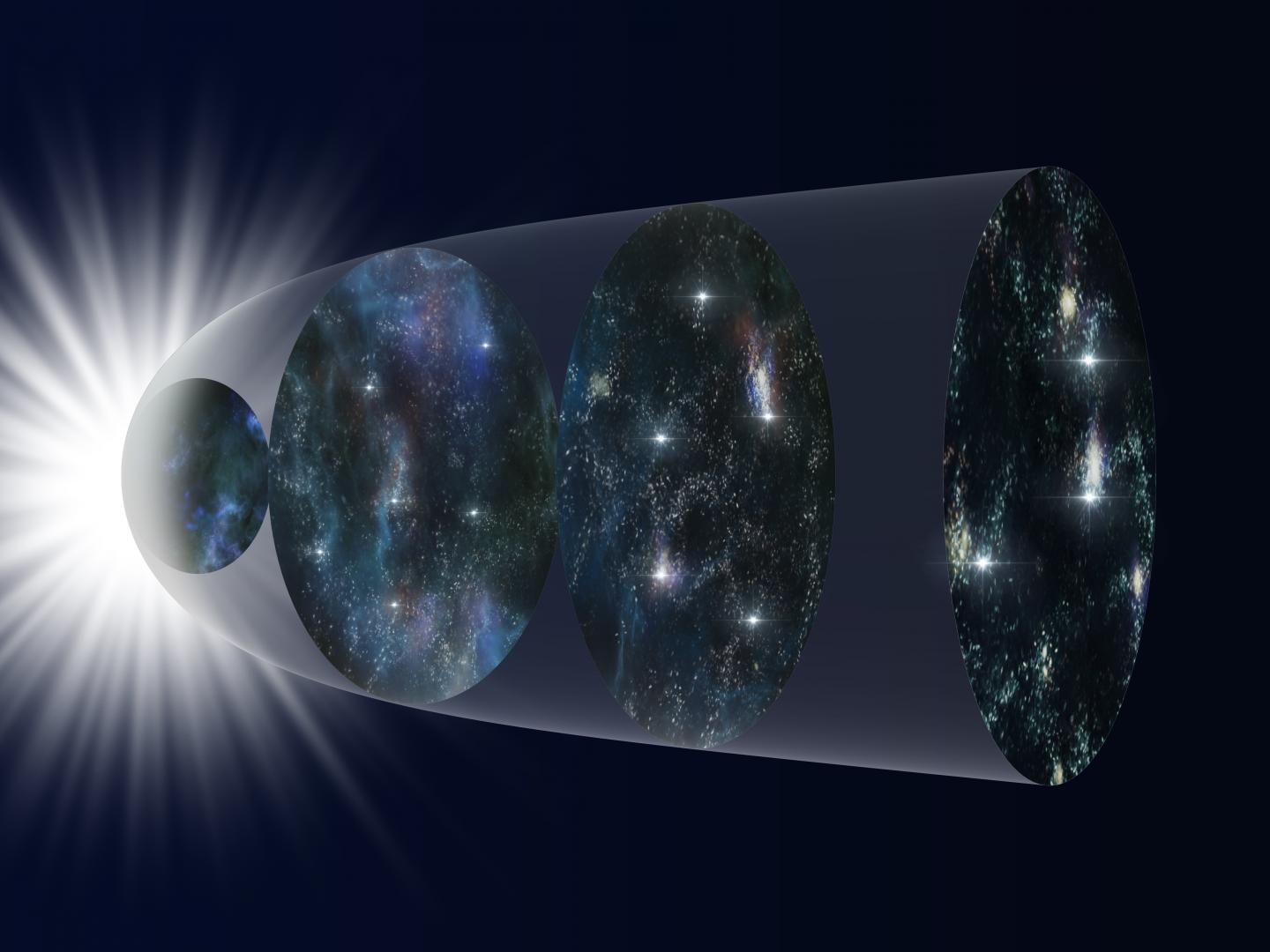
An international research team analyzed a database of more than 1000 supernova explosions and found that models for the expansion of the Universe best match the data when a new time dependent variation is introduced. If proven correct with future, higher-quality data from the Subaru Telescope and other observatories, these results could indicate still unknown physics working on the cosmic scale.

Edwin Hubble’s observations over 90 years ago showing the expansion of the Universe remain a cornerstone of modern astrophysics. But when you get into the details of calculating how fast the Universe was expanding at different times in its history, scientists have difficulty getting theoretical models to match observations.

To solve this problem, a team led by Maria Dainotti (Assistant Professor at the National Astronomical Observatory of Japan and the Graduate University for Advanced Studies, SOKENDAI in Japan and an affiliated scientist at the Space Science Institute in the U.S.A.) analyzed a catalog of 1048 supernovae which exploded at different times in the history of the Universe. The team found that the theoretical models can be made to match the observations if one of the constants used in the equations, appropriately called the Hubble constant, is allowed to vary with time.

There are several possible explanations for this apparent change in the Hubble constant. A likely but boring possibility is that observational biases exist in the data sample. To help correct for potential biases, astronomers are using Hyper Suprime-Cam on the Subaru Telescope to observe fainter supernovae over a wide area. Data from this instrument will increase the sample of observed supernovae in the early Universe and reduce the uncertainty in the data.

But if the current results hold-up under further investigation, if the Hubble constant is in fact changing, that opens the question of what is driving the change. Answering that question could require a new, or at least modified, version of astrophysics.

These results will appear as M.G. Dainotti et al. “On the Hubble Constant Tension in the SNe Ia Pantheon Sample” in the Astrophysical Journal on May 17, 2021.

###

Media Contact
Dr. Hitoshi Yamaoka
[email protected]

Original Source

https://www.nao.ac.jp/en/news/science/2021/20210514-dos.html

Related Journal Article

http://dx.doi.org/10.3847/1538-4357/abeb73

Tags: AstronomyAstrophysicsSpace/Planetary Science
Share12Tweet8Share2ShareShareShare2

Related Posts

Miniature Sensor Uses Light to Detect Touch — Chemistry

Miniature Sensor Uses Light to Detect Touch

May 8, 2026
Iron Minerals Determine Whether Dissolved Organic Matter Fuels Microbes or Becomes Long-Term Carbon Storage — Chemistry

Iron Minerals Determine Whether Dissolved Organic Matter Fuels Microbes or Becomes Long-Term Carbon Storage

May 8, 2026

Kate Evans Appointed Associate Lab Director for Biological and Environmental Systems Science at ORNL

May 8, 2026

Advancing Multiscale Modeling and Overcoming Operational Challenges in Autothermal COâ‚‚-to-Methanol Reactors

May 8, 2026
Please login to join discussion

POPULAR NEWS

  • Research Indicates Potential Connection Between Prenatal Medication Exposure and Elevated Autism Risk

    840 shares
    Share 336 Tweet 210
  • New Study Reveals Plants Can Detect the Sound of Rain

    727 shares
    Share 290 Tweet 181
  • Scientists Investigate Possible Connection Between COVID-19 and Increased Lung Cancer Risk

    68 shares
    Share 27 Tweet 17
  • Salmonella Haem Blocks Macrophages, Boosts Infection

    61 shares
    Share 24 Tweet 15

About

We bring you the latest biotechnology news from best research centers and universities around the world. Check our website.

Follow us

Recent News

Evaluating Digoxin Use in Patients with Symptomatic Rheumatic Heart Disease

Evaluating the Effectiveness and Safety of Digitalis Glycosides in Treating Heart Failure

Urdu Fall Risk Questionnaire Adapted for Elderly

Subscribe to Blog via Email

Enter your email address to subscribe to this blog and receive notifications of new posts by email.

Join 82 other subscribers
  • Contact Us

Bioengineer.org © Copyright 2023 All Rights Reserved.

Welcome Back!

Login to your account below

Forgotten Password?

Retrieve your password

Please enter your username or email address to reset your password.

Log In
No Result
View All Result
  • Homepages
    • Home Page 1
    • Home Page 2
  • News
  • National
  • Business
  • Health
  • Lifestyle
  • Science

Bioengineer.org © Copyright 2023 All Rights Reserved.