• HOME
  • NEWS
  • EXPLORE
    • CAREER
      • Companies
      • Jobs
    • EVENTS
    • iGEM
      • News
      • Team
    • PHOTOS
    • VIDEO
    • WIKI
  • BLOG
  • COMMUNITY
    • FACEBOOK
    • INSTAGRAM
    • TWITTER
Saturday, July 11, 2026
BIOENGINEER.ORG
No Result
View All Result
  • Login
  • HOME
  • NEWS
  • EXPLORE
    • CAREER
      • Companies
      • Jobs
        • Lecturer
        • PhD Studentship
        • Postdoc
        • Research Assistant
    • EVENTS
    • iGEM
      • News
      • Team
    • PHOTOS
    • VIDEO
    • WIKI
  • BLOG
  • COMMUNITY
    • FACEBOOK
    • INSTAGRAM
    • TWITTER
  • HOME
  • NEWS
  • EXPLORE
    • CAREER
      • Companies
      • Jobs
        • Lecturer
        • PhD Studentship
        • Postdoc
        • Research Assistant
    • EVENTS
    • iGEM
      • News
      • Team
    • PHOTOS
    • VIDEO
    • WIKI
  • BLOG
  • COMMUNITY
    • FACEBOOK
    • INSTAGRAM
    • TWITTER
No Result
View All Result
Bioengineer.org
No Result
View All Result
Home NEWS Science News Chemistry

Characterization of ‘hidden’ dioxins from informal e-waste processing

Bioengineer by Bioengineer
April 13, 2019
in Chemistry
Reading Time: 2 mins read
0
IMAGE
Share on FacebookShare on TwitterShare on LinkedinShare on RedditShare on Telegram

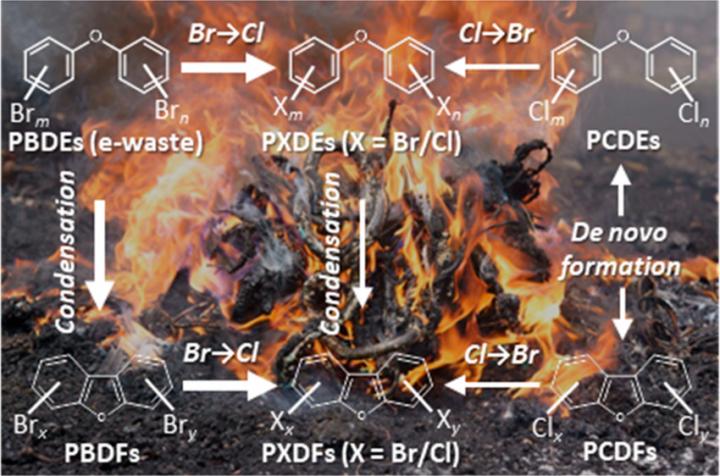
Investigation of the complex mixture of chlorinated, brominated and mixed halogenated dibenzofurans and diphenyl ethers released from open e-waste burning in Ghana
IMAGE

Credit: Reprinted with permission from Environmental Science & Technology. Copyright 2019 American Chemical Society.

A research team in Ehime University characterized the complex composition of chlorinated, brominated and mixed halogenated dioxins as well as their major precursors in soils from e-waste burning and dismantling areas in Agbogbloshie (Accra, Ghana), a major hub of informal e-waste processing in Africa. The findings were published on February 22, 2019 in Environmental Science & Technology.

E-waste, or Waste Electrical and Electronic Equipment (WEEE), refers to end-of-life products such as communication devices, consumer electronics and home appliances. E-waste contains substantial amounts of valuable metals to recycle, but is also considered as hazardous waste due to the presence of toxic substances such as heavy metals and many various plastic additives. A large volume of these hazardous waste materials has been recycled inappropriately, and treated informally in Asian and African developing countries using primitive methods such as circuit board heating and open burning of wires. These informal recycling activities have led to serious environmental pollution caused by the emission of not only contaminants contained in e-waste but also unintentionally formed secondary toxic chemicals.

Dioxin-like compounds, or simply dioxins, are a group of unintentional contaminants generated during informal processing of e-waste with a wide range of potential toxic effects. However, assessment of the environmental and health impacts of dioxins from e-waste is challenging due to their complex composition. Chlorinated dioxins including polychlorinated dibenzo-p-dioxins and dibenzofurans are combustion by-products of polyvinyl chloride (PVC) used in wire coating. Lesser-known brominated dioxins are thermal degradation products of brominated flame retardants (BFRs), which are plastic additives designed to prevent accidental fires. Mixed brominated/chlorinated dioxins are also generated during e-waste burning, but have not been well characterized because of the difficulties in analyzing their large number.

The research team in Ehime University used special analytical methods based on two-dimensional gas chromatography (GC×GC) and time-of-flight mass spectrometry (ToFMS) to conduct a comprehensive profiling of halogenated contaminants in the soils collected near e-waste burning and dismantling areas. Polybrominated and mixed halogenated dibenzofurans (PBDFs and PXDFs) were the major dioxins detected. Their composition profiles suggest that PBDFs were generated from polybrominated diphenyl ethers (PBDEs), a group of flame retardants commonly found in e-waste plastics; and PXDFs mainly from PBDFs through successive bromine-to-clorine exchange. High concentrations of PXDFs in e-waste burning areas indicate that these “hidden” dioxins may contribute substantially to the total toxicity of the e-waste-derived dioxin mixture, and need to be included in future environmental and human exposure risk assessment.

###

Media Contact
Public Relations Division
[email protected]

Related Journal Article

http://dx.doi.org/10.1021/acs.est.8b06929

Tags: Chemistry/Physics/Materials Sciences
Share14Tweet8Share2ShareShareShare2

Related Posts

Blue Light and Chemistry Simplify Complex Drug Production Steps

Blue Light and Chemistry Simplify Complex Drug Production Steps

July 10, 2026
New Discovery Promises Brighter, More Energy-Efficient Digital Displays

New Discovery Promises Brighter, More Energy-Efficient Digital Displays

July 10, 2026

New Crystalline 3D Frameworks Linked by Spiroborates Developed

July 10, 2026

IBEC Joins Major European Grant on Living Matter Physics

July 10, 2026
Please login to join discussion

POPULAR NEWS

  • Detection of EDCs in Breast Milk and Infant Urine Up to Six Months Highlights Early Exposure Risks

    77 shares
    Share 31 Tweet 19
  • New Drug Candidate Developed at McMaster Shows Potential for Treating Brain Cancer

    58 shares
    Share 23 Tweet 15
  • KTU Researchers Explore Ultrasound’s Role in Enhancing Blood Flow Beyond Diagnostics

    53 shares
    Share 21 Tweet 13
  • 高齢者の骨粗鬆症治療の持続性比較

    51 shares
    Share 20 Tweet 13

About

We bring you the latest biotechnology news from best research centers and universities around the world. Check our website.

Follow us

Recent News

Akkermansia massiliensis and FcRL3 Gene Linked to Multiple Sclerosis Protection

Calcineurin/NFAT Pathway Links Calcium Stress to Neurodegeneration Timing

Pycnogenol Reduces Neurobehavioral and Liver Damage from Thioacetamide Exposure

Subscribe to Blog via Email

Enter your email address to subscribe to this blog and receive notifications of new posts by email.

Join 85 other subscribers
  • Contact Us

Bioengineer.org © Copyright 2023 All Rights Reserved.

Welcome Back!

Login to your account below

Forgotten Password?

Retrieve your password

Please enter your username or email address to reset your password.

Log In
No Result
View All Result
  • Homepages
    • Home Page 1
    • Home Page 2
  • News
  • National
  • Business
  • Health
  • Lifestyle
  • Science

Bioengineer.org © Copyright 2023 All Rights Reserved.