Women who went on to clear a high-risk human papillomavirus infection showed measurably higher levels of two lipid signaling molecules in their cervicovaginal fluid than HPV-negative women, according to an exploratory pilot study published in Frontiers in Cellular and Infection Microbiology. The findings, drawn from archived samples in a long-running prospective cohort, suggest that the balance of locally produced fat-derived inflammatory mediators may differ according to whether the virus is ultimately eliminated or persists.
High-risk HPV infection is the primary cause of cervical cancer, yet the great majority of infections are spontaneously cleared by the host immune system before any clinically significant disease develops. Viral persistence is the critical determinant of carcinogenesis, but the local mechanisms that tip the balance between clearance and persistence remain incompletely understood. Previous work has linked HPV outcomes to cell-mediated immunity, cervical cytokine production and the composition of the cervicovaginal microbiome, and metabolic profiling studies have reinforced the idea that microbial communities, inflammation and local immune responses interact to shape disease risk. What has been largely missing from this picture is the contribution of lipid mediators, potent signaling molecules derived from fatty acids that regulate inflammation, host defense and tissue repair.
Lipid mediators are generated through interconnected enzymatic pathways. Cyclooxygenase-derived prostanoids such as prostaglandin E2 (PGE2) and thromboxane B2 (TxB2) can promote inflammatory signaling, while lipoxygenase products of arachidonic acid, including leukotriene B4 (LTB4), 12-hydroxyeicosatetraenoic acid (12-HETE) and 15-hydroxyeicosatetraenoic acid (15-HETE), influence leukocyte activation and migration. Mediators derived from the omega-3 fatty acid docosahexaenoic acid, such as 14-hydroxydocosahexaenoic acid (14-HDHA), are associated with pathways that actively resolve inflammation, restoring tissue homeostasis while preserving host defense. Because disturbances in these circuits have been implicated in chronic inflammation and ineffective pathogen clearance, the research team hypothesized that distinct cervicovaginal lipid signatures might be associated with subsequent HPV outcomes.
To test this, the investigators used targeted liquid chromatography–tandem mass spectrometry to profile lipid mediators in cervicovaginal wash samples from 30 women enrolled in a prospective longitudinal natural-history study of HPV that ran from 1990 to 2014. The participants, healthy women aged 13 to 21 with normal cytology at enrollment, attended clinic visits every four to six months for HPV testing, cytology and colposcopy. The analysis included three groups: 14 HPV-negative women with no HPV detected within two years before or after the sampled visit; 6 women who were HPV-positive at the sampled visit but negative for the relevant type at the next visit, designated the subsequent-clearance group; and 10 women in whom the same HPV type remained detectable at the next visit, the subsequent-persistence group. Crucially, all specimens from the outcome groups were collected during active infection, before the subsequent result was known.
In the laboratory, one-milliliter aliquots of wash fluid were spiked with deuterium-labeled internal standards, precipitated with ice-cold methanol, and extracted by C18 solid-phase extraction before separation on an ultra-high-performance liquid chromatography system coupled to a triple-quadrupole mass spectrometer. Six mediators met the detection and quantification criteria: TxB2, PGE2, LTB4, total 12-HETE, total 15-HETE and total 14-HDHA. Hydroxylated fatty acids were quantified without stereochemical discrimination, so their values represent the combined abundance of R and S stereoisomers. Statistical comparisons used the Kruskal–Wallis test with Dunn’s pairwise comparisons on measured concentrations, with a secondary analysis expressing each mediator as a percentage of the six-mediator pool detected in the same sample.
The central result was that women who subsequently cleared their HPV infection had significantly higher measured concentrations of total 12-HETE and total 14-HDHA than HPV-negative women. Concentrations in the subsequent-persistence group largely overlapped those of the HPV-negative group. Because the clearance-group specimens were collected while the women were still HPV-positive, the authors interpret this as a selective enrichment of these two mediators during infection in women who go on to eliminate the virus. Exploratory checks found no association between any lipid mediator and smoking after correction for multiple comparisons, and a nominal link between hormonal contraceptive use and higher TxB2 concentrations did not survive FDR correction.
The secondary percentage-based analysis added a different perspective on the composition of the detected mediator pool. The relative contribution of PGE2 was lower in the subsequent-clearance group than in both the HPV-negative and subsequent-persistence groups, while the relative share of total 14-HDHA was higher in the subsequent-persistence group than in HPV-negative women. Notably, the absolute-concentration differences for 12-HETE and 14-HDHA were markedly attenuated after normalization to the total detected pool, suggesting that the observed patterns may reflect a broader reorganization of lipid mediator production according to HPV status rather than isolated changes in individual molecules.
Because lipid mediators arise from interconnected enzymatic pathways, the team also examined pairwise correlations within each group. In HPV-negative women, LTB4 correlated positively with total 12-HETE (ρ = 0.893) and 12-HETE correlated with 14-HDHA (ρ = 0.744); among women with subsequent clearance, 12-HETE and 14-HDHA were perfectly rank-correlated (ρ = 1.000). The most striking finding emerged from direct between-group comparison of correlation coefficients using permutation testing: TxB2 and total 14-HDHA were positively associated in the subsequent-clearance group (ρ = 0.829) but inversely associated in the subsequent-persistence group (ρ = −0.689), a difference of Δρ = 1.518 that reached significance by exact two-sided permutation testing (p = 0.0011). No correlation differences between HPV-negative women and either HPV-positive group survived FDR correction.
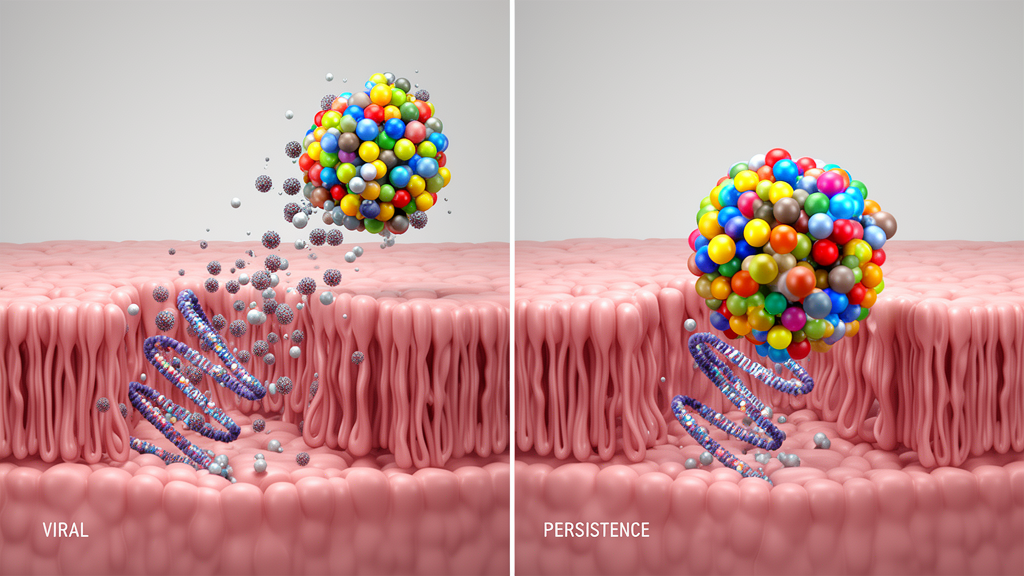
The authors propose that the concurrent elevation of 12-HETE, linked to leukocyte activation and inflammatory regulation, and 14-HDHA, a marker of pro-resolving DHA pathways, in women who subsequently cleared infection may reflect a balanced mucosal response: enough inflammatory activation to drive antiviral defense, paired with resolution mechanisms that prevent chronic inflammation and favor viral elimination. Women with subsequent persistence lacked comparable concentration changes, and instead showed altered proportions within the detected mediator pool, which the authors suggest could indicate an inadequate or dysregulated local lipid mediator response. The cervicovaginal environment, where epithelial cells, immune cells, soluble mediators and resident microbiota interact, provides a plausible setting for such bidirectional effects, since microbiota composition has previously been associated with distinct cytokine profiles and differential HPV outcomes.
Substantial caveats temper these conclusions. The study is exploratory, with a small sample size and a particularly small clearance group, a single sample per participant, a restricted panel of detected mediators, and quantification of hydroxylated fatty acids without stereochemical resolution. The absence of paired samples immediately before and after the outcome, and the lack of virological, immunological, microbiological and clinical covariates, preclude mechanistic interpretation. The authors emphasize that the findings identify candidate lipid mediator correlates that require validation in larger longitudinal studies with paired sampling and integrated measures of viral burden, mucosal immunity and microbiota composition, rather than supporting any clinical application at this stage.
Subject of Research: Cervicovaginal lipid mediator profiles associated with subsequent high-risk HPV clearance or persistence
Article Title: Cervicovaginal lipid mediator profiles during high-risk HPV infection associated with subsequent viral clearance or persistence: an exploratory pilot study
Article References: Mucci, M., Recchiuti, A., Moscicki, A.-B., & Mattoscio, D. (2026). Cervicovaginal lipid mediator profiles during high-risk HPV infection associated with subsequent viral clearance or persistence: an exploratory pilot study. Frontiers in Cellular and Infection Microbiology, 16, Article 1954769. https://doi.org/10.3389/fcimb.2026.1954769
Image Credits: AI Generated
DOI: 10.3389/fcimb.2026.1954769
Keywords: HPV, lipid mediators, 12-HETE, 14-HDHA, cervicovaginal microenvironment, LC-MS/MS, viral clearance, viral persistence, mucosal immunity, oxylipins, cervical cancer, pilot study
News Source: Kristina Jarvis. (October 24, 2026). Cervicovaginal Lipid Signatures Linked to HPV Clearance or Persistence in Pilot Study. Scienmag.