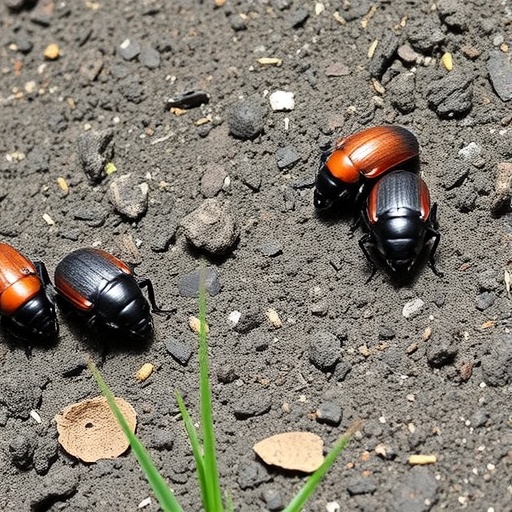
Recent studies have shed light on the intricate relationships between animals and their environment, particularly in relation to the decomposition processes that are vital for nutrient cycling in ecosystems. One noteworthy contribution in this realm has been made by Reis, Peñaflor, Beiroz, and their collaborators, who explored the effects of Cerrado ash on the emissions from fecal matter and the subsequent responses of dung beetles, a key player in the ecological landscape of the Cerrado biome. Their research offers compelling insights into how certain environmental factors might alter the dynamics of this critical ecosystem function.
Dung beetles are integral to the decomposition process, aiding in the breakdown of organic matter and facilitating soil health. These beetles exhibit varied responses to different substrates, including feces, which release volatile organic compounds (VOCs) as they decompose. These VOCs serve as a cue for dung beetles, guiding them to their preferred food sources. However, the introduction of Cerrado ash into their habitat raises intriguing questions about the potential alteration of these cues and the implications for dung beetle behavior.
Cerrado, the Brazilian savanna characterized by its distinct flora and fauna, presents a unique setting for studying these interactions. The researchers investigated whether the incorporation of Cerrado ash into fecal matter would influence the VOCs emitted and whether it would subsequently affect the olfactory responses of dung beetles. The results were revealing, indicating a reduced level of volatile emissions from fecal matter mixed with Cerrado ash, but surprisingly, no significant influence on the dung beetles’ olfactory responses was detected.
This finding is particularly striking, as it suggests that while the physical properties of the environment, such as the presence of Cerrado ash, can diminish the emission of certain signals, it does not necessarily lead to a change in the behavioral patterns of the dung beetles. This could imply a level of resilience in dung beetles or a potential adaptation to various environmental shifts, which could have broad implications for their role in ecosystem services. Their capacity to locate food sources may transcend the immediate chemical cues typically relied upon for navigation.
The researchers employed a range of methods to assess both the volatile emissions and the dung beetles’ olfactory responses. By using gas chromatography and olfactometry, they meticulously characterized the chemical changes induced by the ash. The methodological rigor of the study ensures that the findings contribute valuable knowledge to the field of ecological research. It raises essential inquiries about how anthropogenic changes in habitat may influence insect behavior and, consequently, ecosystem functions.
Moreover, by showing that the incorporation of Cerrado ash alters VOCs but does not affect beetle responses, the study underscores a complex interplay between environmental factors and animal behavior. The implications for conservation strategies in the Cerrado ecosystem are profound, particularly in light of ongoing habitat degradation and climate change. Understanding these interactions helps in formulating plans that support the preservation of dung beetle populations and the critical services they provide.
The resilience of dung beetles in the face of changing environmental conditions suggests that they could be important bioindicators for ecosystem health. Monitoring their behavior and ecological role may provide insights into the broader impacts of environmental changes. Such research is essential for developing strategies aimed at mitigating the effects of habitat degradation and ensuring the sustainability of these ecosystems.
Furthermore, the findings may have practical applications in agriculture, where understanding dung beetle behavior can inform practices that utilize these insects for natural pest control and soil fertility enhancement. The results highlight an opportunity for collaboration between ecologists and agricultural scientists to explore integrated management practices that leverage the services provided by dung beetles.
In conclusion, the study by Reis and colleagues marks a significant step forward in our understanding of the interactions between dung beetles and their environment. It illustrates the intricate balance between chemical signals and animal behavior, opening avenues for further research into how environmental changes impact ecological dynamics. As researchers continue to unravel these complex relationships, their findings will contribute to better management and conservation strategies for the unique ecosystems like the Cerrado.
While the research predominantly emphasizes the interactions at play, it also paves the way for broader discussions about biodiversity, conservation, and the impact of human activity on natural processes. As our ecosystems face unprecedented challenges, studies like these highlight the necessity for ongoing research and awareness to safeguard the delicate balances that ensure ecological health and sustainability.
In essence, Reis et al.’s exploration of Cerrado ash and its effects on dung beetles serves as a reminder of the constantly evolving nature of our ecosystems and the critical need to understand the factors influencing the survival and behavior of key species. Such knowledge is indispensable for fostering sustainable practices that can mitigate environmental impacts while enhancing biodiversity and ecosystem resilience.
Subject of Research: The influence of Cerrado ash on volatile emissions from feces and olfactory responses of dung beetles.
Article Title: Cerrado ash reduces volatile emissions from faeces but does not influence the olfactory responses of the dung beetles.
Article References:
Reis, N.L., Peñaflor, M.F.G.V., Beiroz, W. et al. Cerrado ash reduces volatile emissions from faeces but does not influence the olfactory responses of the dung beetles.
Sci Nat 112, 68 (2025). https://doi.org/10.1007/s00114-025-02022-x
Image Credits: AI Generated
DOI: https://doi.org/10.1007/s00114-025-02022-x
Keywords: Dung beetles, Cerrado ash, volatile organic compounds, olfactory responses, ecosystem services, conservation biology, biodiversity, environmental impact.
Tags: animal behavior and environmental factorsBrazilian savanna ecological studiesCerrado biome ecological interactionsdecomposition processes in ecosystemsdung beetle responses to substrate changesdung beetles and nutrient cyclingeffects of Cerrado ash on emissionsenvironmental cues for dung beetlesimpact of ash on fecal matter decompositionresearch on decomposition and emissions in Cerrado.soil health and ecosystem dynamicsvolatile organic compounds and dung beetles