Scientists now have a deeper understanding of how a fungus develops a symbiotic lifestyle inside grass leaf and why the grass leaf fails to defend itself against the intruder, thanks to research coming from Massey University in New Zealand and the University of Münster in Germany.
Fungal endophytes of the Epichloë species are known to form symbiotic associations with aerial tissues of cool season grasses. These endophytes form networks within the leaf sheath and blade as well as the flower stems and play an important role in protecting the grass from biotic and abiotic stresses, including insects and drought.
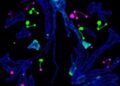
When observing this relationship between these fungal endophytes and perennial ryegrass, scientists noticed that chitin, which primarily makes up cell walls in fungi, was depleted or modified once the endophytes infected the grass. They found instead that these cell walls contained chitosan, a natural plant defense activator derived from chitin. Once the endophytes exit the leaf to grow on the leaf surface, chitin is once again found in the cell walls.
“These observations suggest that conversion of chitin to chitosan is crucial for the symbiotic lifestyle,” explains scientist Barry Scott. “This conversion possibly suppresses a host defense response.”
This is the first study to show the role of cell wall remodeling of chitin to chitosan in a plant-associated symbiotic fungus and helps explain why the plant host fails to elicit any major host defense response.
“A better understanding of these associations will help develop new strategies and technologies to protect natural ecosystems and benefit agriculture,” Scott adds.
This article is important for those who study fungal-plant interactions and provides an entirely new perspective on how fungi can live in symbiotic association with plants. Read more in “Chitin Deacetylases Are Required for Epichloë festucae Endophytic Cell Wall Remodeling During Establishment of a Mutualistic Symbiotic Interaction with Lolium perenne” published in the open access MPMI journal.
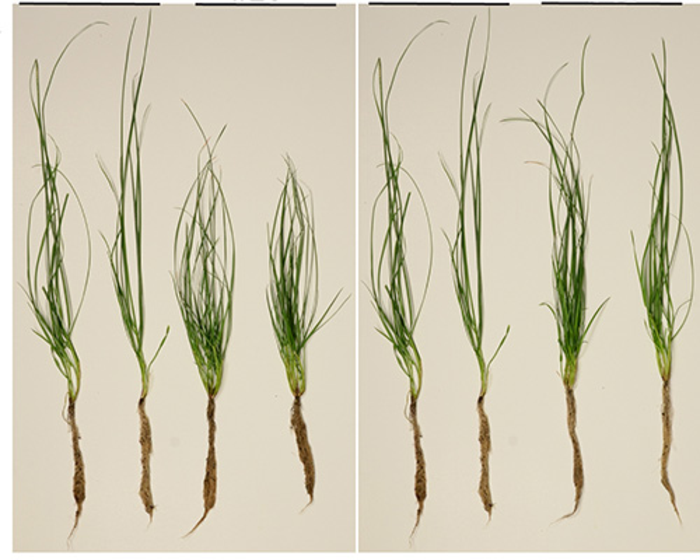
Credit: Nazanin Noorifar, Matthew S. Savoian, Arvina Ram, Yonathan Lukito, Berit Hassing, Tobias W. Weikert, Bruno M. Moerschbacher, and Barry Scott
Scientists now have a deeper understanding of how a fungus develops a symbiotic lifestyle inside grass leaf and why the grass leaf fails to defend itself against the intruder, thanks to research coming from Massey University in New Zealand and the University of Münster in Germany.
Fungal endophytes of the Epichloë species are known to form symbiotic associations with aerial tissues of cool season grasses. These endophytes form networks within the leaf sheath and blade as well as the flower stems and play an important role in protecting the grass from biotic and abiotic stresses, including insects and drought.
When observing this relationship between these fungal endophytes and perennial ryegrass, scientists noticed that chitin, which primarily makes up cell walls in fungi, was depleted or modified once the endophytes infected the grass. They found instead that these cell walls contained chitosan, a natural plant defense activator derived from chitin. Once the endophytes exit the leaf to grow on the leaf surface, chitin is once again found in the cell walls.
“These observations suggest that conversion of chitin to chitosan is crucial for the symbiotic lifestyle,” explains scientist Barry Scott. “This conversion possibly suppresses a host defense response.”
This is the first study to show the role of cell wall remodeling of chitin to chitosan in a plant-associated symbiotic fungus and helps explain why the plant host fails to elicit any major host defense response.
“A better understanding of these associations will help develop new strategies and technologies to protect natural ecosystems and benefit agriculture,” Scott adds.
This article is important for those who study fungal-plant interactions and provides an entirely new perspective on how fungi can live in symbiotic association with plants. Read more in “Chitin Deacetylases Are Required for Epichloë festucae Endophytic Cell Wall Remodeling During Establishment of a Mutualistic Symbiotic Interaction with Lolium perenne” published in the open access MPMI journal.
Journal
Molecular Plant-Microbe Interactions
DOI
10.1094/MPMI-12-20-0347-R
Method of Research
Experimental study
Subject of Research
Not applicable
Article Title
Chitin Deacetylases Are Required for Epichloë festucae Endophytic Cell Wall Remodeling During Establishment of a Mutualistic Symbiotic Interaction with Lolium perenne
Article Publication Date
28-Oct-2021