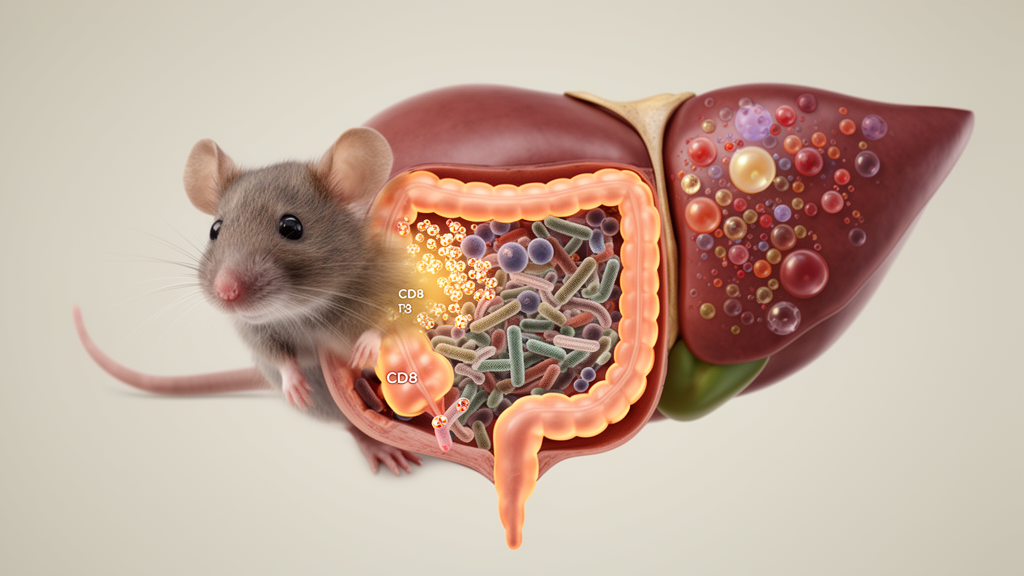
CD8-positive T-cell deficiency altered the gut bacterial community and broad metabolic profile of the liver in female mice, while repeated transfer of the missing cells into deficient animals reversed selected microbial changes but did not fully restore the liver metabolite profile. The study combined fecal microbiome sequencing with untargeted liver metabolomics in a systemic Cd8a-knockout model. It therefore provides evidence of linked changes in a mouse immune–microbiome–metabolism system, not proof that CD8-positive T cells directly cause each metabolic effect or that the findings apply to people.
The investigators used female C57BL/6J mice, with six animals in each of three groups: normal controls, CD8-positive T-cell-deficient mice and deficient mice reconstituted with CD8-positive T cells. Flow cytometry showed that CD8-positive T cells constituted 41.9% of T cells in controls and 0.99% in knockout animals. For the reconstitution group, the researchers isolated splenic CD8-positive T cells from control mice and transferred them intravenously.
The transferred population fell from 16.4% on the first day after transfer to 0.86% by the third day, so transfers were repeated every three days. Feces and liver tissue were collected four weeks after the final transfer. Genotyping by PCR and agarose gel electrophoresis distinguished wild-type and homozygous-deficient animals.
Fecal DNA sequencing identified 5,337 operational taxonomic units across the three groups: 2,263 in controls, 2,310 in deficient mice and 2,096 in reconstituted mice. Good’s Coverage was 1 in every group, which the researchers interpreted as adequate sequencing depth for the subsequent comparisons. Principal-coordinate analysis and nonmetric multidimensional scaling indicated a significant difference in overall community structure between controls and deficient mice.
Within-sample diversity showed a distinct pattern: the deficient group had a mean Shannon index of 6.97 and Simpson index of 0.98, compared with 6.85 and 0.98 in controls. After reconstitution, the Shannon index fell to 6.37 and the Simpson index to 0.96; both reductions relative to the deficient group were reported as statistically significant. Thus, the deficient group did not show an absence of an increase in Shannon diversity, and cell restoration was associated with lower within-sample diversity rather than a return to the control values.
Bacteroidetes and Firmicutes were the dominant phyla, with Muribaculaceae and Lachnospiraceae the most abundant families. Among genera, unclassified Muribaculaceae and the Lachnospiraceae_NK4A136_group had the highest relative abundance. Linear discriminant analysis of effect size at a threshold of 3.5 identified 24 taxa distinguishing the experimental groups, with differences distributed across Firmicutes, Bacteroidetes, Proteobacteria and Actinobacteriota.
Pairwise abundance analysis found that deficient mice had higher relative abundances of several organisms, including unclassified_Clostridia_UCG_014, unclassified_RF39, uncultured Lachnospiraceae bacteria, uncultured Muribaculaceae bacteria, Family_XIII_AD3011_group, Intestinimonas, Catabacter, Vicinamibacter, Mesorhizobium, Catellatospora and Stomatobaculum. Most of these taxa declined after CD8-positive T-cell transfer. These are measured associations with the knockout and reconstitution groups, not evidence that any named bacterium caused a liver change.
Liver metabolites also separated the experimental groups. The investigators extracted metabolites using acetonitrile, methanol and water, then analyzed them by liquid chromatography with tandem mass spectrometry on a high-resolution quadrupole time-of-flight instrument. Principal-component analysis and orthogonal partial least squares discriminant analysis showed separation among control, deficient and reconstituted samples, with all samples reported within 95% confidence ellipses.
Permutation tests were used to assess model validity and guard against overfitting. Differential screening used a variable importance in projection greater than one, p less than 0.05 and an absolute log2 fold change greater than two. It identified 121 altered metabolites in deficient mice relative to controls, comprising 64 higher and 57 lower levels.
The reconstituted group still had 123 differentially abundant metabolites relative to controls—48 higher and 75 lower—showing that repeated cell transfer did not normalize every measured hepatic metabolite. Pathway enrichment implicated branched-chain amino acids, lipids and xenobiotic metabolism. Relative to controls, deficient mice differed in pathways for valine, leucine and isoleucine biosynthesis and degradation, alpha-linolenic acid metabolism, arachidonic acid metabolism, sphingolipid metabolism, steroid biosynthesis and cytochrome P450 metabolism.
The valine, leucine and isoleucine biosynthesis pathway had the clearest reported association with CD8-positive T-cell deficiency. One degradation product, 4-methyl-2-oxopentanoate, was lower in deficient mice, which the authors interpreted as evidence that processing of the three amino acids differed under deficiency. These amino acids contribute to protein synthesis, energy regulation and immune activity; leucine can also relieve inhibition of mTORC1, which supports the growth and differentiation of activated CD8-positive T cells.
The experiment did not measure mTOR signaling directly, so its involvement remains a proposed context rather than a demonstrated mechanism. Individual metabolites connected the microbial analysis with lipid-related pathways. Deficient mice had lower trans-2-dodecenoylcarnitine and hepta-2,5-dienoylcarnitine.
Both are trans-2-enoylcarnitines described by the authors as intermediates in mitochondrial fatty-acid beta-oxidation, and both were inversely correlated with Family_XIII_AD3011_group. Other deficient-state changes included increased 4-hydroxynonenal, a product of arachidonic acid metabolism, and increased 1-(6Z,9Z,12Z-octadecatrienoyl)-glycero-3-phosphate, identified as a precursor in arachidonic acid synthesis. A sphingolipid, Cer(d20:1/20:3(5Z,8Z,11Z)-O(14R,15S)), also increased and was reported to be highly correlated with 7-deaza-2′-deoxyguanosine.
Following reconstitution, ursodeoxycholic acid and several other metabolites remained below control levels. Pathway analysis in the reconstituted group identified differences from controls involving alpha-linolenic acid, histidine and beta-alanine metabolism, sphingolipids, arachidonic acid, bile-acid biosynthesis, fatty-acid biosynthesis and purines. Integrative analysis also found that the relative abundance of Family_XIII_AD3011_group was inversely associated with trans-2-dodecenoylcarnitine and hepta-2,5-dienoylcarnitine.
Intestinimonas, which was more abundant in deficient mice and declined after transfer, was discussed in relation to its reported capacity to convert dietary fructose and lysine into butyrate. Butyrate is an energy source for intestinal epithelial cells and has been reported to influence CD8-positive T-cell activity by inhibiting histone deacetylases. However, the experiment did not measure butyrate and did not test a microbial-metabolite pathway as a cause of lymphocyte loss or liver metabolism.
The microbial and metabolite correlations therefore provide hypotheses for further mechanistic testing. Several design limitations constrain interpretation. The systemic Cd8a knockout removed the broader CD8-positive T-cell pool rather than a particular subset, so the study cannot assign the observed effects specifically to intestinal or hepatic tissue-resident memory cells.
The transferred cells originated in the spleen and were injected through the tail vein, unlike cells naturally resident in mucosal tissues, and limited persistence required repeated administration that differs from physiological steady state. The researchers did not directly characterize those resident populations, intestinal permeability or circulating lipopolysaccharide. The experiment also used only female mice and six animals per group.
Sex can influence microbiota, immune function and hepatic metabolism, while the small sample size warrants cautious interpretation and replication. These constraints mean the results demonstrate associations and group differences rather than a resolved causal chain. Overall, the mouse experiment links systemic CD8-positive T-cell deficiency with changes in gut community structure, altered hepatic metabolite profiles and correlations between selected bacterial taxa and liver molecules.
Replenishment of the missing cells reversed many of the measured microbial increases and shifted several metabolites, yet 123 liver metabolites still differed from controls under the study’s thresholds. The work supports CD8-positive T cells as one component of a broader gut–liver regulatory system and identifies lipid, amino-acid and xenobiotic pathways for further examination. Subset-specific cell transfers, direct assessment of barrier integrity and larger studies including male mice will be needed to determine which relationships are causal and how broadly they extend beyond this knockout model.
Subject of Research: Effects of systemic CD8-positive T-cell deficiency and restoration on gut microbiota and liver metabolism in female mice
Article Title: Effects of Cd8a Gene Knockout on Gut Microbiota and Liver Metabolism
Article References: Dai, Z., Wang, C., Mu, H., Hou, C., Tang, J., Ma, J., Zhu, M., & Qian, B. (2026). Effects of Cd8a Gene Knockout on Gut Microbiota and Liver Metabolism. Immunity, Inflammation and Disease, 14(10), Article e70557. https://doi.org/10.1002/iid3.70557
Image Credits: AI Generated
DOI: 10.1002/iid3.70557
Keywords: CD8-positive T cells, gut microbiome, liver metabolism, gut–liver axis, Cd8a knockout, adoptive T-cell transfer, untargeted metabolomics, microbiota–metabolite associations, branched-chain amino acids, immune metabolism, Effects, Cd8a
News Source: Daisy Hatcher. (October 20, 2026). CD8 T-cell loss alters gut microbes and liver metabolism in mice. Scienmag.