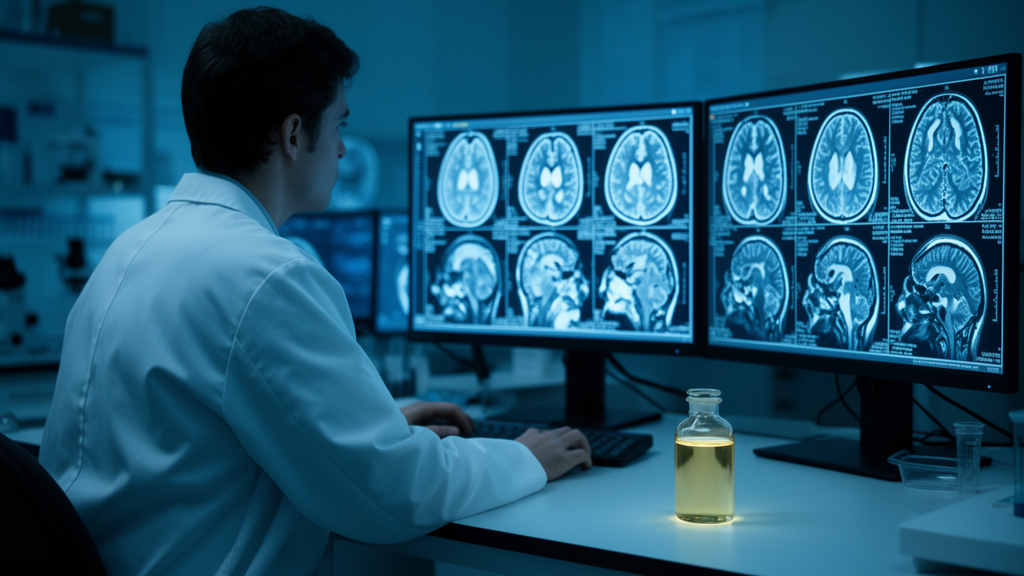
Cannabidiol, better known as CBD, has become one of the most talked-about wellness compounds on the planet, sold in gummies, oils and tinctures with promises of calm in a bottle. But a rigorous new systematic review from researchers at the Massachusetts Institute of Technology suggests that the scientific evidence for how CBD affects the anxious brain is far weaker than the hype. The analysis, published in Frontiers in Neuroimaging, systematically combed through every available functional brain imaging study of CBD and found a field built on small samples, overlapping participants, and wildly inconsistent results.
The review team, led by Omar Rutledge of MIT’s Department of Brain and Cognitive Sciences and the McGovern Institute for Brain Research, set out to answer a deceptively simple question: when scientists give people CBD and scan their brains under stress or anxiety, do the same brain regions respond the same way every time? The answer, after exhaustive analysis, was essentially no. The team searched PubMed, Web of Science, EBSCO and ProQuest for studies published through June 30, 2025, screened nearly 1,400 records after removing duplicates, and ultimately identified just 12 eligible studies containing a combined 146 participants drawn from only seven distinct participant cohorts.
That small number carries a striking implication. Several of the studies came from the same laboratory and reused the same volunteers across multiple papers, meaning the actual independent evidence base is even thinner than the study count suggests. Five of the twelve studies traced back to a single cohort of 15 healthy men scanned in London during the late 2000s. When the reviewers projected all reported brain activation peaks onto a standardized brain template, every case of apparent spatial overlap between studies involved the same cohort rather than independent confirmation. What looked like replication was, in fact, the same data counted twice.
The technical picture that emerged was one of fragmentation. The included studies used doses ranging from 125 to 800 milligrams of single-dose CBD, imaging sessions timed from 60 to 180 minutes after administration, and a patchwork of tasks including fearful-face discrimination, response inhibition, verbal learning, sensory stimulation and alcohol cue reactivity. Imaging modalities split between task-based functional magnetic resonance imaging, which tracks blood-oxygen-level-dependent signals during cognitive challenges, and single-photon emission computed tomography, or SPECT, which measures regional cerebral blood flow at rest. Populations ranged from healthy volunteers to people with social anxiety disorder, clinical high risk for psychosis, and alcohol use disorder.
Because the studies were too dissimilar for a traditional statistical meta-analysis, the team used a Synthesis Without Meta-analysis approach, organizing findings by anatomical location and by assignment to large-scale functional networks defined by the widely used Yeo parcellation. Across the six task-based fMRI studies reporting whole-brain results, 44 peak coordinates contributed to the anatomical synthesis. After a vote-counting procedure that gave each study a single vote per region per direction, the tally came out perfectly deadlocked: 12 votes for increased activation and 12 for decreased activation relative to placebo. Effects appeared across frontal, temporal, parietal, insular and occipital cortex, as well as subcortical structures and the cerebellum, with no region showing a consistent directional pattern.
The network-level analysis was similarly inconclusive. Reported peaks were scattered across all seven Yeo networks, with the somatomotor and visual networks receiving the most votes but in both directions. The only hint of coherence came from the ventral attention, or salience, network, which showed three deactivation votes in the primary analysis. That network helps detect behaviorally relevant stimuli and redirect attention toward them, so its consistent dampening could plausibly relate to anxiolysis. But the effect evaporated in a sensitivity analysis restricted to coordinates falling directly within network parcels, leaving just a single deactivation vote, and the three contributing reports all derived from the same cohort. The reviewers concluded the pattern was partly an artifact of the assignment procedure.
Regional analyses limited to predefined areas of interest offered slightly more intrigue, though still far from proof. Decreased activation appeared in limbic regions such as the amygdala and parahippocampal gyrus and in the ventral striatum’s nucleus accumbens, while the dorsal striatum’s putamen and caudate showed increased activation in one high-risk cohort. One study using dynamic causal modeling found that CBD disrupted forward connectivity from the anterior cingulate cortex to the amygdala during fearful-face processing, a circuit-level observation the reviewers called hypothesis-generating but far from a reproducible mechanism. The two SPECT studies, both conducted under the stress of venipuncture for tracer injection, reported perfusion changes in opposite directions across their different populations.
Perhaps most telling was what happened to behavior. Across most of the included studies, CBD produced no significant difference from placebo on subjective ratings of anxiety, stress or mood, despite the brain activity changes reported. Notable exceptions were the two SPECT studies, where CBD modestly reduced self-reported anxiety, and a 2025 trial in people with alcohol use disorder, in which 800 milligrams of CBD reduced both alcohol craving and cue-induced nucleus accumbens activation. Physiological measures were equally unremarkable: cortisol, heart rate and blood pressure showed no consistent CBD-related changes, and skin conductance findings were mixed. The reviewers described a striking dissociation between neural effects and any measurable benefit, which may reflect subtle or transient neuromodulation that short laboratory paradigms cannot capture behaviorally, or simply the insensitivity of standard outcome measures.
The quality assessments were sobering. Using the revised Cochrane Risk of Bias tool, most studies raised at least some concerns, and only one met criteria for low risk across all domains. A particular problem involved missing outcome data in the overlapping London cohort, where some participants who experienced psychotic symptoms after receiving THC in a separate experimental condition were excluded from analysis without clear accounting of their CBD and placebo data. Many studies also lacked pre-registration, raising concerns about selective reporting, though searches of clinical trial registries found no completed but unpublished neuroimaging CBD trials, offering no strong evidence of publication bias. When the reviewers applied the GRADE framework to rate confidence in the evidence, every outcome received a rating of low or very low certainty, downgraded for serious risk of bias, inconsistency and imprecision.
The verdict is not that CBD does nothing, but that science cannot yet say what it does. The reviewers argued that the observed heterogeneity likely stems more from methodological variation than from biology, and they laid out a roadmap for the field: pre-registered protocols with predefined imaging outcomes, standardized task paradigms and timing, adequately powered samples, routine sharing of unthresholded statistical maps, and recruitment that includes women and diverse populations, given known sex differences in stress responsivity and endocannabinoid signaling. Most participants in the existing literature were white men, making the current findings difficult to generalize. Until such rigor arrives, claims that CBD quiets the anxious brain should remain, like the compound’s effects on it, provisional.
Subject of Research: Functional neuroimaging evidence for the acute effects of cannabidiol on stress and anxiety
Article Title: Functional neuroimaging of Cannabidiol in stress and anxiety: a systematic review
Article References: Rutledge, O., Goyette, R. B., Wang, K. L., Park, M. S., & Gabrieli, J. D. E. (2026). Functional neuroimaging of Cannabidiol in stress and anxiety: a systematic review. Frontiers in Neuroimaging, 5, Article 1860919. https://doi.org/10.3389/fnimg.2026.1860919
Image Credits: AI Generated
DOI: 10.3389/fnimg.2026.1860919
Keywords: cannabidiol, CBD, anxiety, stress, functional neuroimaging, fMRI, SPECT, systematic review, amygdala, placebo-controlled trials, GRADE, brain imaging
News Source: Colin Clarke. (October 15, 2026). CBD and Anxiety: Brain Imaging Evidence Falls Short in Landmark Review. Scienmag.