Cannabinoid Receptors Show Preclinical Neuroprotective Potential for Parkinson’s Disease Therapy
Preclinical evidence indicates that targeting specific cannabinoid receptors may provide neuroprotection in experimental models of Parkinson's disease.
Preclinical evidence indicates that targeting specific cannabinoid receptors may provide neuroprotection in experimental models of Parkinson's disease.
A fatty acid-based deep eutectic solvent demonstrated low cytotoxicity and preserved DNA integrity across human keratinocyte and hepatocyte cell models ...
A clinical review published in Clinical Phytoscience evaluates the therapeutic evidence for cannabidiol across epilepsy, pain, and psychiatric conditions while ...

A narrative review synthesizes decades of clinical evidence and pharmacological mechanisms governing clobazam's adjunctive role in managing drug-resistant epilepsy syndromes.

A randomized trial evaluating purified cannabidiol in boys with profound autism found no broad adaptive functioning gains over placebo, despite ...
A scoping review of in vitro studies reveals that neuronal responses to cannabidiol vary substantially across concentrations, without establishing universal ...
A comprehensive review outlines how phytocannabinoids engage interconnected cellular stress adaptation networks across central nervous system disorders while distinguishing proven ...
A systematic review and network meta-analysis of twenty-eight randomized trials found that palmitoylethanolamide and tetrahydrocannabinol provided modest pain relief while ...

A post hoc clinical analysis demonstrates that a thirty-three percent reduction in seizure frequency constitutes a clinically meaningful improvement for ...

A newly published editorial in Frontiers in Neuroscience details preclinical and clinical strategies to optimize cannabinoid dosing and therapeutic efficacy ...

An analysis of more than two decades of FDA pharmacovigilance reports demonstrates that adverse reactions associated with hemp-derived products exhibit ...
A study in mice reveals that prenatal exposure to cannabidiol disrupts neonatal spermatogonial homeostasis and significantly impairs adult sperm production.

A ten-year bibliometric analysis of nearly ten thousand studies indexed in PubMed tracks the evolution of drug-resistant epilepsy research from ...
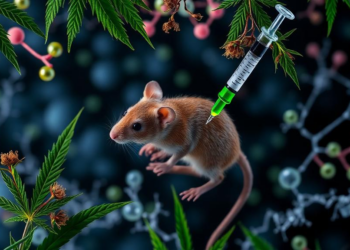
Daily injections of pure CBD altered the duodenal microbiome of mice in a seemingly dose-dependent pattern over a 28-day experiment.
A new review finds cannabidiol consistently reduces neuroinflammation and oxidative stress in Alzheimer's preclinical models, but evidence for amyloid, tau, ...
A solid-phase microextraction and LC-MS/MS platform has, for the first time, tracked unbound cannabidiol in the living bloodstream and mapped ...
A preclinical study reports that cannabidiol selectively impaired viability, migration, invasion, and clonogenic survival of cisplatin-resistant HPV-negative head and neck ...

A survey of 55 Bulgarian patients found that 85.5 percent would use cannabidiol if recommended by a healthcare professional, despite ...
A new MIT-led systematic review finds that brain imaging studies of cannabidiol show no consistent pattern of neural effects on ...

A new narrative review finds cannabidiol exhibits antioxidant, anti-inflammatory and cytoprotective effects against UV-induced skin damage in preclinical studies, but ...