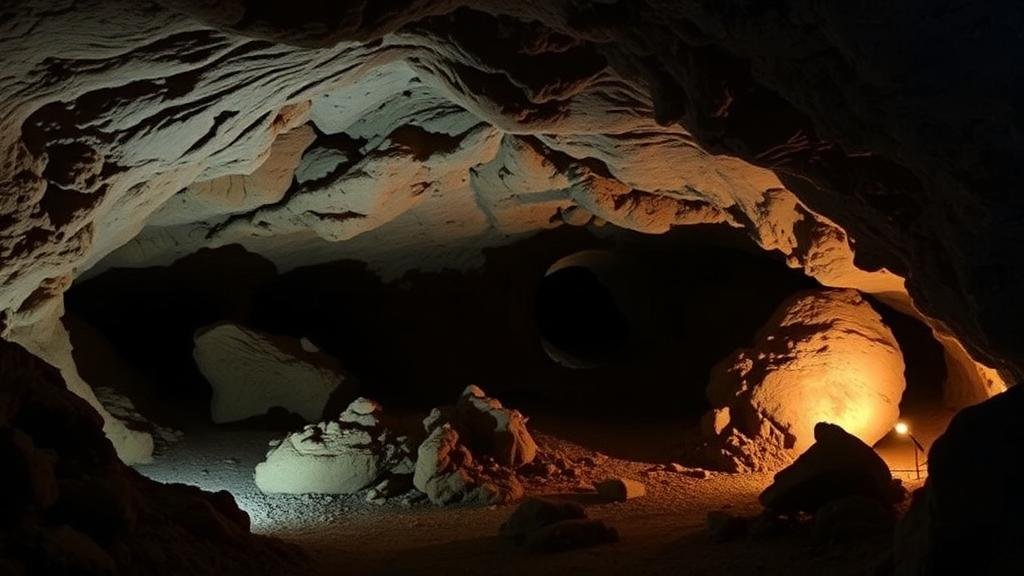
Caves have inspired human creativity for tens of thousands of years, from the earliest known drawings on cave walls in Indonesia, dated to roughly 51,200 years ago, to contemporary exhibitions in major European museums. A new perspective article published in the journal Subterranean Biology argues that this long artistic relationship could now be harnessed for a very modern purpose: protecting the fragile and largely unseen ecosystems that exist beneath the Earth’s surface. The authors, a team of subterranean biologists, contend that art offers a powerful, underused tool for communicating the uniqueness of cave-dwelling life and for building public support for its conservation.
The evidence of art’s fascination with the underground is everywhere. Sebastião Salgado’s “Genesis” photographic series includes haunting images of cave formations that emphasize the untouched beauty of subterranean landscapes. Werner Herzog’s documentary “Cave of Forgotten Dreams” meditates on the prehistoric art of Chauvet Cave at the intersection of time, art, and human consciousness. In painting, Anselm Kiefer frequently features cave-like structures exploring memory, history, and mythology, while Seamus Heaney’s poem “The Underground” uses cave and tunnel imagery to evoke fear, wonder, and the unknown. Even street art has weighed in, with Banksy’s 2008 piece “Cave Painting Removal” offering a wry commentary on humanity’s relationship with its oldest artworks.
In recent years, caves have moved from background motif to central protagonist. The “Subterranean” exhibition at Amos Rex in Helsinki, held from April to August 2022, and “Subterranean Worlds” (Mondes souterrains) at the Louvre Lens museum in Paris, running from March to July 2024, both celebrated hidden worlds while underscoring the growing pressures that human activities place on them. The Helsinki exhibition’s pamphlet noted that humanity has carved its own footprint beneath the surface of the Earth, themes central to many contemporary artists who comment on political conflicts and unsustainable development. The authors argue that this convergence of art and science holds great promise for subterranean conservation, if the two communities can learn to work together effectively.
The scientific case for collaboration is grounded in a growing literature on arts-based environmental education. A study by Franquesa-Soler and colleagues demonstrated that an arts-based educational program focused on black howler monkeys led to greater knowledge gains among children and higher satisfaction than conventional approaches. Similarly, research on aquarium keeping as a form of art showed how hands-on engagement with aquatic ecosystems fostered personal connections to conservation. Within subterranean science, Danielopol proposed as early as 1998 that integrating artistic perception with scientific facts could enhance cultural education by emphasizing the unique organisms inhabiting underground ecosystems, though the idea remained abstract and lacked actionable frameworks until now.
The practical benefits flow in both directions, the authors argue. Art can make subterranean science accessible to audiences who will never descend into a cave, inspire new research questions, strengthen conservation projects, attract funding, and even contribute data. Subterranean science, in turn, can offer artists material, inspiration, and collaboration opportunities. This matters because subterranean ecosystems are invisible to most people and consequently marginal in conservation policy. Art can illuminate their ecological importance and interdependence with surface ecosystems, galvanize public support, and drive donations in a field where resources are chronically limited. It can also foster collaboration with stakeholders such as farmers and water managers, who use large quantities of groundwater but often lack direct knowledge of the environments it flows through.
Concrete examples of artistic tools in scientific contexts already abound. Photography showcases hidden wonders and can hold scientific value for cave research. Professional logos, infographics teaching best practices for conserving biodiversity in cenotes and their caves, graphical abstracts summarizing complex studies, and live graphic facilitation at workshops all translate dense scientific ideas into accessible visual forms. Comics offer a whimsical yet effective way to deliver the core messages of scientific publications. Art may even serve as a source of ecological data: a mid-twentieth-century distemper painting by Mario Sturani captured the community of the Borna Maggiore di Pugnetto cave in Italy, and remarkably, all the depicted species remain abundant today, reflecting the stability and resilience of that ecosystem. No systematic applications of this approach yet exist for subterranean ecosystems, highlighting untapped potential.
Breaking the cultural divide between scientists and artists requires deliberate effort, the authors caution. The two communities often operate in distinct contexts and, in effect, speak different languages, and avoiding obscure speleological jargon is only the first step. Scientists should share research findings, data, and materials to enhance the accuracy of artistic interpretations, organize tours of accessible research sites, and invite artists on expeditions. Where logistics or budgets prevent field visits, inviting artists to conferences and workshops offers an alternative: at the 26th International Conference on Subterranean Biology in Cagliari in September 2024, a scientific illustrator depicted a conservation workshop and several talks, benefiting both parties. Artificial intelligence tools such as DALL-E and Midjourney open new avenues for visualizing subterranean environments, but the authors stress that human supervision is crucial to avoid distortion of scientific concepts, and that ethical questions around authorship and the impact on professional artists must be addressed by positioning AI as a complementary tool rather than a replacement.
Money remains a practical barrier, but one with workable solutions. Institutions can establish grants, fellowships, and artist residencies, while scientists can allocate a portion of research funding to art-related communication. In the authors’ experience, dedicating about five percent of a project grant to communication expenditures, often art-related, typically allows fruitful collaborations; for smaller projects under 50,000 US dollars, this can cover logos, illustrations, and videos, while larger grants can fund expedition invitations and artist stipends. Illustration costs are minimal compared with other non-primary expenditures such as high open-access publication fees, and there is often a return on investment, since including artists in dissemination efforts may increase the likelihood of securing future funding. Artists, for their part, can initiate projects independently, as the comic book “World without End” by Blain and Jancovici did for climate and energy topics, provided they collaborate with experts to avoid scientific inaccuracies.
A striking weakness in the field is the absence of quantitative evidence that art actually advances subterranean conservation. A recent systematic review found that only 31 percent of recommended conservation actions for subterranean ecosystems have been rigorously tested for effectiveness, and just 34 percent of specific actions for subterranean-dwelling bats have undergone testing, with education and communication activities never assessed. The authors propose three routes to close this gap. Scientometric approaches could compare the citation performance, Altmetric scores, and social media engagement of papers with and without artistic elements. Fundraising experiments, inspired by work showing that advertisement design significantly affects donor engagement, could test whether campaigns featuring artistic elements attract more donors for cave conservation. Social science methods, including interviews, focus groups, surveys in tourist caves, and conservation culturomics, the quantitative analysis of online digital data, could probe whether art evokes awe, curiosity, or empathy, enhances memory of ecological concepts, and drives engagement with exhibitions and social media campaigns.
Any push to bring art and audiences underground must also reckon with the vulnerability of caves themselves. Concerts and exhibitions can alter local thermal conditions, disturb native fauna, and introduce waste, external organic matter, and non-native fungi and bacteria. Excessive artificial lighting can promote lampenflora, photosynthetic growth on cave walls, and mismanaged tourism has already forced the closure of sites such as Chauvet, Altamira, and Lascaux after microbial and fungal outbreaks damaged prehistoric art. Precautionary measures include limiting visitor numbers, cleaning shoes and clothing at cave entrances, using lighting that discourages lampenflora, selecting less susceptible areas for artworks, and recommending eco-friendly materials. Full-scale cave replicas, such as Lascaux II and IV, Chauvet II, and the replica of Altamira, offer an effective strategy to mitigate over-tourism while researchers continue working in the original sites. With these safeguards in place, the authors envision a future in which art and science intersect to safeguard both the biological and cultural heritage hidden beneath our feet, ensuring the unseen world finally garners the attention it deserves.
Subject of Research: The role of artistic collaboration in the science communication and conservation of subterranean ecosystems
Article Title: On art, science, and the conservation of subterranean ecosystems
Article References: Mammola, S., Malumbres-Olarte, J., Vaccarelli, I., Nanni, V., Bellvert, A., & Jarić, I. (2025). On art, science, and the conservation of subterranean ecosystems. Subterranean Biology, 51, 1-19. https://doi.org/10.3897/subtbiol.51.139954
Image Credits: AI Generated
DOI: 10.3897/subtbiol.51.139954
Keywords: subterranean ecosystems, cave conservation, art-science collaboration, science communication, speleology, cave art, conservation culturomics, AI-generated imagery, lampenflora, biodiversity, graphic facilitation, environmental education
News Source: Margaret Porter. (October 19, 2026). Caves as Canvases: Why Art May Hold the Key to Saving Hidden Ecosystems. Scienmag.