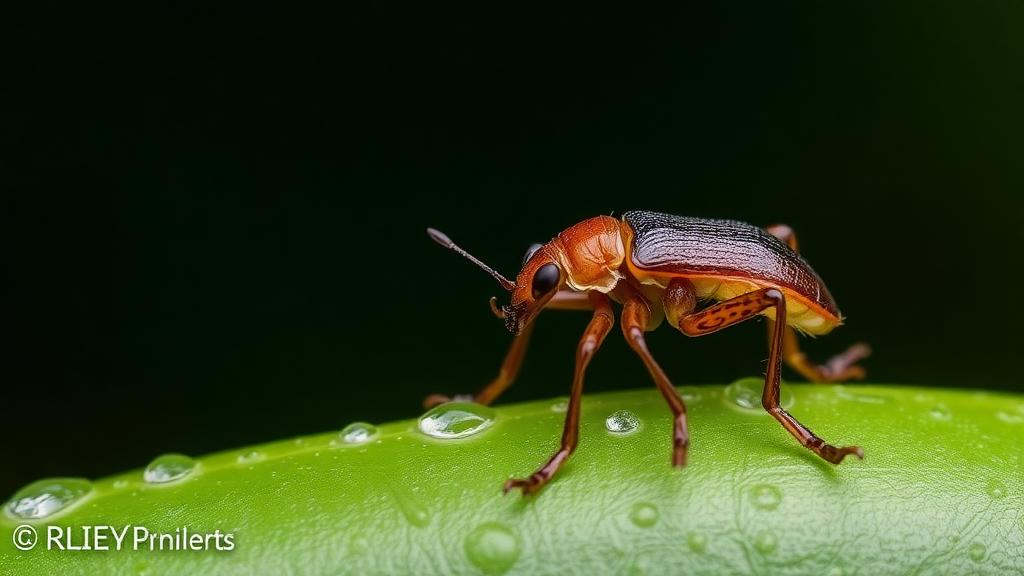
Deep in the mountain meadows of Germany’s Harz National Park, a weevil smaller than a grain of rice has been living out its life almost entirely unnoticed by science. Now, researchers have pulled back the curtain on the complete early development of Anthonomus brunnipennis, a minute member of the snout beetle family Curculionidae, describing its larva and pupa for the very first time. The study, published in the Deutsche Entomologische Zeitschrift, also delivers a critical verdict on what this elusive insect actually eats, overturning decades of questionable host plant records and highlighting the precarious future of a species that depends on some of Europe’s most threatened wetland habitats.
The genus Anthonomus is a giant among weevil lineages, boasting more than 500 described species and holding the title of the largest genus in the tribe Anthonomini. Roughly 400 of these species live in the Neotropics, while 73 occur in the Palaearctic, with smaller numbers scattered across the Afrotropics, the Oriental Region and the Australian and Pacific Regions. These are small to medium-sized beetles, measuring between 1.7 and 5.0 millimetres, equipped with elongate rostra, long antennae, somewhat convex eyes and characteristic teeth on the pro- and mesofemorae. Most species feed on dicotyledonous plants, with larvae developing inside flower buds and pupation taking place either in the buds or, more rarely, in the soil. A few oddballs develop in conifer flowers or live as inquilines inside galls produced by moth larvae.
What makes the new study remarkable is just how little is known about the juvenile stages of this speciose group. Morphological descriptions of immature Anthonomini exist for only around 10 percent of the species, and while that compares favourably with other large genera, entire subgenera remain completely undocumented. Landmark works by Burke in 1968, which described the pupae of 47 species, and by Ahmad and Burke in 1972, along with Burke and Gates in 1974, laid the foundation, and more recent contributions by Zabaluev in 2021 added first descriptions of several Palaearctic species. Yet according to Zabaluev, the bionomics, the full biology and life history, of fewer than 12 percent of Palaearctic Anthonomus species have ever been studied. Against that backdrop, a complete description of both larva and pupa of A. brunnipennis represents a significant addition.
The specimens came from two very different German landscapes. In June 2022, the researchers collected nine larvae of various instars and four pupae from flowers of Potentilla erecta, the common tormentil, in nutrient-poor, partly wet mountain meadows in the National Park Harz near Drei Annen Hohne in Sachsen-Anhalt. Some larvae were reared through to adulthood in the laboratory so that the species identity could be confirmed using established morphological criteria. The second site lies in the Hechtmoor peat bog in Mittelangeln, northern Schleswig-Holstein, where the weevil shares its habitat with bog plants such as Calluna vulgaris, Comarum palustre, Erica tetralix, Sphagnum mosses and cranberry. Together, the two sites span the ecological range of the species in Germany, from wet mountain meadows of the Junco acutiflori-Molinietum and Crepido-Juncetum acutiflori types to genuine raised bog conditions.
The mature larva itself is a strikingly detailed piece of biological engineering. Measuring just 2.46 to 2.66 millimetres long, with a body width of 0.70 to 0.83 millimetres and a head capsule of 0.53 to 0.56 millimetres, the living larva is yellowish with a light brown head. Its body is strongly curved and rounded in cross section, with a prominent prothorax and abdominal segments that taper towards the rear. All spiracles are bicameral, and the cuticle is densely covered with nodular asperities. Using optical stereomicroscopy, scanning electron microscopy and slide preparation techniques involving potassium hydroxide clearing and Faure-Berlese mounting medium, the authors mapped out the complete chaetotaxy, the precise arrangement of sensory setae, across the head, thorax and abdomen, documenting everything from the single stemma on each side of the head to the ten apical sensilla on the terminal receptive area of the maxillary palp.
The pupa proved equally informative. Yellowish and stout, at 1.90 to 2.30 millimetres in length, it bears a very elongate rostrum six times as long as wide, a trapezium-shaped pronotum with a distinct prothoracic depression, and fused urogomphi at the terminal segment whose apices curve outward. Setae sit on conical or thorn-like protuberances across the body, and the pupa shows clear sexual dimorphism: female gonothecae are divided with tubercles on subcontiguous lobes, while those of males are undivided. Spiracles on the abdomen are functional on segments one to five and vestigial on the sixth. Such features matter because they are the raw material for identifying species that adults alone cannot reliably separate.
That identification problem is at the heart of the study. Adults of A. brunnipennis are notoriously similar to those of its sibling species A. rubi, the strawberry blossom weevil, and the two can be told apart only by subtle characters such as body size with overlapping ranges, the configuration of light longitudinal fields on the aedeagus, aedeagal length, and the slenderness of the first and second antennomeres of the funicle. The new work demonstrates that the immature stages, by contrast, differ distinctly. The larva of A. brunnipennis has a brown head with three postepicranial and two ventroepicranial setae, ten pronotal setae, a single cluster of four epipharyngeal sensilla pores and two-segmented labial palps, whereas the larva of A. rubi has a yellowish head with four postepicranial setae and none ventroepicranial, eleven pronotal setae, two separate sensilla clusters and one-segmented labial palps. The pupae differ in rostral setae, head setae, the number of dorsal setae on the abdominal segments and the structure of the urogomphi.
These differences carry evolutionary weight. Zabaluev had proposed dividing Anthonomus into five species groups based on preimaginal morphology, placing A. rubi in group 3 alongside A. rubripes. Intriguingly, despite the close resemblance of the adults, the larva of A. brunnipennis lacks the hallmarks of that group, and its pupa shows features such as prothoracic depressions and superorbital setae that point elsewhere. In fact, both the larva and pupa of A. brunnipennis possess characters found almost exclusively in Nearctic, that is North American, species, including the single sensilla cluster, two-segmented labial palps, prothoracic depression and alternating setal lengths on the pupal abdomen. The authors conclude that the species group division within the genus requires redefinition, a reminder that juvenile morphology can rewrite the family tree drawn from adults alone.
Perhaps the most consequential finding concerns diet. Literature going back to Hoffmann in 1954 lists Comarum palustre, Dryas octopetala, Filipendula ulmaria and Potentilla erecta as host plants, and one record even places the weevil on Helianthemum, a genus in an entirely different plant family. The new review finds that only Potentilla erecta is well documented, and Hoffmann’s original account overlooked the main host altogether, undermining the reliability of his host plant data. In Schleswig-Holstein, the weevil was found only on tormentil even where Comarum palustre grew nearby, and current British sources list only Potentilla erecta. A barcoding study of Alpine populations collected from Helianthemum and Dryas found no differentiation from A. rubi, and the authors recommend that Cistaceae be struck from the host lists of both species. Claims about other hosts, they argue, should be accepted only when backed by records of larvae or observed oviposition.
The ecological picture that emerges is of a stenotopic, hygrophilous specialist, tied to cold, wet, nutrient-poor sites such as swamps, bogs, mountain meadows and moorlands. Unlike its ubiquitous relative A. rubi, A. brunnipennis survives at only a few sites with a high degree of naturalness, particularly at the southern edge of its range in central Europe, where it is confined to national parks and reserves. Those ecosystems face mounting pressure from atmospheric nitrogen deposition, which alters vegetation composition, and from climate warming, with drought and rising temperatures pushing cold-adapted wetland species ever closer to the margins. The weevil is already classified as highly endangered in Germany and may qualify for similar status in other countries along its southern range boundary. In describing the hidden stages of its life, the study provides not just taxonomic housekeeping but a diagnostic toolkit, one that conservationists can now use to confirm the presence of a rare insect whose fate is bound to the survival of Europe’s vanishing wet meadows and bogs.
Subject of Research: Immature stages and host plant biology of the weevil Anthonomus brunnipennis
Article Title: Description of the immature stages and bionomics of Anthonomus ( Anthonomus ) brunnipennis Curtis, 1840 ( Coleoptera , Curculionidae , Anthonomini )
Article References: Gosik, R., & Sprick, P. (2024). Description of the immature stages and bionomics of Anthonomus (Anthonomus) brunnipennis Curtis, 1840 (Coleoptera, Curculionidae, Anthonomini). Deutsche Entomologische Zeitschrift, 71(2), 303-318. https://doi.org/10.3897/dez.71.129867
Image Credits: AI Generated
Keywords: Anthonomus brunnipennis, Curculionidae, weevil, larval morphology, pupa, chaetotaxy, Potentilla erecta, host plants, wetland conservation, bionomics, Anthonomini, sibling species
News Source: Margaret Porter. (October 19, 2026). Hidden Lives of a Tiny Wetland Weevil Revealed for the First Time. Scienmag.