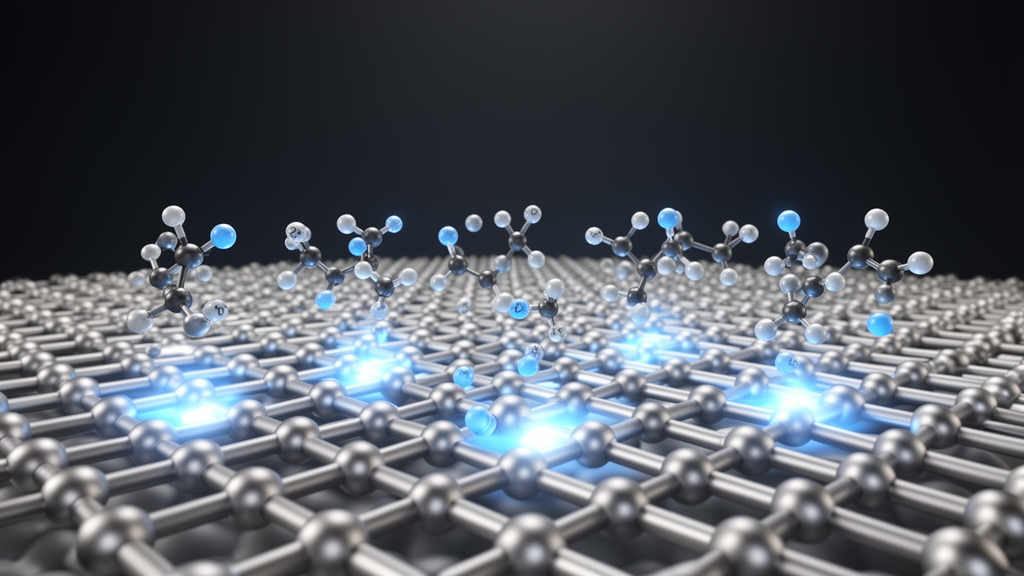
Deuterium-labeled compounds have become indispensable tools across pharmaceutical research and development, analytical testing, and materials science, and the demand for efficient ways to make them is rising fast. A new open-access review published in the journal Catal on 28 September 2026 surveys the state of heterogeneous catalytic deuteration, arguing that the future of the field lies not just in new reactions but in the deliberate design of the catalysts themselves. Written by Fu-Jia Gao, Xiang-Yi Liu, and Guang-Ping Hao, the work consolidates recent advances in both site-selective deuteration, which places deuterium at precise positions in a molecule, and perdeuteration, which replaces every carbon-hydrogen bond with a carbon-deuterium bond.
The case for deuterium labeling rests on a fundamental physical effect. Deuterium, the stable isotope of hydrogen discovered by Harold Clayton Urey in 1931, has twice the mass of hydrogen, so a carbon-deuterium bond has a lower vibrational zero-point energy than a carbon-hydrogen bond and demands more activation energy to break. This kinetic isotope effect means deuterated molecules behave chemically like their ordinary counterparts but cleave and form bonds at altered rates. In pharmaceuticals, strategically placed deuterium atoms can modulate absorption, distribution, metabolism, and excretion, enhancing metabolic stability and prolonging a drug’s half-life. In mass spectrometry, deuterated internal standards match the chemical behavior of the analyte while differing in mass-to-charge ratio, avoiding signal overlap and sharpening detection. In organic luminescent materials, replacing carbon-hydrogen with carbon-deuterium bonds lowers molecular vibrational frequencies and suppresses non-radiative decay, boosting luminescence efficiency and photostability.
Two principal routes exist for making deuterium-labeled compounds: chemical synthesis from deuterated building blocks and catalytic deuteration. The established commercial route relies on deuterated starting materials, which are limited in variety and expensive, restricting its usefulness for complex molecules. Catalytic deuteration, by contrast, enables fast late-stage introduction of deuterium into organic molecules and divides into acid- or base-catalyzed, homogeneous, and heterogeneous approaches according to the physical state of the catalyst. Heterogeneous systems have emerged as an important direction because the catalyst is easy to separate and recover, recyclable, and compatible with continuous production. Heterogeneous catalysis was once associated with nonspecific incorporation of multiple deuterium atoms, but a growing body of work shows that strategic catalyst design can overcome those traditional selectivity limits.
Mechanistically, heterogeneous catalytic deuteration operates through three major pathways: hydrogen isotope exchange, reductive deuteration, and defunctionalization deuteration. The review organizes the factors governing efficiency and selectivity into four coupled dimensions: the metal active centers, the support, the substrate structure, and the reaction conditions. Metal centers matter at the level of electronic configuration. Noble metals such as iridium and rhodium possess d-orbital structures that chelate efficiently with nitrogen- or oxygen-containing directing groups under mild conditions, forming stable five- or six-membered metallacyclic intermediates for highly selective ortho carbon-hydrogen activation. Non-noble metals suffer from contracted d-orbitals and higher-lying d-band centers, weakening both sigma-orbital acceptance and pi-back-donation and lowering intrinsic activity. Metal valence state matters too: in a palladium single-atom catalyst on hydrogenated titanium dioxide, photogenerated electrons from the photoexcited support transferred to palladium sites, forming partially reduced active species that dominated the deuteration.
The physical form of the metal is equally decisive. Nanoparticles expose terraces, steps, kinks, and corners, a diversity that benefits some reactions but reduces selectivity in hydrogen isotope exchange because multiple reactivity patterns coexist. Single-atom catalysts maximize noble metal utilization and provide uniform, well-defined sites that avoid non-selective side reactions; a palladium single-atom catalyst on iron oxide achieved a fifteen-fold enhancement in carbon-hydrogen activation efficiency over conventional palladium nanoparticles, enabling exclusive alpha-site deuteration of benzylic alcohols with heavy water under hydrogen at 90 degrees Celsius. Ligand engineering adds another handle: N-heterocyclic carbene ligands on iridium nanoparticles and polyvinylpyrrolidone-stabilized palladium nanoparticles reshape electron density, coordination geometry, and intermediate binding, constraining the activation pathway and suppressing side reactions.
Supports are not passive scaffolds. Through metal-support interactions, defect engineering, and surface modification, they actively participate in the reaction. In a platinum catalyst on oxygen-vacancy-rich ceria, the interaction between metal and support increased the platinum(II) content and, together with the inherent water-dissociation activity of ceria, induced homolytic cleavage of heavy water into deuterium and hydroxyl radicals that remained immobilized as activated surface species, driving hydrogen isotope exchange of anilines while tolerating reducible functional groups such as halogens and nitro groups. In a palladium catalyst on superwetting porous carbon used for deoxygenative deuteration of aldehydes, the superhydrophilic support strengthened interfacial contact between heavy water and palladium and accelerated desorption of non-polar deuterated products, preventing catalyst poisoning; complete carbon-oxygen bond cleavage and quantitative trideuteration of the formyl group were achieved with 1 mole percent palladium under hydrogen at 100 degrees Celsius.
Substrate structure and reaction conditions complete the design space. Directing groups such as amides, aromatic ketones, and pyridines coordinate to metal centers and confine exchange to ortho carbon-hydrogen bonds, while electronic effects route electron-rich arenes toward electrophilic substitution pathways and electron-deficient haloarenes toward nucleophilic, concerted metalation-deprotonation, or radical routes. Steric hindrance impedes contact between metal centers and target bonds. Among deuterium sources, heavy water stands out as the most cost-effective and environmentally benign option, though its high oxygen-deuterium bond dissociation energy demands interfacial catalytic activation. Solvent choice matters, as a tetrahydrofuran-heavy water co-solvent significantly improved deuteration of polar substrates over iridium nanoparticles, and functional additives ranging from rare-earth dopants to crown ethers and ferric chloride can tune electron density, reorganize hydrogen-bond networks, or couple deuteration to the water-gas-shift reaction.
The review’s comparative assessment of metal classes yields a clear picture. Noble-metal systems based on iridium, rhodium, palladium, ruthenium, and platinum currently deliver the broadest capabilities, covering both site-selective deuteration and perdeuteration, with regioselectivity achieved through ligand engineering, support functionalization, and atomically dispersed fabrication. Non-noble-metal systems based on iron, manganese, nickel, and copper are gaining traction for their low cost and environmental profile; an atomically dispersed iron-phosphorus pair-site catalyst with only 0.15 weight percent iron reached a turnover frequency of 131.3 per hour, thirty times higher than a state-of-the-art iron nanoparticle catalyst, though demanding conditions such as 20 bar hydrogen remain a limitation. Metal-free systems, including electrochemical and photochemical strategies, avoid residual metal contamination and suit late-stage pharmaceutical labeling, but generally show lower activity and narrower substrate scope, particularly for non-activated aliphatic carbon-hydrogen bonds.
In perdeuteration, noble metals dominate because they efficiently activate both deuterium sources and carbon-hydrogen bonds, but the central challenge is suppressing competitive aromatic ring hydrogenation. Solutions reported in the literature include generating trace hydrogen in situ through alcohol dehydrogenation over platinum or iridium catalysts, using decalin to selectively suppress ring hydrogenation without inhibiting exchange, protecting free amines that would otherwise poison platinum, and running continuous-flow reactors in which platinum on carbon beads sustained activity for over 24 hours with a turnover number of 2737 for phenol. Bimetallic systems push further: a tantalum-iridium heterobimetallic catalyst on mesoporous silica reached 97 percent conversion of aromatic substrates within 3 hours at room temperature, while a tantalum-cobalt analogue perdeuterated n-pentane at room temperature under sub-bar deuterium pressure, outperforming the noble-metal version.
Looking ahead, the authors identify seven priority directions: low-loading noble-metal systems pushing toward sub-ppm metal levels, systematic engineering of functional additives and reaction media, improved non-noble-metal catalysts, mild deuteration with cheap deuterium sources such as heavy water under ambient conditions, deeper mechanistic understanding through operando techniques like neutron scattering and operando infrared spectroscopy, machine-learning-guided high-throughput screening supported by public databases, and scalability demonstrated through continuous-flow integration for kilogram-scale production. Current noble-metal loadings typically remain between 1 and 10 mole percent, far above industrial acceptability, and bimetallic catalysts still face metal segregation, leaching, and complex synthesis. The review also notes that the strategies extend beyond carbon-hydrogen bonds to nitrogen-hydrogen, oxygen-hydrogen, and sulfur-hydrogen bonds, which often exchange concomitantly. As the field converges on catalyst design, mechanistic insight, and data-driven methods, deuterium labeling appears set to move from specialized technique toward routine industrial practice.
Subject of Research: Heterogeneous catalyst design for site-selective and full deuteration of organic molecules
Article Title: Catalyst design in heterogeneous deuteration: recent advances and perspectives
Article References: Gao, F.-J., Liu, X.-Y., & Hao, G.-P. (2026). Catalyst design in heterogeneous deuteration: recent advances and perspectives. Catal, 2(1), Article 20. https://doi.org/10.1007/s44422-026-00033-x
Image Credits: AI Generated
DOI: 10.1007/s44422-026-00033-x
Keywords: deuterium labeling, heterogeneous catalysis, hydrogen isotope exchange, single-atom catalysts, heavy water, perdeuteration, pharmaceutical synthesis, metal-support interactions, non-noble metal catalysts, continuous-flow chemistry, kinetic isotope effect, catalyst design
News Source: Bethany Barker. (October 28, 2026). Catalyst design takes center stage in heterogeneous deuterium labeling. Scienmag.