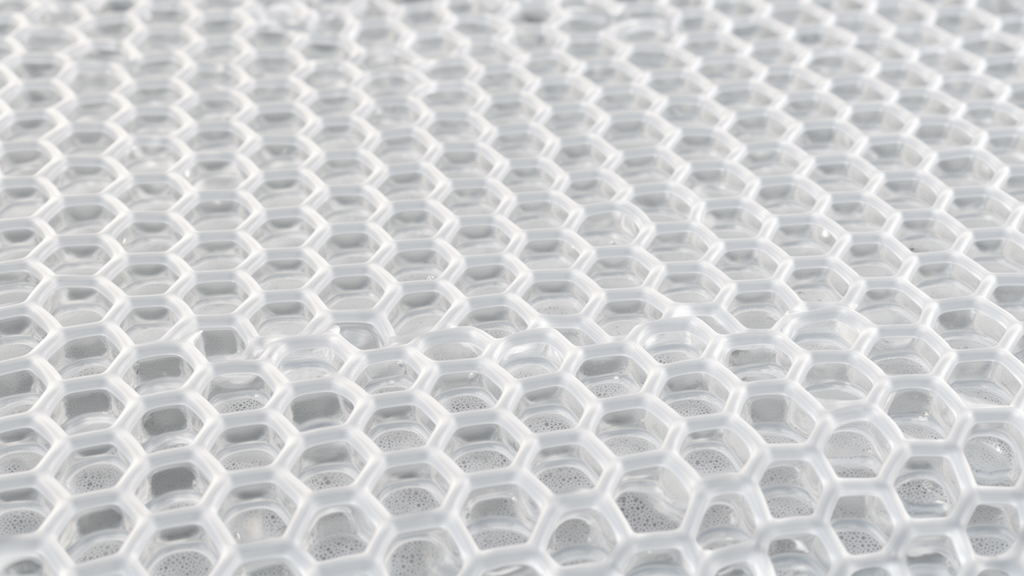
Researchers combining material synthesis, multi-scale image processing, and all-atom molecular dynamics simulations have uncovered how environmental casting parameters and molecular-level interfacial behaviors govern the formation of ordered honeycomb membranes from polystyrene and cellulose acetate blends. Honeycomb-structured porous films fabricated through breath-figure condensation offer distinct advantages in separation, catalysis, and biomedical engineering due to their space-efficient hexagonal arrangements and robust mechanical load distribution. During membrane fabrication via the breath-figure technique, rapidly evaporating volatile solvents induce evaporative cooling across the liquid surface, prompting ambient moisture to nucleate and self-assemble into ordered water-droplet templates. While the macroscopic variables controlling solvent evaporation rates and droplet templating have been studied across standard synthetic polymers, the molecular organization and spatial partition of blended bio-based components during the phase separation process have remained largely uncharacterized. The research team investigated this multi-scale assembly mechanism by casting blends of synthetic polystyrene and renewable cellulose acetate in carbon disulfide under ninety percent relative humidity, demonstrating that final pore morphology is governed by an interplay between casting kinetics and interfacial polymer ordering.
The experimental procedure commenced with the precision synthesis and detailed macromolecular characterization of the polymer components prior to membrane preparation. Atactic polystyrene was synthesized by free-radical polymerization using four point five grams of styrene purified through a basic alumina column and twelve point five milligrams of recrystallized two-two-prime-azobisisobutyronitrile as thermal initiator in a sealed, nitrogen-purged reaction vessel maintained at sixty degrees Celsius for two hours. Polymerization was terminated by thermal quenching in an ice bath, followed by vacuum drying at forty degrees Celsius for forty-eight hours to eliminate unreacted residual monomer. Absolute molecular weight distributions of the resulting atactic polystyrene were determined using gel permeation chromatography with dimethylformamide mobile phase flowing at one milliliter per minute at twenty-five degrees Celsius through three Styragel columns connected in series, monitored by multi-angle light scattering, differential refractive index, and differential viscometry detectors. Commercial cellulose acetate with an average number-average molecular weight of thirty thousand, an acetyl mass fraction between thirty-nine point three and forty point three percent, and a moisture content below three percent was dispersed in reagent-grade carbon disulfide under continuous agitation for one hundred and forty-four hours.
To formulate stable polymer casting mixtures without triggering premature aggregation or visible precipitation of the biopolymer, the cellulose acetate carbon disulfide dispersion was concentrated by controlled evaporation to twenty-five percent of its initial volume. This volume reduction elevated the stable cellulose acetate concentration to zero point one six seven milligrams per milliliter, after which synthesized polystyrene was incorporated to establish a total combined polymer concentration of ten milligrams per milliliter. Film casting was performed inside a specialized environmental chamber maintained at twenty-five degrees Celsius and ninety percent relative humidity, equipped with automated temperature and moisture controls and an electric fan to regulate boundary-layer airflow. Aliquots of twenty microliters of the polystyrene-cellulose acetate solution were drop-cast onto five-millimeter-diameter glass coverslips under four distinct experimental conditions to isolate the effects of convective airflow and substrate preconditioning. The variables contrasted stagnant air without airflow against parallel airflow generated by an axial fan delivering twenty-one cubic feet per minute at an outlet velocity of approximately one point five five meters per second, paired with either dry substrates or wet substrates pre-equilibrated in the chamber for thirty seconds.
Morphological evaluation using optical microscopy and scanning electron microscopy demonstrated that casting variables dramatically altered pore geometry, pore diameter, and spatial regularity across the solidified membranes. Quantitative assessment of porous ordering was conducted using a modified quantitative virtual light scattering workflow, wherein scanning electron micrographs were segmented using the deep-learning convolutional neural network framework Cellpose across multiple diameter scales to generate robust pore masks. The quantitative virtual light scattering algorithm evaluated deviations from an idealized hexagonal lattice by generating numerical span and theta parameters, alongside area-weighted pore size distributions derived from kernel density estimation. Membranes cast without airflow onto dry glass substrates achieved the highest structural uniformity and nearest-ideal hexagonal ordering, displaying circular pores of approximately six micrometers in diameter, a minimal span value of zero point twenty-eight, and a theta value of seven point forty-four. Conversely, membranes subjected to convective airflow over wet substrates exhibited the greatest morphological disorder, producing irregular pore diameters spanning three point five to five micrometers, accompanied by elevated span and theta metrics of zero point thirty-four and eight point four.
Membranes prepared under the mixed conditions of stagnant air over wet substrates and convective airflow over dry substrates produced distinctive bimodal pore-size distributions while retaining identical intermediate ordering metrics with span values of zero point thirty-four and theta values of eight point eighteen. In these bimodal systems, a secondary population of smaller pores clustered around the primary quasi-hexagonal framework of larger pores measuring approximately five micrometers for wet substrates without airflow and eight micrometers for dry substrates under airflow. The authors deduced that neither convective airflow nor substrate moisture acts as a single dominant driver of membrane structure; instead, final film architecture emerges from a dynamic competition between enhanced solvent evaporation, water condensation rates, droplet coalescence, and polymer precipitation kinetics. Calcofluor-white fluorescent staining, which binds selectively to beta-one-four-glycosidic linkages within cellulose acetate, further corroborated this physical divergence by revealing pronounced variations in surface fluorophore coverage. Surface fluorescence reached thirty-four point six percent on membranes cast without airflow on dry substrates, but dropped to five point eight percent under airflow on wet substrates, confirming that processing kinetics strongly modulate the ultimate surface presentation of the biopolymer.
To resolve the nanosecond interfacial mechanisms responsible for templating these macroscopic honeycomb patterns, the authors conducted extensive all-atom molecular dynamics simulations tracking model chains at a planar water-carbon disulfide interface. The atomistic models comprised thirty repeat units for each macromolecule, representing local chain segments rather than full molecular weight distributions. The atactic polystyrene chain contained four hundred and eighty-two atoms modeled with the second-generation general Amber force field and whole-chain AM1-BCC partial atomic charges, while cellulose acetate was represented using the GLYCAM06 force field with tailored charge sets for O-acetyl derivatives. To accurately capture the commercial biopolymer composition, the cellulose acetate chain carried seventy-four acetyl groups across ninety available hydroxyl sites, matching an experimental degree of substitution of two point forty-seven. Simulations were performed using OpenMM in an orthorhombic periodic box with lateral dimensions of nineteen point two by seven point three nanometers, incorporating TIP3P water and a rigid three-site model for carbon disulfide under constant normal pressure at two hundred and ninety-three Kelvin.
Four distinct simulation configurations comprising three independent replicates each yielded sixty-five nanoseconds of production trajectories, exploring different starting locations, polymer compositions, and acetyl substitution distributions. When cellulose acetate was initialized fully immersed within the organic carbon disulfide phase at least one nanometer from the interface, its center of mass systematically migrated toward the aqueous interface across all replicates, reaching the interfacial dividing boundary within one point four to six point eight nanoseconds. Once adsorbed at the interface, the cellulose acetate chain remained anchored along the boundary for the entirety of the trajectories, adopting an extended conformation oriented parallel to the interfacial plane with principal axis tilt angles of eighty-eight to ninety degrees. The biopolymer formed an ultra-thin interfacial layer measuring zero point forty-five nanometers at full width at half maximum, centered zero point zero six nanometers into the organic side of the Gibbs dividing surface, perfectly overlapping the region where water and carbon disulfide densities interpenetrate.
Detailed structural profiling revealed a strict spatial ordering of functional groups within this interfacial cellulose acetate monolayer. Hydroxyl oxygen atoms localized directly along the interfacial plane with approximately half their density protruding into the aqueous phase, followed inward by pyranose ring atoms and ester carbonyl oxygens, whereas hydrophobic acetyl methyl groups projected outward into the carbon disulfide phase by zero point twelve to zero point seventeen nanometers. Across the trajectories, each cellulose acetate chain established approximately fifty-two hydrogen bonds with water molecules through its carbonyl oxygens and nine hydrogen bonds through its residual hydroxyl groups, corresponding to average coordination frequencies of zero point seven and zero point five hydrogen bonds per available functional site. Interaction energy calculations demonstrated that cellulose acetate gained between three thousand and three thousand four hundred kilojoules per mole of favorable electrostatic interaction with water upon arriving at the interface, while simultaneously retaining the majority of its dispersive Lennard-Jones interactions with the surrounding carbon disulfide solvent.
In marked contrast to the interfacial affinity displayed by cellulose acetate, the hydrophobic polystyrene chain remained entirely sequestered inside the bulk carbon disulfide phase throughout all simulation trajectories. Less than four percent of polystyrene heavy atoms crossed into the aqueous boundary layer, and polystyrene interaction energies with water remained an order of magnitude weaker than its cohesive interactions with carbon disulfide. Encounters between polystyrene and cellulose acetate were rare and transient, with heavy-atom contacts within zero point forty-five nanometers occurring in nineteen percent or fewer trajectory frames and yielding negligible interaction energies between zero and minus twelve kilojoules per mole. Control simulations conducted in the complete absence of polystyrene, as well as simulations evaluating an alternative random acetyl substitution pattern possessing a higher ratio of free C6 primary hydroxyl groups, demonstrated identical chain extension, interfacial positioning, and amphiphilic functional group orientation, confirming that cellulose acetate interfacial organization is an intrinsic thermodynamic preference driven by its amphiphilic macromolecular structure.
The authors underscored critical physical limitations inherent to the computational models when interpreting the macroscopic experimental membranes. The atomistic simulations represented single thirty-unit chains interacting at an idealized flat liquid-liquid boundary over five to ten nanoseconds, thus excluding collective multi-chain entanglement, droplet surface curvature, and time-dependent solvent depletion occurring over multi-second experimental evaporation intervals. Furthermore, potential energy evaluations extracted from trajectories did not represent free energies of adsorption, and interfacial tension values were not explicitly measured.
Subject of Research: Interfacial organization and casting conditions of polystyrene-cellulose acetate honeycomb membranes
Article Title: Casting conditions and interfacial organization in polystyrene-cellulose acetate honeycomb membranes: experimental and molecular dynamics insights
Article References: López-Simeon, R., López, S., Gomez-Maldonado, D., Turner, C., & Hernández-Guerrero, M. (2026). Casting conditions and interfacial organization in polystyrene-cellulose acetate honeycomb membranes: experimental and molecular dynamics insights. Journal of Materials Science. https://doi.org/10.1007/s10853-026-14059-y
Image Credits: AI Generated
DOI: 10.1007/s10853-026-14059-y
Keywords: honeycomb membranes, breath figures, cellulose acetate, polystyrene, molecular dynamics, carbon disulfide, liquid-liquid interface, pore-size distribution, quantitative virtual light scattering, scanning electron microscopy, calcofluor-white, amphiphilic polymers, free-radical polymerization, GLYCAM06, OpenMM, phase separation, porous materials
News Source: Denise Maddox. (November 24, 2026). Casting Conditions and Interfacial Dynamics Shape Polystyrene-Cellulose Acetate Honeycomb Membranes. Scienmag.