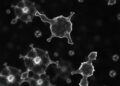
CLEVELAND—Researchers from Case Western Reserve University have identified a new mechanism by which a protein known for repairing damaged DNA also protects the integrity of DNA by preserving its structural shape.

Credit: Case Western Reserve University
CLEVELAND—Researchers from Case Western Reserve University have identified a new mechanism by which a protein known for repairing damaged DNA also protects the integrity of DNA by preserving its structural shape.
The discovery, involving the protein 53BP1, offers insight into understanding how cells maintain the integrity of DNA in the nucleus, which is critical for preventing diseases like premature aging and cancer.
A research team led by Youwei Zhang, an associate professor of pharmacology at the Case Western Reserve School of Medicine and a member of the Molecular Oncology Program at the Case Comprehensive Cancer Center, conducted the study. The findings were published (Jan. 18, 2022) in Nature Communications.
DNA, or deoxyribonucleic acid, is the chemical name for the molecule that carries genetic instructions in all living things.
53BP1 is a large protein known for determining how cells will repair a particular type of DNA damage—DNA double-strand break (DSB), in which the two strands of DNA are both broken, leaving a free DNA end floating around in the cell’s nucleus.
When DSB occurs, if not repaired, DNA ends could fuse to what it should not under normal conditions, which leads to the disruption of genetic information. In the short term, cells with unrepaired DNA may kill themselves off; but if a cell lost this self-surveillance, it may start the journey toward cancer.
The study
In this study, the team discovered 53BP1 has a biological function in mediating the structure of DNA, specifically at a highly compacted region called heterochromatin.
The researchers found that this new function involves a new form of activity of 53BP1, in which the protein accumulates at the condensed DNA regions and forms small liquid droplets—a process called liquid-liquid phase separation, similar to mixing oil with water for salad dressing.
The team determined how 53BP1 can form liquid droplets: They found that this process requires the participation of other proteins known to support the structure of those highly condensed DNA. But, in turn, they discovered that 53BP1 actually stabilized the gathering of these proteins at these DNA regions, which is important for keeping the overall function of the DNA.
They then carried out detailed molecular analysis to break the large protein into small pieces and determined which pieces are important for the liquid droplet formation of 53BP1. They further changed amino acid of a specific position of the 53BP1 protein and determined the contribution of several amino acids that are critical for this new function.
“More excitingly, through these comprehensive analyses, we found that this new protective activity of 53BP1 is independent of the widely known role of this protein in repairing DNA damage, indicating a totally new function of 53BP1,” Zhang said. “Our study suggests that, in addition to DSB repair modulation, 53BP1 contributes to the maintenance of genome stability through the formation of these liquid droplets.”
With this new information, Zhang and his team hope to better understand how diseases like cancer can be prevented, and even design therapies that use this new feature of 53BP1 to treat cancers in the future.
Zhang’s lab focuses on understanding cell biology to develop anticancer therapies—specifically how cells protect the stability of DNA. Without that protection, it can cause genome instability and eventually lead to the early onset of degenerative disorders such as premature aging and cancer.
“Our goal,” Zhang said, “is to understand the molecular mechanisms that maintain the genome stability in human cells by identifying the genes and the signaling pathways involved. Long term, we hope to translate this knowledge into potential anticancer treatment strategies.”
###
Case Western Reserve University is one of the country’s leading private research institutions. Located in Cleveland, we offer a unique combination of forward-thinking educational opportunities in an inspiring cultural setting. Our leading-edge faculty engage in teaching and research in a collaborative, hands-on environment. Our nationally recognized programs include arts and sciences, dental medicine, engineering, law, management, medicine, nursing and social work. About 5,800 undergraduate and 6,300 graduate students comprise our student body. Visit case.edu to see how Case Western Reserve thinks beyond the possible.
Journal
Nature Communications
DOI
10.1038/s41467-022-28019-y
Method of Research
Imaging analysis
Subject of Research
Cells
Article Title
53BP1 regulates heterochromatin through liquid phase separation
Article Publication Date
18-Jan-2022