• HOME
  • NEWS
  • EXPLORE
    • CAREER
      • Companies
      • Jobs
    • EVENTS
    • iGEM
      • News
      • Team
    • PHOTOS
    • VIDEO
    • WIKI
  • BLOG
  • COMMUNITY
    • FACEBOOK
    • INSTAGRAM
    • TWITTER
Friday, November 6, 2026
BIOENGINEER.ORG
No Result
View All Result
  • Login
  • HOME
  • NEWS
  • EXPLORE
    • CAREER
      • Companies
      • Jobs
        • Lecturer
        • PhD Studentship
        • Postdoc
        • Research Assistant
    • EVENTS
    • iGEM
      • News
      • Team
    • PHOTOS
    • VIDEO
    • WIKI
  • BLOG
  • COMMUNITY
    • FACEBOOK
    • INSTAGRAM
    • TWITTER
No Result
View All Result
Bioengineer.org
No Result
View All Result
Home NEWS Science News Health

Case Report Tracks Functional Gains Following Prolonged Rehabilitation After Limb-Salvage Surgery

by
November 6, 2026
in Health
Reading Time: 2 mins read
0
Case Report Tracks Functional Gains Following Prolonged Rehabilitation After Limb-Salvage Surgery

Case Report Tracks Functional Gains Following Prolonged Rehabilitation After Limb-Salvage Surgery

Share on FacebookShare on TwitterShare on LinkedinShare on RedditShare on Telegram

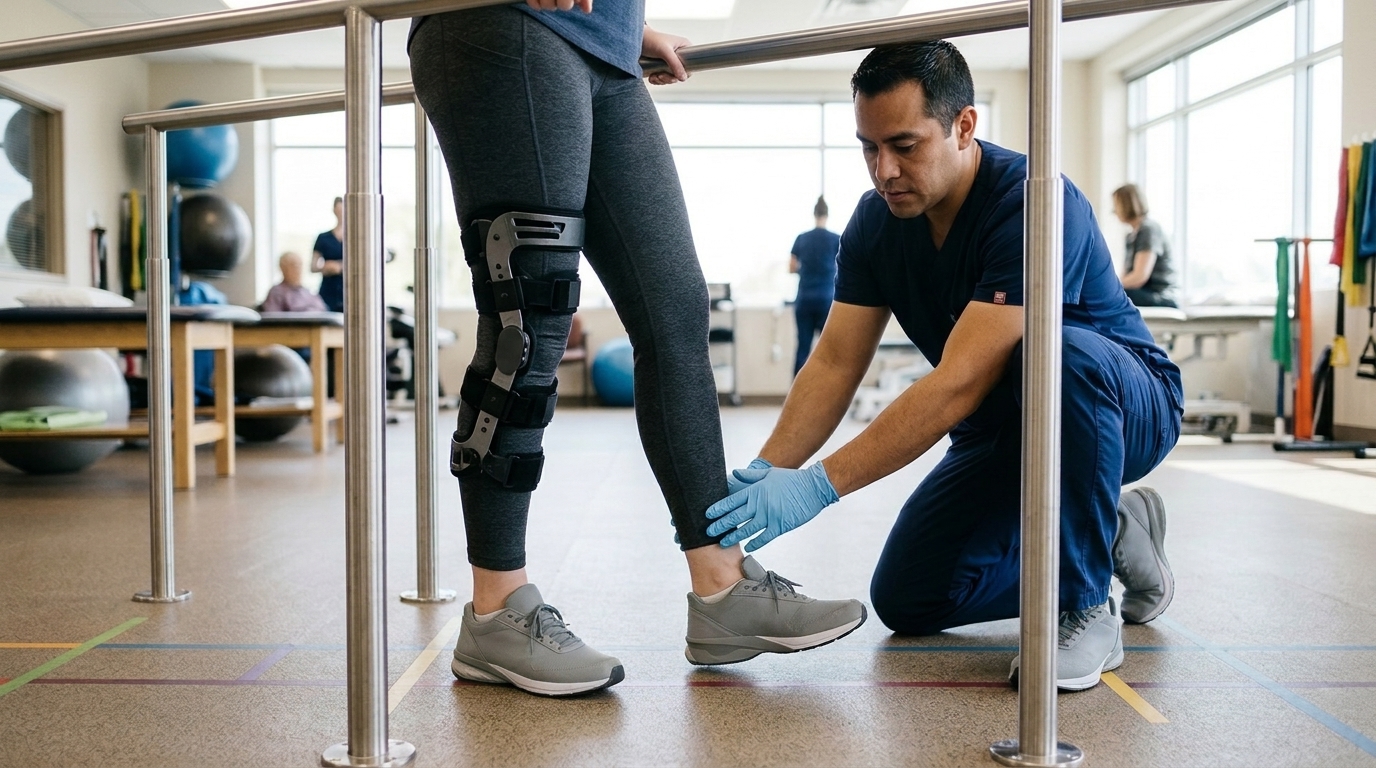
An 18-month supervised exercise-based rehabilitation program completed by a 68-year-old woman recovering from limb-salvage surgery for lower-extremity dedifferentiated liposarcoma was accompanied by positive trends across all functional and mobility outcomes, according to a case report by researchers at the University of Pavia, Fondazione IRCCS Policlinico San Matteo, and Fibion Inc. The patient initiated the intervention 19 months post-surgery—a procedure that frequently leads to persistent functional deficits, impaired balance, and gait asymmetry due to extensive muscle resection—and completed multidimensional evaluations at baseline, nine months, and 18 months.

The individualized rehabilitation regimen integrated resistance, endurance, gait, and balance training, producing marked improvements across standardized clinical evaluations. Over the 18-month training period, the patient’s normal walking gait speed increased by 0.40 meters per second and her 6-Minute Walk Test distance expanded by 97 meters, with both improvements exceeding established minimal clinically important differences. In addition, her balance evaluation on the Mini-Balance Evaluation Systems Test improved from 16 to 25 points, her fall-related concern on the Falls Efficacy Scale–International decreased from 40 to 21 points, and her Toronto Extremity Salvage Score rose from 62.7 percent to 100 percent.

Instrumental biomechanical assessments and objective physical activity tracking revealed corresponding enhancements in walking mechanics and daily mobility. Kinematic gait analysis conducted with an inertial sensor demonstrated that the step-length symmetry ratio between the operated and non-operated limbs normalized from 1.16 at baseline to 0.98 at 18 months during normal walking, and from 1.13 to 1.00 during fast walking. Over the same interval, the gait symmetry index increased from 85.0 percent to 94.7 percent in normal walking and from 88.0 percent to 97.2 percent in fast walking, while tri-axial accelerometer monitoring recorded a daily step count increase from 3,534 to 6,757 steps alongside a reduction in sitting time from 459 to 318 minutes per day.

Despite these favorable observations, the authors caution that the single-patient design and the absence of a control condition prevent directly attributing the measured recovery to the rehabilitation program. The researchers conclude that while these preliminary observations suggest prolonged, tailored exercise rehabilitation may help address chronic impairments following limb-salvage surgery, further verification in larger prospective controlled cohorts remains necessary.

Subject of Research: Long-term exercise-based rehabilitation outcomes following limb-salvage surgery for lower-extremity dedifferentiated liposarcoma

Article Title: Long-term exercise-based rehabilitation after limb-salvage surgery for lower-extremity dedifferentiated liposarcoma: a case report

Article References: Crisafulli, O., Fortunati, M., Rubino, M., Loprieno, E., Tikkanen, O., Odone, A., & D'Antona, G. (2026). Long-term exercise-based rehabilitation after limb-salvage surgery for lower-extremity dedifferentiated liposarcoma: a case report. Frontiers in Rehabilitation Sciences, 7, Article 2010337. https://doi.org/10.3389/fresc.2026.2010337

Image Credits: AI Generated

DOI: 10.3389/fresc.2026.2010337

Keywords: limb-salvage surgery, dedifferentiated liposarcoma, exercise rehabilitation, gait symmetry, case report, physical activity, biomechanical analysis, functional recovery, Long-term, exercise-based, rehabilitation, limb-salvage

News Source: Ophelia Keating. (November 6, 2026). Case Report Tracks Functional Gains Following Prolonged Rehabilitation After Limb-Salvage Surgery. Scienmag.


Tags: Biomechanical analysiscase reportdedifferentiated liposarcomaexercise rehabilitationExercise-basedfunctional recoverygait symmetrylimb salvagelimb-salvage surgeryLong-termphysical activityRehabilitation
Share12Tweet7Share2ShareShareShare1

Related Posts

Summer Heat Worsens Symptoms and Disrupts Care for Older Cardiology Patients

Summer Heat Worsens Symptoms and Disrupts Care for Older Cardiology Patients

November 6, 2026
Adalimumab Linked to Fewer Eye Complications in Juvenile Arthritis Uveitis

Adalimumab Linked to Fewer Eye Complications in Juvenile Arthritis Uveitis

November 6, 2026

Vaginal Microecology Markers Predict Secondary Infection in Abnormal Uterine Bleeding

November 6, 2026

Widefield Angiography Identifies Choroidal Vascular Biomarkers in Chronic Chorioretinopathy Complications

November 6, 2026

POPULAR NEWS

  • Visual Data Mining Platform Maps Cancer Multi-Omics Across Subcellular Compartments

    Visual Data Mining Platform Maps Cancer Multi-Omics Across Subcellular Compartments

    29 shares
    Share 12 Tweet 7
  • Review Separates Artificial Intelligence From Robotic Execution In Total Knee Arthroplasty

    29 shares
    Share 12 Tweet 7
  • Review Analyzes Olive Phenol Hydroxytyrosol Across Cellular Pathways and Clinical Trials

    29 shares
    Share 12 Tweet 7
  • Blood-Brain Barrier Breakdown Heightens Antipsychotic Sensitivity in Alzheimer’s Disease

    29 shares
    Share 12 Tweet 7

About

We bring you the latest biotechnology news from best research centers and universities around the world. Check our website.

Follow us

Recent News

Summer Heat Worsens Symptoms and Disrupts Care for Older Cardiology Patients

Aegean Bottlenose Dolphin Whistles Differ by Social Group and Sea Temperature

Structural Analysis Reveals How Cerium Cations Bind and Function Within Proteins

Subscribe to Blog via Email

Enter your email address to subscribe to this blog and receive notifications of new posts by email.

Join 86 other subscribers
  • Contact Us

Bioengineer.org © Copyright 2023 All Rights Reserved.

Welcome Back!

Login to your account below

Forgotten Password?

Retrieve your password

Please enter your username or email address to reset your password.

Log In
No Result
View All Result
  • Homepages
    • Home Page 1
    • Home Page 2
  • News
  • National
  • Business
  • Health
  • Lifestyle
  • Science

Bioengineer.org © Copyright 2023 All Rights Reserved.