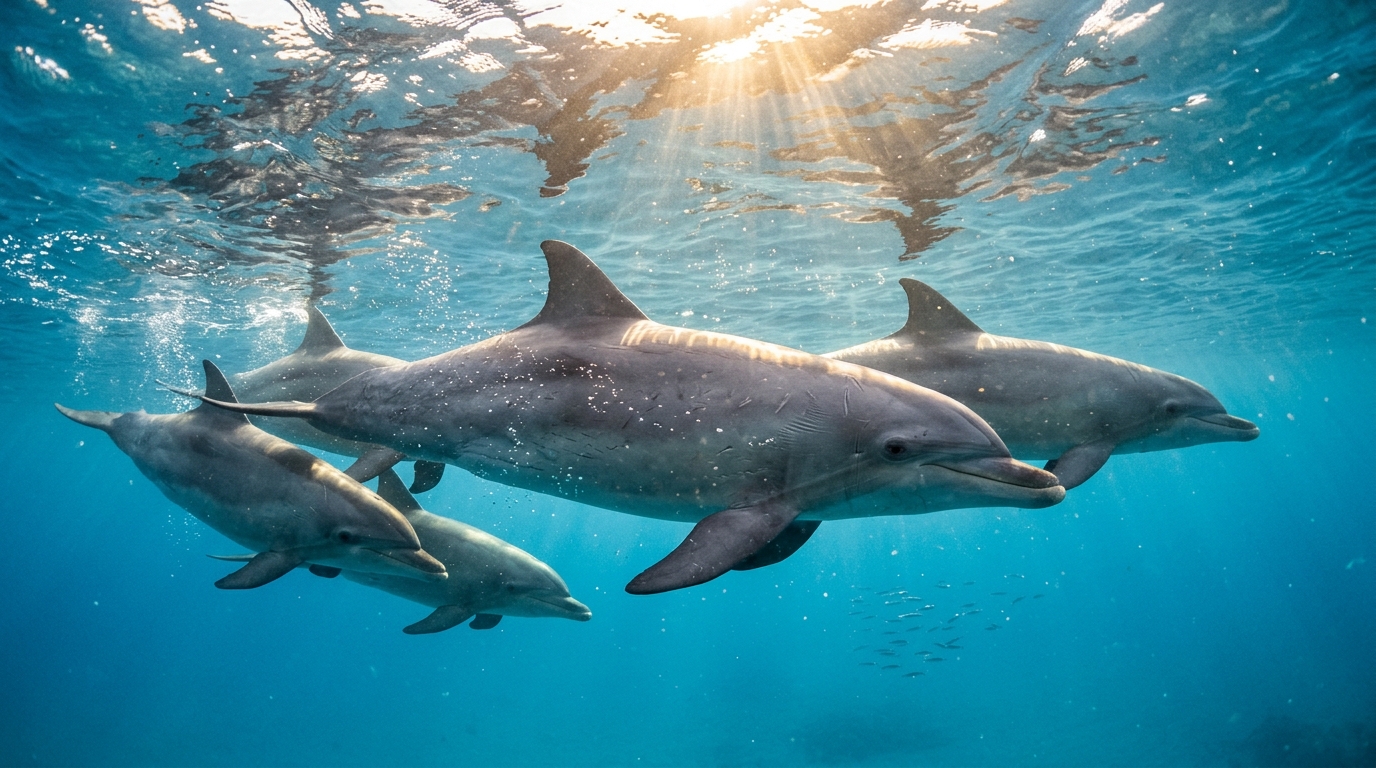
Common bottlenose dolphins inhabiting the eastern Aegean Sea produce acoustic whistles whose structures differ significantly between social groupings when environmental conditions are taken into account, according to an extensive bioacoustic and photo-identification study published in Frontiers in Mammal Science. Researchers from the Archipelagos Institute of Marine Conservation and the National Institute of Oceanography and Applied Geophysics evaluated the acoustic ecology of local dolphins around the Greek islands of Samos, Ikaria, Fourni, and Lipsi. Across 671 boat-based survey trips completed between September 2017 and May 2025, the research team recorded 986 individual whistles across 30 acoustic recordings, linking vocal variations to social cluster associations, sea surface temperatures, depth, and local marine traffic ratios.
Bottlenose dolphins, scientifically known as Tursiops truncatus, rely extensively on acoustic vocalisations for navigation, foraging, and maintaining group coordination. Whistles are frequency-modulated narrow-band acoustic signals that serve vital communicative functions, reinforcing social cohesion in dynamic fission-fusion communities where group composition shifts frequently. While individual association and environmental characteristics are recognized as potential drivers of vocal variations across cetaceans, the combined effects of social structures, marine traffic, and habitat features had remained largely undocumented in the eastern Mediterranean basin. The eastern Aegean Sea represents a vital yet ecologically complex habitat featuring depths from shallow coastal shelves of 5 meters down to the 1,590-meter basin of the Ikaria trench, subject to varied human maritime operations.
To evaluate these interacting factors, the researchers conducted systematic boat surveys during favorable navigation conditions characterized by Douglas sea states below 4. The field team observed all maritime traffic within a 5-kilometer radius every 15 minutes, noting vessel dimensions, vessel types, and observer distances. Whenever dolphin groups were encountered, observers logged vessel GPS coordinates and collected behavioral data every 3 minutes using focal group sampling methods. Group sizes and overall compositions were recorded alongside photographic identification capturing individual dorsal fin notches, scars, and coloration patterns, permitting systematic identification of individual animals across multiple encounters.
Acoustic data collection utilized two distinct hydrophone configurations depending on the survey boat deployed. One vessel utilized a 250-meter towed hydrophone array consisting of paired medium-frequency Benthos AQ4 elements with matched broadband Magrec HP/02 preamplifiers providing 29 decibels of gain, complemented by spherical ceramic elements connected to a 40-decibel preamplifier with high-pass filtration set at minus 3 decibels at 2 kilohertz. A Keller pressure sensor continuously recorded hydrophone deployment depth, sampling signals at 96 kilohertz with 24-bit resolution while the vessel remained in motion. The second setup deployed an Aquarian AS-1 broadband hydrophone with a linear range of 1 hertz to 100 kilohertz and receiving sensitivity of minus 208 decibels relative to 1 volt per micropascal, sampling at 44.1 kilohertz and 16-bit resolution while stationary with boat engines turned off.
Acoustic recordings were subsequently analyzed in Raven Pro software by two independent researchers who identified and classified whistle vocalizations. Analysts extracted six core structural acoustic parameters from each whistle: minimum frequency, maximum frequency, duration, start frequency, end frequency, and the total count of inflection points, defined as directional changes in the frequency contour. Whistles were also classified into six standard geometric contour shapes, including concave, convex, downsweep, flat, sinusoid, and upsweep contours. Habitat bathymetry was extracted via geographic information systems from the EMODnet bathymetry layer, sea surface temperature was retrieved from the Copernicus Marine Service Mediterranean Sea Physics Reanalysis product, and marine traffic ratio was mapped across 5-by-5-kilometer grid cells.
Social network analysis was performed using the Half-Weight Association Index on 58 dolphins photographed in at least two separate encounters from a total catalog of 60 identified individuals. Permutation testing confirmed that individuals exhibited non-random social preferences, with observed association variation exceeding randomized network models. While modularity algorithms divided the social network into nine clusters, overall modularity did not exceed random expectations, indicating that clusters represented tentative social aggregations rather than rigid, isolated units. Only the two largest clusters, designated Cluster 1 and Cluster 2, had sufficient independent acoustic recordings across multiple survey days to support comparative bioacoustic analysis, representing 840 whistles across 22 recordings.
Multivariate PERMANOVA analysis revealed that whistle structure differed significantly between the two social clusters when accounting for environmental variables, accounting for 29 percent of the observed acoustic variation. In contrast, when environmental variables were omitted, acoustic differences between the two social clusters were not statistically significant, demonstrating that environmental variation masked social vocal differentiation when examined in isolation. Whistles produced by dolphins in Cluster 2 exhibited a significantly higher number of frequency inflection points than those in Cluster 1, alongside a significantly greater proportion of sinusoidal contours, whereas concave contours predominated in recordings attributed to Cluster 1.
Environmental analyses demonstrated that sea surface temperature was significantly associated with whistle structure in multivariate models and partial redundancy analyses within social clusters, with frequency metrics exhibiting a general tendency to increase at higher temperatures. However, the authors noted that sea surface temperature was strongly correlated with seasonal changes and moderately correlated with marine traffic, preventing full separation of seasonal or ecological effects from direct thermal influences. Water depth showed no significant effect on overall whistle structure, though maximum frequency exhibited a non-significant tendency to increase with depth, a finding potentially constrained by the fact that 23 of 28 acoustic recordings occurred in water depths of 170 meters or shallower.
Marine traffic ratios remained low across the eastern Aegean survey encounters, ranging from 0 to 0.0021 with an average of approximately two vessels observed per encounter. At these low baseline traffic levels, marine traffic exhibited no consistent or statistically robust effect on dolphin whistle structures across sensitivity checks, losing statistical significance when accounting for the specific research vessel or excluding shared recording days. The researchers emphasized that while elevated vessel noise can trigger acoustic masking and compensatory vocal adjustments in cetaceans, detecting subtle vocal modifications requires dedicated acoustic measurements of sound pressure levels and wider exposure gradients than those captured during their low-traffic survey encounters.
The study authors highlighted several methodological limitations, noting that multivariate analyses relied on 15 recordings with complete environmental data and that the fluid nature of fission-fusion societies meant some whistles were assigned to overlapping group encounters. Furthermore, individual signature whistles could not be separated from non-signature whistles, and behavioral contexts could not be statistically evaluated due to uneven sample distributions across behavioral states. Despite these constraints, the study establishes an essential empirical baseline regarding the interplay between social organization, temperature conditions, and acoustic signaling for eastern Mediterranean bottlenose dolphins, providing valuable bioacoustic evidence to assist regional conservation initiatives and Natura 2000 marine habitat management.
Subject of Research: Bottlenose dolphin acoustic ecology and social structure in the eastern Aegean Sea
Article Title: Relationships between social structure, environmental conditions and whistle characteristics in common bottlenose dolphins (Tursiops truncatus) in the eastern Aegean Sea
Article References: Tintoré, B., Lamberti, E., Medina, M., Carroccia, L., Ingrosso, M., Miliou, A., & Tsimpidis, T. (2026). Relationships between social structure, environmental conditions and whistle characteristics in common bottlenose dolphins (Tursiops truncatus) in the eastern Aegean Sea. Frontiers in Mammal Science, 5, Article 1966731. https://doi.org/10.3389/fmamm.2026.1966731
Image Credits: AI Generated
DOI: 10.3389/fmamm.2026.1966731
Keywords: Bottlenose dolphins, Tursiops truncatus, Eastern Aegean Sea, Passive acoustic monitoring, Social network analysis, Bioacoustics, Marine ecology, Whistle variation, Sea surface temperature, Marine traffic, Relationships, between
News Source: Drew Townsend. (November 6, 2026). Aegean Bottlenose Dolphin Whistles Differ by Social Group and Sea Temperature. Scienmag.