Credit: by William Shieh, Chuanbowen Sun, and Honglin Ji
In the recent decade, various schemes of field recovery with direct detection have been investigated in short-reach optical communications. Since direct detection generally provides only intensity information, until now, signals have been mainly restricted to the single sideband (SSB) modulation format in various proposed intensity-only detection schemes. For such detection schemes, signal-signal beating interference (SSBI) is the dominant limitation. Additionally, compared to the optical spectral efficiency (SE), a high electrical SE is a more dictating factor for short-reach applications. The electrical SE is intrinsically limited for the SSB modulation format because one sideband is unfilled, and half of the electrical SE is lost. Apart from the electrical SE, SSB signals suffer from noise folding due to the square-law detection of the photodiode. Consequently, rather than SSB signals, it is highly desirable to investigate the direct detection of complex-valued double sideband (DSB) signals with field recovery.
In a new paper published in Light: Science & Application, engineers from the Department of Electrical and Electronic Engineering, The University of Melbourne, Australia developed a novel receiver scheme for detecting complex-valued double sideband signals with field recovery, called carrier-assisted differential detection (CADD). Compared with conventional single-sideband (SSB) modulation, the electrical SE is doubled without sacrificing the receiver sensitivity. In addition, no precise optical filters are needed for the CADD receiver, indicating the potential of utilizing low-cost uncooled lasers for the CADD receiver scheme.
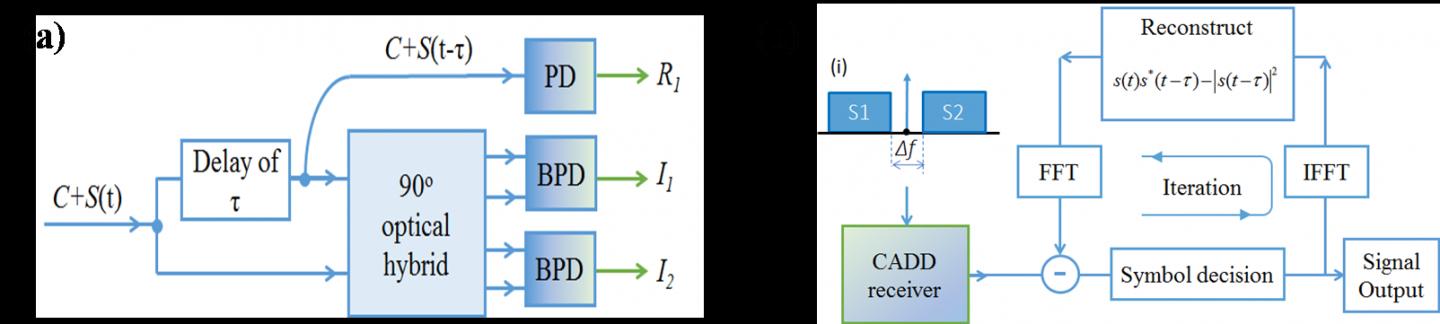
The gist of the new scheme lies in adopting an optical interferometer and 90-degree optical hybrid in the receiver which is capable of detecting both inphase and quadrature components of the linear optical field. Furthermore, the higher-order nonlinear product is mitigated by a novel iterative cancellation algorithm (See Figure below). These engineers summarize the operational principle of their receiver:
“CADD possesses two advantages over conventional carrier-less differential detection (CDD) for field recovery: (i) CADD doubles the electrical SE compared to CDD, as CADD recovers the linear signal while CDD needs to recover the 2nd-order signal-to-signal beating term, and (ii) CADD is insensitive to chromatic dispersion, while CDD is not. This is because without a carrier, the field of CDD can reach zero, which makes differential detection impossible for large chromatic dispersion”
“The advantage of CADD over the Kramers-Kronig (KK) receiver in direct detection is analogous to that of homodyne over heterodyne receivers in coherent detection – although CADD requires a larger number of components, it reduces the optoelectronic bandwidth by half. By adopting photonic integration, either in the InP or silicon photonics (SiP) platform, the large component count in CADD will be much mitigated, while the reduced bandwidth of CADD will greatly reduce the overall implementation cost. Compared to coherent homodyne receivers, CADD does not require highly stable and low-linewidth lasers, leading to a more compact and cost-effective solution suitable for short-reach applications such as intra-data interconnects and ultra-high-speed wireless fronthaul networks” they added.
“The receiver architecture opens a new class of direct detection schemes that are scalable to high baud rate and suitable for photonic integration. It would be very useful for short-reach applications such as intra-data interconnects and ultra-high-speed wireless fronthaul networks” the engineers forecast.
###
This work was supported by Australian Research Council (ARC) Discovery Projects Under the Grants Nos. DP150101864 and DP190103724.
Media Contact
William Shieh
[email protected]
Related Journal Article
http://dx.