The history of science is a series of paradigm shifts – conventional theories debunked and replaced by new discoveries. Kanso Bioinspired Motion Lab at USC Viterbi School of Engineering has made a habit of such paradigm shifts, publishing their findings in leading journals.
Credit: IMAGE BY JANNA NAWROTH*
The history of science is a series of paradigm shifts – conventional theories debunked and replaced by new discoveries. Kanso Bioinspired Motion Lab at USC Viterbi School of Engineering has made a habit of such paradigm shifts, publishing their findings in leading journals.
The lab’s most recent paper, published in Nature Physics, is titled “Flow Physics Guides Morphology of Ciliated Organs” and presents a new understanding of the connection between two distinct mechanisms for pumping fluids in living organisms: the “flame” model and the “carpet” model of ciliated ducts.
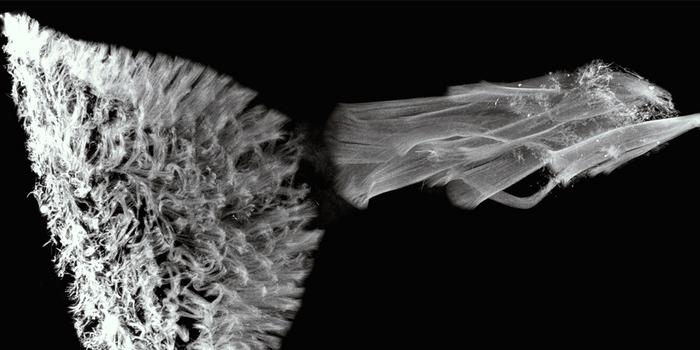
In humans, ciliated tissues pump fluids in the airways, brain ventricles, spinal canal and reproductive system. These cilia are characterized by the “carpet” design – imagine a dense layer of short fibers perpendicular to the epithelial surface. Many animals also feature ducts with a strikingly different cilia arrangement: the ciliary flame design, where tightly packed, comparatively long cilia beat longitudinally along a narrow lumen.
Ciliary flames are not found in large multicellular organisms such as human beings, leading to the understanding that these two morphologies, carpets and flames, are differentiated by evolutionary processes. However, Professor Eva Kanso and her team of researchers, notably co-authors USC PhD student Feng Ling* and research scientist Janna Nawroth*, have discovered that the distinction is in fact dependent on distinct fluid pumping needs.
In other words, form follows function. The team proposes that convergence of ciliated organ designs follows mechanistic constraints rather than phylogenetic trajectory (evolutionary and relational development).
The paper presents a series of universal design rules for ciliary pumps: a unified fluid model that proposes an unforeseen continuity between the two typically opposed models. Two structural parameters, lumen diameter and cilia-to-lumen ratio, organize the ciliated duct diversity into a continuous spectrum that connects carpets to flames.
At either end of the spectrum, results indicate maximized flow rate and pressure generation (consistent with physiological requirements for bulk transport and filtration), whereas intermediate designs along the morphological spectrum constitute optimally efficient hybrids.
The new findings enable greater clarity when studying and managing major pathologies that are associated with cilia malfunction and fluid buildup, including bronchiectasis, hydrocephalus and ectopic pregnancy. The findings also advance understanding of the functioning of specific organs. For instance, ciliary flames that pump fluid for the purpose of excretion provide a model system for studying human kidney disease.
Despite the fundamental importance of ciliated organs s in animal physiology, the relationship between ciliated duct morphology and their ability to pump fluid had remained largely unexplored, due to the difficulty in measuring ciliary beat and fluid flow in intact internal ducts. By tackling this challenging area of research both experimentally and using mathematical modeling, Kanso Lab proposes a new approach that is both innovative and intuitive. A dichotomy is reframed as a continuum, and a significant challenge in science and engineering is one step simpler.
*Currently at Nawroth Mechanobiology Lab, Helmholtz Pioneer Campus, Munich
Journal
Nature Physics
Article Title
“Flow Physics Guides Morphology of Ciliated Organs”
Article Publication Date
29-Jul-2024