


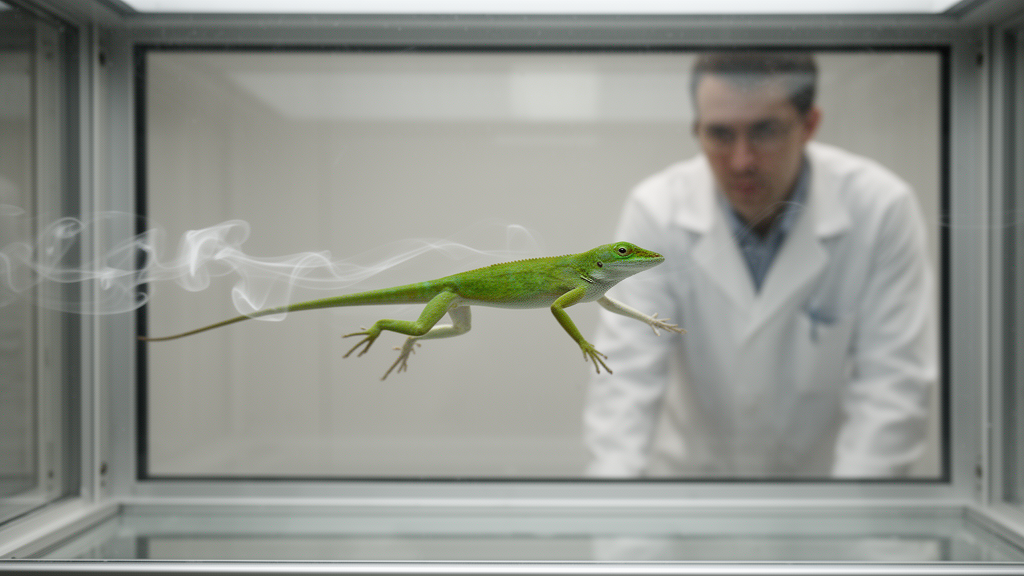
Anole lizards have no wings, no skin flaps, and no webbed feet, yet dropped into a vertical column of moving air they do not simply plummet. A new study published in BMC Ecology and Evolution reports that all five tested species of these Caribbean lizards adopted a stereotypical skydiving posture and executed controlled, non-vertical descents, steering their bodies through the air with nothing more than limb position, body orientation, and tail movements. The finding suggests that rudimentary aerial control may be far more widespread among arboreal animals than the presence of dedicated gliding structures would imply.
The research, conducted by Erik Andrew Sathe and Robert Dudley at the University of California, Berkeley, examined five anole species representing three of the classic Caribbean ecomorphs: the trunk-ground forms Anolis cristatellus and A. sagrei, the trunk-crown forms A. carolinensis and A. coelestinus, and the crown giant A. equestris. In the study, twenty-three individuals from five species were used, with fifteen gliding trials planned for each lizard in a vertically oriented wind tunnel; 114 trials in total met the criteria for detailed three-dimensional kinematic reconstruction.
During the trials, lizards were released by hand into the upward airstream roughly 25 centimeters above the arena floor, and three synchronized cameras filming at 400 frames per second recorded their movements from one dorsal and two lateral perspectives. Landmarks painted on the head between the eyes, at four points along the midline, and at the tail tip were tracked in three dimensions, allowing the researchers to compute vertical and horizontal velocities, accelerations, glide angles, and glide ratios. The mean wind speed used in flight trials was 11.6 meters per second, and the authors report that spatial variation in wind speed across the working section was comparable to naturally occurring spatial variation along vertical gradients within forest canopies.
Every lizard, upon release, assumed the same characteristic posture: limbs splayed laterally, body held dorsoventrally upright, a configuration that maximizes the projected surface area presented to the airflow and enhances aerodynamic force production. All individuals then produced non-vertical glides with measurable horizontal displacement, though at very steep angles. The best glider, A. carolinensis, achieved a minimum glide angle of roughly 85 degrees, while the other species reached angles of about 86.5 degrees.
Performance varied among species in ways that tracked body size. Anolis carolinensis, the lightest study animal at around 4.5 grams on average, descended at the slowest vertical velocity, about 9.5 meters per second, and posted the highest maximum horizontal velocity at 0.82 meters per second. The crown giant A. equestris, averaging roughly 13 grams even as juveniles, fell fastest at about 12.1 meters per second. When the researchers accounted for the phylogenetic relatedness of the five species using phylogenetic generalized least squares regressions, body mass emerged as a significant negative predictor of vertical velocity, and wing loading was significantly and inversely correlated with maximum glide ratio, meaning animals carrying less mass per unit of ventral surface area tended to achieve shallower glides.
Perhaps the most striking result was what did not differ. The three ecomorphs varied significantly in body mass and ventral surface area, but wing loading and every measured kinematic variable showed no statistically significant differences among ecomorph categories. The hypothesis that trunk-ground lizards, which live low on tree trunks and frequently leap to the ground, would perform worse in the air than trunk-crown species occupying higher perches was not supported. Even the two trunk-crown species diverged sharply from one another, with A. carolinensis clearly outperforming its heavier relative A. coelestinus, while the two trunk-ground species performed similarly.
Qualitative observations hinted at behavioral differences that statistics on averaged variables might miss. The trunk-crown species frequently performed S-shaped lateral body oscillations as they moved through the air, movements the authors suspect contribute to thrust production, and both executed large, rapid tail displacements that appear to facilitate yaw control, possibly through inertial mechanisms. Trunk-ground and crown giant lizards, by contrast, kept their limbs laterally extended, rarely oscillated their bodies, and used smaller tail deviations, raising the tail above the body plane and rotating it clockwise or counterclockwise in motions likely serving yaw stability. The authors suggest these muted dynamics may indicate less active aerial control.
The study has important caveats. The glides recorded were transient and non-equilibrium: lizards were dropped directly into a vertical airstream, so aerodynamic forces never had time to equilibrate into steady-state gliding, and the steep glide ratios reflect a time-averaged mixture of accelerations. Only a single species represented the crown giant ecomorph, and the A. equestris individuals studied were juveniles because adults are too large to glide within the wind tunnel; the authors note that their body dynamics and kinematics are likely representative of adults given isometric scaling in the species. Wing loading for A. equestris may also have been underestimated, since the animals grew substantially during the six weeks of trials while surface area was measured only at the end. With just five species, the authors acknowledge that apparent ecomorph patterns merit further investigation.
Why does any of this matter ecologically? In steep glides, even small differences in descent velocity meaningfully change kinetic energy at impact and therefore injury risk. The roughly 2.5 meter per second, or about 20 percent, difference between the fastest and slowest species is enough to substantially alter the energy of a landing. For heavy crown giants perching near the treetops, where the cost of falling is highest, the authors propose an evolutionary tradeoff: the advantages of being a large canopy predator may simply outweigh the costs of reduced gliding performance, particularly since these animals spend more time near the trunk and need less horizontal translation to reach a safe landing site.
The broader evolutionary implication is that behavior may precede morphology. None of these lizards possess the patagia, skin folds, or interdigital webbing of dedicated gliders, yet all demonstrated aerial control through posture and subtle movements. The inverse relationship between wing loading and glide performance, consistent with findings in other aerially capable lizards, hints that relatively modest differences in surface area and mass could be the raw material from which selection, over evolutionary time, shapes more specialized gliding structures. The authors suggest that controlled aerial descent may be widespread not only within Anolis but among arboreal lizards generally, and even among invertebrates and other vertebrates dwelling in low vegetation, and they call for future work on takeoff behavior, limb kinematics during maneuvers, and additional species, including adult crown giants and the twig ecomorph anoles known to glide in the wild.
Subject of Research: Gliding performance and aerial control in five Anolis lizard species representing three Caribbean ecomorphs
Article Title: Comparative gliding performance of Anolis lizards among three Caribbean ecomorphs
Article References: Sathe, E. A., & Dudley, R. (2026). Comparative gliding performance of Anolis lizards among three Caribbean ecomorphs. BMC Ecology and Evolution, 26(1), Article 81. https://doi.org/10.1186/s12862-026-02586-w
Image Credits: AI Generated
DOI: 10.1186/s12862-026-02586-w
Keywords: Anolis lizards, gliding, ecomorphs, wind tunnel, biomechanics, wing loading, directed aerial descent, Caribbean, locomotion, evolution, kinematics, arboreal
News Source: Drew Townsend. (October 30, 2026). Caribbean Anole Lizards Glide Without Wings, Wind Tunnel Study Finds. Scienmag.



