• HOME
  • NEWS
  • EXPLORE
    • CAREER
      • Companies
      • Jobs
    • EVENTS
    • iGEM
      • News
      • Team
    • PHOTOS
    • VIDEO
    • WIKI
  • BLOG
  • COMMUNITY
    • FACEBOOK
    • INSTAGRAM
    • TWITTER
Friday, May 15, 2026
BIOENGINEER.ORG
No Result
View All Result
  • Login
  • HOME
  • NEWS
  • EXPLORE
    • CAREER
      • Companies
      • Jobs
        • Lecturer
        • PhD Studentship
        • Postdoc
        • Research Assistant
    • EVENTS
    • iGEM
      • News
      • Team
    • PHOTOS
    • VIDEO
    • WIKI
  • BLOG
  • COMMUNITY
    • FACEBOOK
    • INSTAGRAM
    • TWITTER
  • HOME
  • NEWS
  • EXPLORE
    • CAREER
      • Companies
      • Jobs
        • Lecturer
        • PhD Studentship
        • Postdoc
        • Research Assistant
    • EVENTS
    • iGEM
      • News
      • Team
    • PHOTOS
    • VIDEO
    • WIKI
  • BLOG
  • COMMUNITY
    • FACEBOOK
    • INSTAGRAM
    • TWITTER
No Result
View All Result
Bioengineer.org
No Result
View All Result
Home NEWS Science News Chemistry

Carbon soccer ball with extra proton probably most abundant form in space

Bioengineer by Bioengineer
November 25, 2019
in Chemistry
Reading Time: 3 mins read
0
IMAGE
Share on FacebookShare on TwitterShare on LinkedinShare on RedditShare on Telegram

IMAGE

Credit: Radboud University


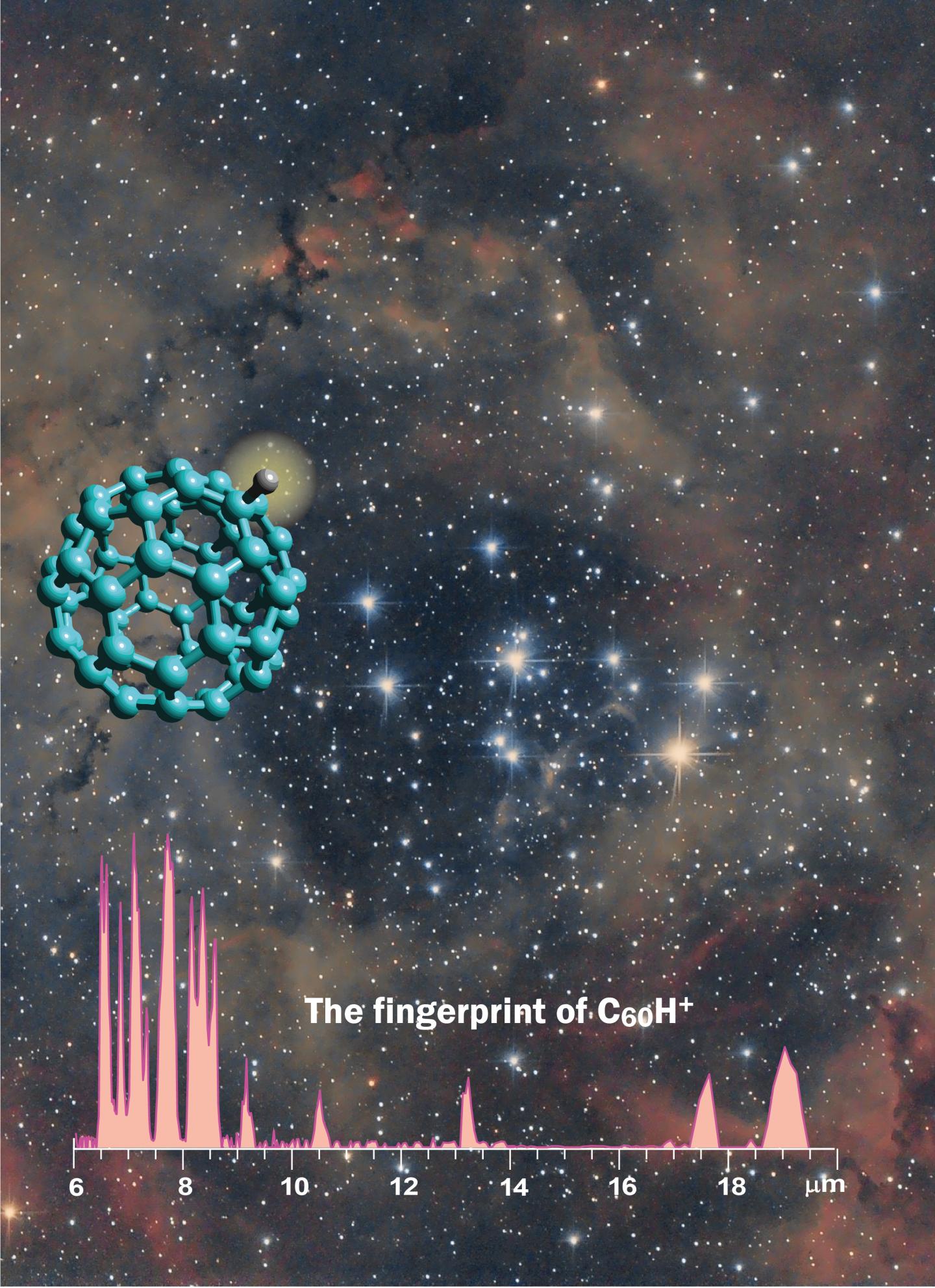
It is one of the most common forms of carbon in space: C60, a soccer ball-shaped carbon molecule, but one that has an extra proton attached to it. This is the conclusion of research carried out at Radboud University, which has succeeded for the very first time in measuring the absorption spectrum of this molecule. Such knowledge could ultimately help us to learn more about the formation of planets. The researchers will publish their findings on November 25th in Nature Astronomy.

“Almost every property of the iconic C60 molecule – also called a molecular soccer ball, Buckminsterfullerene or buckyball – that can be measured, has been measured,” says Jos Oomens, professor of Molecular Structure and Dynamics at Radboud University. Even so, he and his colleagues have managed to measure something new: the absorption spectrum of the molecule in its protonated form, C60H+.

“In doing so, we show that it is probably abundant in interstellar clouds, while we also demonstrate a textbook example of the role of symmetry in molecular physics”, explains Oomens.

Carbon football in space

When the astronomer Harry Kroto discovered C60 in 1985, he predicted that, due to its high stability, this new form of carbon would be widespread in space. C60 consists of 60 carbon atoms in the form of a soccer ball, and has the highest possible symmetry in molecular physics. And indeed, over the last ten years, C60 has been detected in many interstellar clouds.

It is important for astronomers to determine the chemical composition of such interstellar clouds, because this is where new stars and planets are formed, including our own solar system. The more we learn about the molecules present in these clouds, the more we can discover about how our own planet was formed. C60 is one of the most complex molecules identified so far in these clouds.

Kroto also predicted that not C60, but the protonated version of the molecule, would be the most prevalent in space. Now the researchers have shown for the first time that this could in fact be the case. “When we compared the infrared spectra emitted by interstellar clouds with our infrared spectrum for protonated C60, we found a very close match”, explains Oomens.

Colour change due to symmetry loss

Protonated C60 has a proton (H+) attached to the outside of the football, which means that the molecule loses its perfect symmetry. “Our research shows that, as a result, protonated C60 absorbs many more colours of light than ‘normal’ C60. In fact, you could say that C60H+ has a very different colour compared with the C60 molecule, although this is in the infrared spectrum. This is a well-known effect in molecular physics, and is beautifully demonstrated in the new spectrum.”

This is the first time that researchers have successfully measured the light absorption spectrum of protonated C60. Because of the charge on the molecules, they repel one another, and this makes it difficult to obtain a sufficiently high density to obtain an absorption spectrum. “We found a way to work around this using the free-electron laser at the FELIX laboratory. By combining the FELIX laser with a mass spectrometer, C60H+ disintegrates and we can detect the fragmented ions rather than measuring the direct absorption spectrum.”

###

Media Contact
Jos Oomens
[email protected]
31-243-653-950

Related Journal Article

http://dx.doi.org/10.1038/s41550-019-0941-6

Tags: AstrophysicsAtomic/Molecular/Particle PhysicsChemistry/Physics/Materials SciencesMolecular Physics
Share12Tweet8Share2ShareShareShare2

Related Posts

Personalized beverages offer vital nutrients for space missions, new study reveals — Chemistry

Personalized beverages offer vital nutrients for space missions, new study reveals

May 15, 2026
Synthetic Cell Microreactor with Dual Dynamic DNA Pores — Chemistry

Synthetic Cell Microreactor with Dual Dynamic DNA Pores

May 15, 2026

Hanyang University Researchers Pinpoint 2.5 Nanometers as Minimum Coating Thickness for Durable Solid-State EV Batteries

May 15, 2026

Smart Hydrogels Revolutionize Information Security with Photo-Patterning and Multi-Stimuli Responsive Structural Colors

May 15, 2026
Please login to join discussion

POPULAR NEWS

  • Research Indicates Potential Connection Between Prenatal Medication Exposure and Elevated Autism Risk

    843 shares
    Share 337 Tweet 211
  • New Study Reveals Plants Can Detect the Sound of Rain

    729 shares
    Share 291 Tweet 182
  • Salmonella Haem Blocks Macrophages, Boosts Infection

    62 shares
    Share 25 Tweet 16
  • Breastmilk Balances E. coli and Beneficial Bacteria in Infant Gut Microbiomes

    58 shares
    Share 23 Tweet 15

About

We bring you the latest biotechnology news from best research centers and universities around the world. Check our website.

Follow us

Recent News

Precision Anti-Aging Strategies Focus on Eliminating Harmful Senescent Cells While Preserving Beneficial Ones

CityUHK Leads Innovation in Safer Aqueous Zinc Battery Technology

Observing Reproductive Behavior of Black Sea Bream: Patrolling Males and Waiting Females in the Wild

Subscribe to Blog via Email

Enter your email address to subscribe to this blog and receive notifications of new posts by email.

Join 82 other subscribers
  • Contact Us

Bioengineer.org © Copyright 2023 All Rights Reserved.

Welcome Back!

Login to your account below

Forgotten Password?

Retrieve your password

Please enter your username or email address to reset your password.

Log In
No Result
View All Result
  • Homepages
    • Home Page 1
    • Home Page 2
  • News
  • National
  • Business
  • Health
  • Lifestyle
  • Science

Bioengineer.org © Copyright 2023 All Rights Reserved.