Approximately seventy-five years ago, the serendipitous synthesis of ferrocene revolutionized the field of transition metal chemistry. This compound, wherein an iron (Fe) atom is symmetrically sandwiched between two cyclopentadienyl (C₅H₅) rings, not only broadened our understanding of organometallic frameworks but also catalyzed advances across catalysis, materials science, biology, and medicine. Its iconic “sandwich” structure, (C₅H₅)Fe(C₅H₅), demonstrated the unique ability of carbon-based rings to coordinate transition metals with remarkable stability and versatility, a feature long sought but never replicated with elements other than carbon—until now.
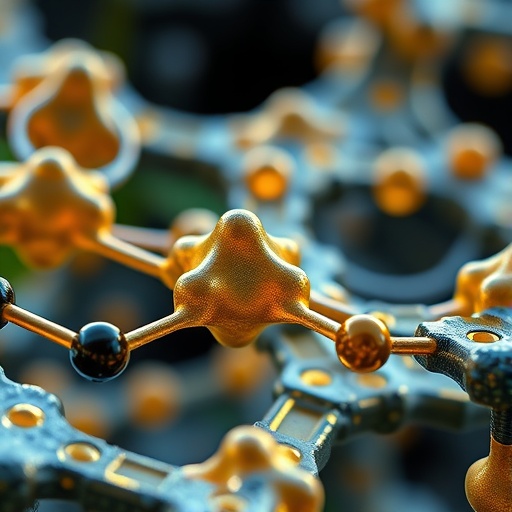
In a groundbreaking study recently published in Science, researchers from the Indian Institute of Technology Madras (IITM) and the Indian Institute of Science (IISc) have synthesized a carbon-free analog of ferrocene by replacing carbon rings with boron-based ligands. This monumental achievement was realized using osmium (Os), a transition metal in the same group as iron, to coordinate two pentaborane-based rings, specifically (B₅H₁₀). The resulting complex, denoted as [Os(η⁵-B₅H₁₀)₂], emulates the structural aesthetics of ferrocene while exhibiting a fundamentally different and stronger bonding paradigm.
The conceptual leap to boron arose from the challenge of proving that the “sandwich” motif—once thought to be a hallmark of carbon chemistry—could extend to other elements in the periodic table. Such an achievement not only pushes the boundaries of inorganic chemistry but also unlocks new avenues for material design. Boron, with its electron-deficient yet versatile bonding characteristics, poses a unique candidate for constructing stable cyclic frameworks analogous to carbon rings. By exploiting boron’s ability to form multicenter bonds and rich cluster chemistry, the researchers have demonstrated the element’s latent potential to mimic complex organometallic architectures.
Central to the synthesis was the strategic employment of thermolysis, a controlled heating process that facilitates the reaction between an osmium precursor and a boron-hydrogen source at approximately 100 degrees Celsius. This precise thermochemical environment enabled the formation and stabilization of the boron sandwich complex, which manifested as a colourless crystalline solid. Comprehensive structural validation via X-ray diffraction and nuclear magnetic resonance (NMR) spectroscopy confirmed the distinct sandwich configuration, positioning osmium centrally between two planar boron hydride pentagons.
Remarkably, the study revealed that the boron-based sandwich possesses a bonding interaction surpassing that of its carbon counterpart. The enhanced stability derives predominantly from the presence of B-H and bridging B-H-B hydrogen atoms within the boron rings. These hydrogens act as electron-donating sites, effectively increasing the orbital overlap with the osmium metal center, thereby strengthening metal-ligand bonds. This phenomenon contrasts with the carbon-based cyclopentadienyl rings, wherein electronic interactions rely primarily on delocalized π-electrons without the additional stabilizing influence of bonding hydrogen atoms.
Beyond replicating ferrocene’s basic architecture, the research also illuminated the existence of a novel isomeric form of the compound. This alternate structure features an unconventional mode of ring-metal coordination not previously observed in traditional ferrocene chemistry. Such diversity in bonding topologies underscores the broader versatility of boron clusters, suggesting that boron-metal interactions can afford unprecedented structural motifs and electronic properties, expanding the chemical space far beyond carbon analogs.
The collaborative efforts led by Eluvathingal D. Jemmis (National Science Chair-ANRF at IISc) and Sundargopal Ghosh (Professor at IITM) reflect over fifteen years of pioneering work on polyhedral boranes stabilized with transition metals. Their approach integrated orbital engineering principles to design target molecules like [Os(η⁵-B₅H₁₀)₂], leveraging computational insights alongside synthetic ingenuity. This union of theory and experiment marks a milestone in controlling boron-based architectures, potentially enabling the tailored design of boron-rich organometallic entities for bespoke applications.
Zooming out, the implications of this discovery resonate with recent surges in boron chemistry, notably the advent of two-dimensional boron allotropes—borophenes. These atomically thin sheets have drawn substantial interest due to their remarkable electronic, mechanical, and chemical properties. Jemmis envisions that his group’s progress heralds a forthcoming era where metal-intercalated boron bilayers and multilayers could become commonplace. Such materials might rival or even surpass graphene in a variety of technological applications, including electronics, catalysis, and energy storage, shaped by the unique bonding environments introduced by boron-metal frameworks.
Fundamental to this advancement is the validation that boron can rival carbon not only in forming stable, planar cyclic ligands but also in accommodating diverse coordination geometries and bonding patterns. This paradigm shift challenges the long-held perception of carbon’s exclusivity in organometallic sandwich compounds and invites a reevaluation of bonding theories within the context of electron-deficient systems. Additionally, these findings augment our understanding of multicenter bonding contributions and hydrogen’s role in enhancing transition metal stabilization.
Furthermore, the synthetic methodology established by the IITM and IISc team opens new experimental routes for exploring transition metal complexes with boron clusters, which could translate into novel catalytic platforms or materials with exceptional thermal and chemical resilience. Potential future research directions include studying the reactivity patterns of such complexes, tuning ring substituents to modulate electronic properties, and exploring heavier homologs or heteroatom substitutions to diversify this burgeoning chemical family.
In sum, the successful creation of a carbon-free ferrocene analog featuring osmium and boron pentahydride rings extends the frontiers of inorganic chemistry and atomic bonding paradigms. This innovative work not only pays homage to the original serendipity of ferrocene’s discovery but also inaugurates an exciting new chapter in boron chemistry, promising transformative impacts across materials science, catalysis, and beyond. As these new boron-metal sandwiches enter textbooks and laboratories worldwide, their full potential is only beginning to be realized.
Subject of Research:
Boron-based organometallic sandwich complexes as carbon-free analogs of ferrocene.
Article Title:
[Os(η⁵-B₅H₁₀)₂]: A carbon-free analog of ferrocene
News Publication Date:
23-Apr-2026
Web References:
http://dx.doi.org/10.1126/science.aed9192
Image Credits:
Suvam Saha
Keywords
Transition metals, Boron clusters, Organometallic chemistry, Synthetic chemistry, Chemical bonding, Borophenes, Hydrogen bonding, Materials, Catalysis
Tags: [Os(η⁵-B₅H₁₀)₂] structure analysisadvances in transition metal catalysisalternative to carbon cyclopentadienyl ringsboron ring coordination chemistryboron-based ligands in organometallic chemistrycarbon-free ferrocene analognext-generation organometallic materialsnovel bonding paradigms in metal complexesorganometallic frameworks beyond carbonosmium pentaborane complex synthesistransition metal sandwich compounds