• HOME
  • NEWS
  • EXPLORE
    • CAREER
      • Companies
      • Jobs
    • EVENTS
    • iGEM
      • News
      • Team
    • PHOTOS
    • VIDEO
    • WIKI
  • BLOG
  • COMMUNITY
    • FACEBOOK
    • INSTAGRAM
    • TWITTER
Tuesday, May 12, 2026
BIOENGINEER.ORG
No Result
View All Result
  • Login
  • HOME
  • NEWS
  • EXPLORE
    • CAREER
      • Companies
      • Jobs
        • Lecturer
        • PhD Studentship
        • Postdoc
        • Research Assistant
    • EVENTS
    • iGEM
      • News
      • Team
    • PHOTOS
    • VIDEO
    • WIKI
  • BLOG
  • COMMUNITY
    • FACEBOOK
    • INSTAGRAM
    • TWITTER
  • HOME
  • NEWS
  • EXPLORE
    • CAREER
      • Companies
      • Jobs
        • Lecturer
        • PhD Studentship
        • Postdoc
        • Research Assistant
    • EVENTS
    • iGEM
      • News
      • Team
    • PHOTOS
    • VIDEO
    • WIKI
  • BLOG
  • COMMUNITY
    • FACEBOOK
    • INSTAGRAM
    • TWITTER
No Result
View All Result
Bioengineer.org
No Result
View All Result
Home NEWS Science News Health

Carbon dots make calcium easier to track

Bioengineer by Bioengineer
November 12, 2019
in Health
Reading Time: 2 mins read
0
IMAGE
Share on FacebookShare on TwitterShare on LinkedinShare on RedditShare on Telegram

IMAGE

Credit: SIBET


In hospitals, doctors often advise patients to take calcium supplements. But does the calcium get into the cells that need it? Until recently, it’s been hard to tell.

But now, Prof. DONG Wenfei’s research group from the Suzhou Institute of Biomedical Engineering and Technology (SIBET) has developed a new type of fluorescent carbon dot that can effectively detect calcium levels in cells.

Calcium is essential to the life. Calcium ions regulate a variety of important cellular functions such as differentiation, proliferation, growth and gene transcription.

In addition, studies have reported that calcium status in cancer cells is associated with tumorigenesis, metastasis and angiogenesis. Other studies have also shown that abnormal changes in intracellular Ca2+ concentration are associated with the occurrence and development of Parkinson’s disease, Huntington’s disease and Alzheimer’s disease. Thus, detection of intracellular calcium levels is very important.

Conventional methods for calcium ion detection such as atomic absorption spectroscopy (AAS) and nuclear magnetic resonance (NMR) require expensive equipment and tedious sample preparation, limiting their applications in intracellular detection. Therefore, developing affordable, efficient, sensitive and simple techniques for detecting Ca2+ ions in cells is a priority. Fortunately, fluorescence detection meets these requirements.

As a new fluorescent probe, carbon dots (CDs) have been widely used in ion and small-molecule detection due to their extraordinary performance, which includes water solubility, excellent stability, nontoxicity, adjustable fluorescence and high quantum yield.

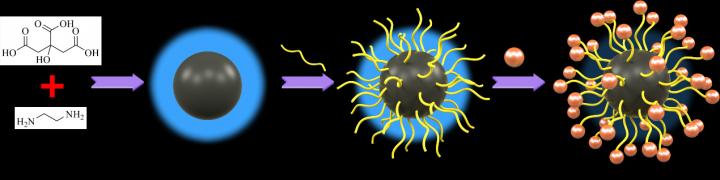
In this study, the researchers used an innovative approach to preparing functional CDs. They first synthesized the CDs from citric acid and ethylenediamine using a hydrothermal method. Then they modified the surface of the CDs with EGTA by reheating the solution.

This is a simple and convenient chemical preparation method, compared with the traditional cross-linking procedure, because all reactions are carried out in the same autoclave. The EGTA-modified CDs are the final product; no secondary purification and separation is required.

This work entitled “Two-Step Hydrothermal Preparation of Carbon Dots for Calcium Ion Detection” has been published on the ACS Applied Materials & Interface.

The CDs exhibit bright blue fluorescence. As calcium concentration increases, the fluorescence intensity drops sharply.

Cellular experiments show that CDs are nontoxic and have good biocompatibility, suggesting they may be a useful probe for intracellular Ca2+ detection.

In the future, researchers expect to develop fluorescent carbon dots in the near-infrared band with strong penetration. The distribution of calcium ions in internal organs could then be detected nondestructively.

###

Media Contact
XIAO Xintong
[email protected]

Original Source

http://english.cas.cn/newsroom/research_news/life/201911/t20191112_223119.shtml

Related Journal Article

http://dx.doi.org/10.1021/acsami.9b13737

Tags: cancerMedicine/HealthTechnology/Engineering/Computer Science
Share12Tweet8Share2ShareShareShare2

Related Posts

Medicaid Expansion Reduces Mortality in Young Adults with Kidney Failure

May 11, 2026

CRISPR Technology Shows Promise in Inhibiting Hepatitis E Virus

May 11, 2026

Mapping Ocular Bioenergetics: Insights into TCA Cycle Intermediates and Gender Differences in Eye Tissues

May 11, 2026

Telemedicine Does Not Drive Higher Medical Utilization or Health Care Costs, Study Finds

May 11, 2026
Please login to join discussion

POPULAR NEWS

  • Research Indicates Potential Connection Between Prenatal Medication Exposure and Elevated Autism Risk

    841 shares
    Share 336 Tweet 210
  • New Study Reveals Plants Can Detect the Sound of Rain

    728 shares
    Share 290 Tweet 182
  • Salmonella Haem Blocks Macrophages, Boosts Infection

    62 shares
    Share 25 Tweet 16
  • Breastmilk Balances E. coli and Beneficial Bacteria in Infant Gut Microbiomes

    57 shares
    Share 23 Tweet 14

About

We bring you the latest biotechnology news from best research centers and universities around the world. Check our website.

Follow us

Recent News

Humans and Zebra Finches Share Similar Speech Learning Techniques #ASA190

New Study Uncovers How Fungal Parasites Attack Strawberries and Raspberries

City of Hope Researchers to Present Groundbreaking Immunotherapy and Precision Medicine Advances Across Multiple Cancer Types at ASCO 2026

Subscribe to Blog via Email

Enter your email address to subscribe to this blog and receive notifications of new posts by email.

Join 82 other subscribers
  • Contact Us

Bioengineer.org © Copyright 2023 All Rights Reserved.

Welcome Back!

Login to your account below

Forgotten Password?

Retrieve your password

Please enter your username or email address to reset your password.

Log In
No Result
View All Result
  • Homepages
    • Home Page 1
    • Home Page 2
  • News
  • National
  • Business
  • Health
  • Lifestyle
  • Science

Bioengineer.org © Copyright 2023 All Rights Reserved.