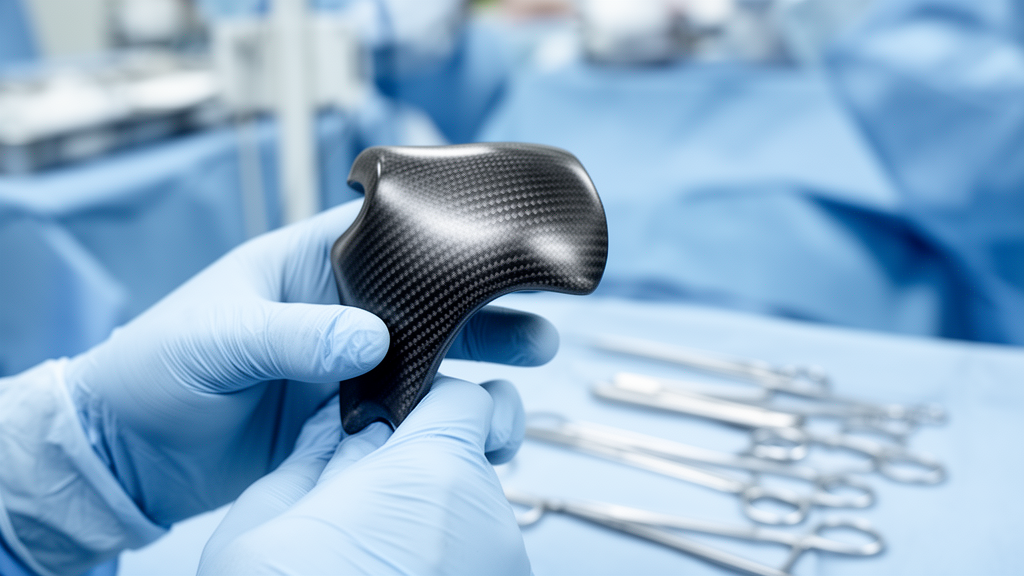
Pyrocarbon, a form of carbon produced by breaking down hydrocarbon gases at extreme temperatures without oxygen, has quietly become one of the most intriguing materials in modern shoulder surgery. A narrative review published in Biomedical Materials Science pulls together the material’s physical properties, manufacturing process and accumulating clinical record, arguing that pyrocarbon implants may offer younger patients an alternative to conventional metal and polyethylene implants whose long-term complications can be difficult to reverse.
The material’s pedigree is unusual for orthopaedics. Pyrocarbon was first developed in the 1950s as a cladding material for nuclear fuel, prized for its resistance to high temperature and its durability. Its biocompatibility was recognised soon after, and from 1969 the company CarboMedics began manufacturing components for mechanical heart valves using a silicon carbide alloyed version of the material. Pure pyrocarbon, marketed as On-X Carbon, entered orthopaedic implants in 1979 and has since delivered satisfactory long-term results, particularly in the small joints of the hand and wrist. It remains the principal material used in mechanical heart valves worldwide, a testament to its tribological durability and blood compatibility.
What makes pyrocarbon attractive in a joint is its mechanical similarity to the tissue it touches. The elastic modulus of pyrocarbon, roughly 25 to 30 gigapascals, sits far closer to that of cortical bone, approximately 11 to 17 gigapascals, than the much stiffer titanium or cobalt-chromium alloys. Implants made of pyrocarbon-coated graphite can therefore transmit and distribute loads in a more physiological manner, with less stress-shielding and bone resorption at the contact points. Finite element analysis of spherical implants articulating against bone suggests that a rigid ceramic sphere concentrates stress in the bone near the contact area, a polyethylene sphere shields the bone from stress but deforms through creep, while a pyrocarbon sphere shares stresses more evenly between implant and bone.
The material is not without fragility. Like ceramics generally, pyrocarbon and its graphite core are relatively brittle, with high resistance to compression but low resistance to bending, and they are theoretically susceptible to crack initiation and subcritical crack growth that can end in delayed fracture. In practice, the review notes that at ambient and body temperatures the crystallographic mechanisms for crack propagation in pyrocarbon are negligible and complications are rare. Tests on pyrocarbon humeral heads made by Tornier, a Stryker subsidiary, indicated a very low risk of acute breakage or delayed fracture during anticipated clinical use, although the material’s brittleness restricts the permissible geometric configurations of pyrocarbon-coated implants subjected to significant lever arms.
Wear behaviour is where the evidence is most striking. In vitro simulator testing compared pyrocarbon and cobalt-chromium humeral heads articulating against bone: the pyrocarbon surface appeared undamaged after five million cycles, with no significant change in surface roughness, whereas the cobalt-chromium testing had to be discontinued at 320,000 cycles. Microscopic examination found no pyrocarbon wear particles embedded in the bone. Animal studies likewise suggest pyrocarbon is much less damaging to native cartilage and bone than metal alloys. From a biomolecular perspective, surface-active phospholipids in synovial fluid, which provide boundary lubrication in natural joints, attach more readily to pyrocarbon than to metallic surfaces, a property hypothesised to contribute to lower cartilage wear and reduced revision rates compared with metal hemiarthroplasty.
Biologically, pyrocarbon is chemically stable and bioinert, likely because carbon does not form ions or free radicals as metals can. The review reports no published cases of toxicity, allergy or immune reaction attributable to the material in orthopaedic use. Its hemocompatibility, which underpins its cardiac history, stems from a hydrophobic surface that adsorbs a protein layer and prevents platelet aggregation. There are even hints of tissue adaptation: in vitro work found that pyrocarbon friction against chondrocytes induces type II collagen generation, a marker of cartilage growth, and histological analysis of explanted pyrocarbon hemiarthroplasties showed cartilage-like tissue forming between the implant and the contacted cortical bone.
The clinical history in the shoulder began in 2010, when Tornier introduced the Inspyre spherical pyrocarbon interposition device, marketed as pyrocarbon interposition shoulder arthroplasty, while Ascension Orthopaedics launched the PyroTITAN resurfacing hemiarthroplasty at nearly the same time. The early resurfacing designs struggled: pyrocarbon does not osseointegrate and cannot be cemented, so fully pyrocarbon implants depend on precise geometric matching to bone for stability, and the finned resurfacing shell faced fixation problems, pain and implant breakage before being withdrawn and modified. Contemporary designs sidestep this by coupling a pyrocarbon humeral head to a conventional metal stem through a factory-assembled metal coupler, allowing secure fixation while keeping the favourable bearing surface. The first post-market pyrocarbon humeral head case in the United States was completed on 20 March 2023.
The registry and cohort data reviewed are cautiously encouraging but far from uniform. An analysis of the Australian Orthopaedic Association National Joint Replacement Registry found that pyrocarbon humeral resurfacing hemiarthroplasty had statistically lower mid-term revision rates than metal resurfacing or metal stemmed hemiarthroplasty in patients under 55 with osteoarthritis, with a hazard ratio of 0.41 and a six-year cumulative revision rate of 8.9 percent versus 17.1 and 17.5 percent for the metal alternatives. Revisions were driven mainly by pain, prosthesis fracture and infection, with none attributed to glenoid erosion. A quantitative study by Mathon and colleagues found glenoid wear of less than 0.6 millimetres at a mean follow-up of three years, roughly five times less than with metallic implants. Kleim and colleagues, following 31 patients for an average of 5.5 years, recorded glenoid erosion averaging 0.3 millimetres per year after an initial bedding-in period, significant improvement in Constant scores from 45.0 to 78.8, and no revisions, although erosion correlated only weakly with pain improvement.
Not all results support enthusiasm. Mid-term follow-up of the interposition Inspyre implant has been mixed, with one study finding that the device does not protect against progressive glenoid erosion and can lead to greater tuberosity erosion and stress fractures. Outcomes in patients with posteriorly worn, type B or C glenoids were considerably lower than expected, with worsening posterior translation in some patients, making these inappropriate indications. In Garret and colleagues’ cohort of 45 pyrocarbon hemiarthroplasty patients followed for a mean of 6.2 years, clinical scores remained stable, but moderate glenoid erosion appeared in 24 percent of patients and severe erosion in 8.1 percent, with erosion progressing by at least one grade in ten shoulders. Early fully pyrocarbon resurfacing implants carried a fracture risk reported at up to 5 percent, though modern modular designs have largely mitigated this, with no recent cases reported. The specialised manufacturing process, which involves depositing pyrocarbon in a fluidised bed of zirconia microbeads heated to 1500 degrees Celsius over up to nine hours, also makes the implants costly.
The review’s authors conclude that pyrocarbon shoulder implants show promising short- and mid-term survivorship, positive clinical outcomes and limited glenoid wear, particularly for younger patients with osteoarthritis, Walch type B glenoids or instability-related arthritis, in whom metal hemiarthroplasty risks rapid glenoid erosion and total shoulder arthroplasty risks glenoid component loosening. Yet they are careful to note that the supporting studies are mostly single-centre, often small, unrandomised and vulnerable to selection bias, that longer follow-up is needed to establish whether interposition arthroplasty survival exceeds that of hemiarthroplasty, and that pyrocarbon should not be considered universally superior to anatomic total shoulder arthroplasty. Longer-term prospective studies and comparative registry analyses, they argue, remain essential to define the indications in which pyrocarbon delivers a clinically meaningful advantage over conventional bearing materials.
Subject of Research: Pyrocarbon implants in shoulder arthroplasty
Article Title: Pyrocarbon in shoulder arthroplasty: a narrative review of material properties and summary of clinical outcomes
Article References: Reddy, N. R., Pesquet, A., Mollard, K., Hassler, M., Chambers, B., Monga, P., & de Gast, A. (2026). Pyrocarbon in shoulder arthroplasty: a narrative review of material properties and summary of clinical outcomes. Biomedical Materials Science, 1(1), Article 11. https://doi.org/10.1186/s44495-026-00013-2
Image Credits: AI Generated
DOI: 10.1186/s44495-026-00013-2
Keywords: pyrocarbon, shoulder arthroplasty, biomaterials, hemiarthroplasty, glenoid erosion, joint replacement, biocompatibility, orthopaedic implants, wear resistance, narrative review, heart valves, registry data
News Source: Denise Maddox. (October 27, 2026). Carbon-coated implants show promise for younger shoulder replacement patients. Scienmag.