His passing marks the loss of a figure whom his doctoral candidates describe as belonging unquestionably among the most universal entomologists of Europe, a scientist whose breadth of knowledge across insect orders shaped generations of systematic entomologists at the ETH Zürich and far beyond it.
Sauter’s institutional career was anchored in the Swiss Entomological Society, which he joined in 1946. His service to that body spanned more than three decades of continuous board membership from 1957 to 1992. Within those years he held three successive offices: he served as the society’s librarian from 1957 to 1977, acted as editor of Insecta Helvetica from 1963 to 1992, and served as president of the society from 1977 to 1980. In recognition of these services, the society appointed him an honorary member in 1988.
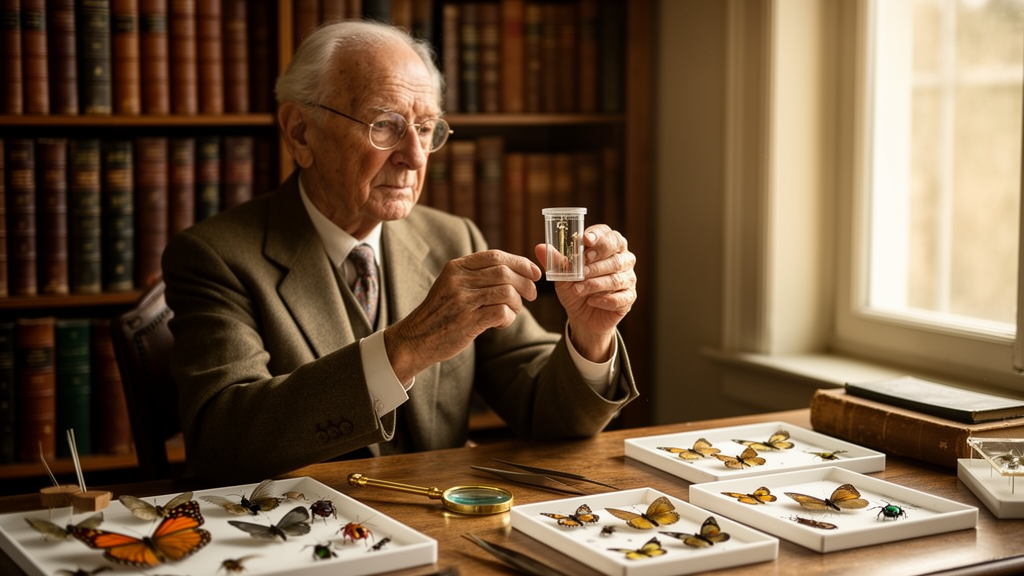
At the ETH Zürich, Sauter held the position of titular professor and conservator, and his professional priorities lay chiefly in teaching and in the care of the institution’s insect collection. His lectures and excursions on systematic entomology were, by the account of his former students, extremely popular among the students, and remain in the memory of many of them to this day. His work as conservator was equally consequential: when he retired, he left behind a well-organised, modern insect collection that had been badly neglected and run down at the time he took over its stewardship.
The lasting testimony to the esteem in which his students held him is written in the scientific names of the insect taxa they dedicated to their teacher. Four such names stand on record: Williella sauteri Horak, 1985, a tortricid moth (Lepidoptera: Tortricidae); Aphalara sauteri Burckhardt, 1983, a psyllid (Hemiptera: Aphalaridae); Lachesilla sauteri Lienhard, 1977, a psocid (Psocoptera: Lachesillidae); and Prorastriopes sauteri Nayrolles & Lienhard, 1990, a springtail (Collembola: Bourletiellidae). Each name was coined by one of the three doctoral students whose dissertations he supervised: Charles Lienhard, who completed his doctorate in 1977, and Daniel Burckhardt and Marianne Horak, both of whom finished theirs in 1983.
The three former students, writing in their memorial tribute, describe Sauter as neither a hard-edged manager nor a showman, but as a person of great authenticity who remained true to himself. In the hectic operations of the former Entomological Institute of the ETH during the 1970s, they recall, he was a calm centre of gravity. Through his friendly and reserved manner he conveyed to the students working under him the insight that full commitment to the subject and good collegial relations need not suffer under excessive ambition. They add, with affection, that at times the insects may have stood closer to him than the people around him, yet he could equally turn to his students with much patience and empathy.
The memorial account preserves vivid scenes from the entomological excursions Sauter led. The otherwise quiet and measured professor would suddenly pursue an interesting butterfly with unexpected energy and great skill, net in hand, usually with success, and would then proudly explain to the students why the animal had caught his interest, describe its way of life and its position in the system of insects, and often mention the difficulties that a more precise species determination would have involved. In demonstrating a particularly handsome insect, his enthusiasm for the beauty of these animals was always palpable. He could describe a shimmering but actually common weevil of the genus Phyllobius, almost effusively, as a jewel of nature. Since insects in the field are hardly available on demand, an excursion can only be prepared to a limited extent, and his professional command made every excursion a special event.
Two anecdotes from the assistantship years under Sauter illustrate his character as his former assistant Charles Lienhard retells them. On one afternoon excursion to the Katzensee near Zurich, with uncertain weather, Sauter shyly asked his young assistant whether he should take a jacket along; after a brief discussion of the possible weather risks they decided, for safety’s sake, to bring it. Lienhard notes that he still asks himself the same question in similar situations, and usually takes the jacket. On another Katzensee excursion, Sauter, the attentive naturalist, suddenly raised a small pair of field glasses, which he always carried with him like his hand lens, and looked skyward. No insect had caught his attention this time, but a common tern, Sterna hirundo, then a species very rarely observed in Switzerland. Lienhard recalls that whenever he now watches these graceful fliers on Lake Constance, where the species has been breeding again in the region for years, he thinks of that excursion.
During the biological field weeks organised each summer together with the botanists of the ETH, Sauter was the lecturer who, through the diversity of his knowledge of all insect groups, could make the then still rarely used concept of biodiversity tangible for students. Faced with the great variety of insects observed and the challenge of identifying them as precisely as possible, his universality proved its worth: he was able to solve or competently comment on almost any problem, or at least point out that the group in question was a particularly difficult one. His intellectual curiosity and openness to new scientific ideas also benefited his doctoral students directly. They remember with pleasure the mini-colloquia he held for five to six doctoral candidates, which introduced them, among other things, to Hennig’s phylogenetic systematics in its almost illegible German original edition. For Marianne Horak’s dissertation on plesiomorphic tortricines of the Southern Hemisphere, a view inspired by the ground plan of the group proved decisive, at a time when that idea was still considered revolutionary.
Sauter’s breadth of interest carried a cost, as his students candidly record. Feeling obliged to speak competently on problems across all insect orders, he distanced himself from a modernising scientific culture in which prestige and the number of published papers stood in the foreground. As a researcher he was marked by great scepticism, and he published relatively little. His perfectionism, common enough among systematists, and his highly critical attitude toward preliminary results, prevented in some cases the publication of interesting observations and insights, which probably still await discovery, noted in his delicate, fine handwriting, ideal as an label script, among his scientific estate. His characteristic question to a student excitedly reporting a new species or even a new genus was simply: Are you sure? And on the appearance of a colleague’s paper he would occasionally remark, proudly but without bitterness, that he had known that for a long time.
His students also record the generosity with which he let them go once they were ready. Horak never forgot how he introduced his doctoral student to his colleagues among the European lepidopterologists and then withdrew, believing himself no longer needed. A token of gratitude for his exemplary role as doctoral supervisor was the naming of a new tortricid genus from New Caledonia after him, a choice complicated by the fact that genus names derived from the name of Hans Sauter, a collector active in East Asia, already existed. The unusual choice of the genus name was something of a gamble, but it met with immediate general approval, leaving no doubt who was being honoured with Williella sauteri. Joy in observation and insight, his students write, often seemed to be the goal of his research rather than the final elaboration of results through to publication, yet that discoverer’s joy transferred to his best students and, where enough ambition was present, led to important publications such as taxonomic revisions and identification keys. In this sense, they conclude, Willi Sauter was not only the most universal Swiss entomologist of his time, but also a catalyst for many well-founded studies across the most varied insect groups, an achievement they regard as among the noblest tasks of a significant university teacher.
Subject of Research: Memorial tribute to Swiss entomologist Professor Willi Sauter and his contributions to systematic entomology at ETH Zürich
Article Title: In Memoriam Professor Willi Sauter (25. Juli 1928 – 3. September 2020)
Article References: Lienhard, C., Burckhardt, D., & Horak, M. (2020). In Memoriam Professor Willi Sauter (25. Juli 1928 – 3. September 2020). Alpine Entomology, 4, 185-187. https://doi.org/10.3897/alpento.4.59694
Image Credits: AI Generated
Keywords: Willi Sauter, entomology, ETH Zürich, Swiss Entomological Society, systematic entomology, insect taxonomy, Insecta Helvetica, tortricid moths, doctoral supervisor, insect collection, biodiversity, memorial
News Source: Margaret Porter. (October 27, 2026). Remembering Willi Sauter, One of Europe’s Most Universal Entomologists. Scienmag.