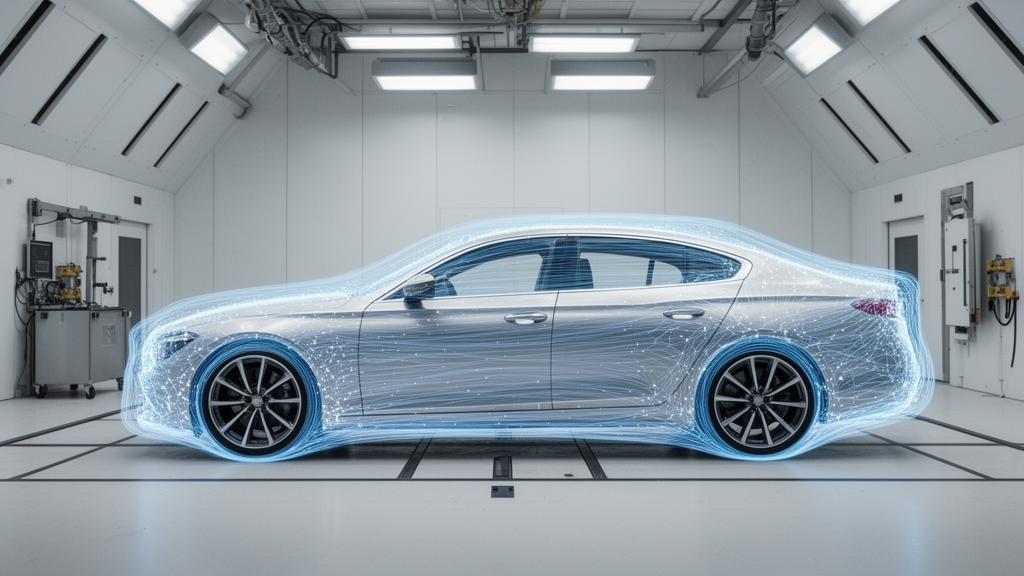
CarBench, a newly introduced open benchmark for high-resolution three-dimensional automotive aerodynamics, evaluates neural surrogate models against DrivAerNet++, a public dataset described by the authors as the largest available for this field and containing more than 8,000 high-fidelity car simulations. The study assesses 11 representative model configurations, comparing predictive accuracy, pressure-field fidelity relative to computational fluid dynamics references, computational efficiency and statistical uncertainty across several families of machine-learning approaches.
The evaluation includes classical neural operators, geometric deep-learning methods, transformer-based neural solvers and implicit-field networks that use triplane representations. Specifically, the benchmark assesses the Fourier Neural Operator, PointNet, RegDGCNN, PointMAE, PointTransformer, Transolver, Transolver++, AB-UPT and TripNet, with 11 configurations evaluated in total. By placing these approaches within one standardized framework, CarBench is designed to support systematic comparisons between different ways of representing and modeling aerodynamic fields over three-dimensional vehicle geometries.
CarBench goes beyond standard interpolation tasks by including cross-category experiments. In these tests, representative transformer-based solvers are trained on a single car archetype and then evaluated on vehicle categories not represented in their training data. The purpose of this setup is to measure performance under changes in the distribution of test geometries, providing a direct assessment of cross-category generalization. The reported analysis covers both interpolation and cross-category evaluation, although the supplied research summary does not provide model-by-model numerical results or identify a single configuration as the overall winner.
Uncertainty is treated as part of the benchmark rather than as an afterthought. The framework includes metric-level uncertainty-estimation routines based on bootstrap resampling, allowing evaluation metrics to be reported with statistical variability. This is particularly important for a benchmark intended to make close comparisons among models, because apparent performance differences can be evaluated in relation to uncertainty in the measured metrics. The study’s comparison also includes computational efficiency, extending the analysis beyond conventional prediction error and pressure-field agreement.
The authors are releasing CarBench as an open-source framework, including the training pipelines, bootstrap-based uncertainty-estimation routines and pretrained model weights. The public repository is intended to give researchers a common basis for training and evaluating models on high-fidelity external automotive-aerodynamics simulations. CarBench does not establish that any tested surrogate can replace computational fluid dynamics or produce validated engineering benefits; its reported contribution is a reproducible benchmark for comparing model accuracy, pressure-field fidelity, efficiency, metric uncertainty and robustness when test geometries differ from those used for training.
Subject of Research: Benchmarking neural surrogates for high-fidelity three-dimensional automotive aerodynamics
Article Title: CarBench: A comprehensive benchmark for neural surrogates on high-fidelity 3D car aerodynamics
Article References: Elrefaie, M., Shu, D., Klenk, M., & Ahmed, F. (2026). CarBench: A comprehensive benchmark for neural surrogates on high-fidelity 3D car aerodynamics. Communications Engineering. https://doi.org/10.1038/s44172-026-00805-2
Image Credits: AI Generated
DOI: 10.1038/s44172-026-00805-2
Keywords: CarBench, neural surrogates, automotive aerodynamics, machine learning, computational fluid dynamics, DrivAerNet++, transformer models, geometric deep learning, pressure fields, model generalization, comprehensive, benchmark
News Source: Cassandra Pierce. (October 21, 2026). CarBench benchmarks neural surrogates for 3D car aerodynamics. Scienmag.