• HOME
  • NEWS
  • EXPLORE
    • CAREER
      • Companies
      • Jobs
    • EVENTS
    • iGEM
      • News
      • Team
    • PHOTOS
    • VIDEO
    • WIKI
  • BLOG
  • COMMUNITY
    • FACEBOOK
    • INSTAGRAM
    • TWITTER
Sunday, August 23, 2026
BIOENGINEER.ORG
No Result
View All Result
  • Login
  • HOME
  • NEWS
  • EXPLORE
    • CAREER
      • Companies
      • Jobs
        • Lecturer
        • PhD Studentship
        • Postdoc
        • Research Assistant
    • EVENTS
    • iGEM
      • News
      • Team
    • PHOTOS
    • VIDEO
    • WIKI
  • BLOG
  • COMMUNITY
    • FACEBOOK
    • INSTAGRAM
    • TWITTER
  • HOME
  • NEWS
  • EXPLORE
    • CAREER
      • Companies
      • Jobs
        • Lecturer
        • PhD Studentship
        • Postdoc
        • Research Assistant
    • EVENTS
    • iGEM
      • News
      • Team
    • PHOTOS
    • VIDEO
    • WIKI
  • BLOG
  • COMMUNITY
    • FACEBOOK
    • INSTAGRAM
    • TWITTER
No Result
View All Result
Bioengineer.org
No Result
View All Result
Home NEWS Science News Biology

Can’t find your keys? You need a chickadee brain

Bioengineer by Bioengineer
November 9, 2021
in Biology
Reading Time: 4 mins read
0
Mountain Chickadee at Feeding Array
Share on FacebookShare on TwitterShare on LinkedinShare on RedditShare on Telegram

Ithaca, N.Y.—For the first time, researchers have shown that there is a genetic component underlying the amazing spatial memories of Mountain Chickadees. These energetic half-ounce birds hide thousands of food items every fall and rely on these hidden stores to get through harsh winters in the mountains of the West. To find these caches, chickadees use highly specialized spatial memory abilities. Although the genetic basis for spatial memory has been shown for humans and other mammals, direct evidence of that connection has never before been identified in birds.
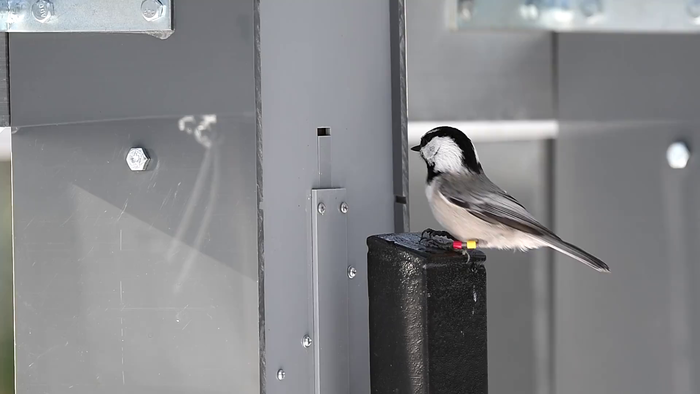
Mountain Chickadee at Feeding Array

Credit: Vladimir Pravosudov, University of Nevada, Reno.

Ithaca, N.Y.—For the first time, researchers have shown that there is a genetic component underlying the amazing spatial memories of Mountain Chickadees. These energetic half-ounce birds hide thousands of food items every fall and rely on these hidden stores to get through harsh winters in the mountains of the West. To find these caches, chickadees use highly specialized spatial memory abilities. Although the genetic basis for spatial memory has been shown for humans and other mammals, direct evidence of that connection has never before been identified in birds.

These findings were just published in the journal Current Biology. The research is a collaboration among scientists from the Cornell Lab of Ornithology, the University of Colorado Boulder, the University of Nevada, Reno, and the University of Oklahoma.

“We all use spatial memory to navigate our environment,” says lead author Carrie Branch at the Cornell Lab of Ornithology. “Without memory there’s no learning and an organism would have to start from scratch for every task. So, it really is life and death for these birds to be able to remember where they stashed their food. We’ve been able to show that natural selection is shaping their ability to remember locations.”

If natural selection (survival of the fittest) is shaping chickadee memory, certain criteria have to be met. There has to be variation in the trait: some chickadees are indeed better than others at re-finding their stores. There has to be a fitness advantage: birds that perform better on a spatial memory task are more likely to survive and produce offspring. Importantly, variation in the trait must have a genetic basis.

“Environment does still matter a lot in terms of shaping behavior, but our work here suggests that genes may create the brain structures, and then experience and learning can build on top of that,” Branch explains.

How do you measure a chickadee’s memory? Senior author Vladimir Pravosudov and his team at the University of Nevada, Reno, designed arrays of “smart” feeders to measure memory in a population of wild Mountain Chickadees in California’s Sierra Nevada mountains. Each feeder is equipped with radio frequency identification sensors. The 42 birds tested were fitted with leg tags the size of a grain of rice which give off an identifying signal. Each bird was assigned to one of the eight feeders in each array. The feeder sensor reads the bird’s ID tag and if it’s the matching feeder for that individual, a mechanism opens the door, and the bird gets a seed. The scientists then tracked how many tries it took before the birds consistently went to the correct feeder. 

“This is an effective system to test spatial learning and memory in hundreds of wild chickadees in their natural environment,” said Pravosudov. “We have previously shown that even very small variations in performance are associated with differences in survival.”

To understand the connection between spatial memory and genetic architecture, co-authors Georgy Semenov and Scott Taylor at the University of Colorado Boulder, sequenced Mountain Chickadee genomes.
 
“We used two methods to link genetic variation with spatial memory in chickadees,” said Semenov. “In the traditional genome-wide approach, we compared genetic data across individuals, from those that performed well on the spatial learning and memory task to those that performed poorly. We did the same comparison with a new machine learning algorithm. Both methods showed hundreds of differences associated with spatial memory. Many of the variations in the genomes turned up in areas known to be associated with learning, memory, and neuron development in the brain.”

The authors say many questions remain about the influence of spatial memory itself, including what role it may play in the female’s choice of a mate.
 
This research was supported by grants to the University of Nevada, Reno, and to the University of Colorado Boulder, from the National Science Foundation and by a Rose Postdoctoral Fellowship from the Cornell Lab of Ornithology.
 
Reference:
Carrie L. Branch, Georgy A. Semenov, Dominique N. Wagner, Benjamin R.
Sonnenberg, Angela M. Pitera, Eli S. Bridge, Scott A. Taylor, Vladimir V. Pravosudov. The genetic basis of spatial cognitive variation in a food-caching bird. (2021) Current Biology. https://doi.org/10.1016/j.cub.2021.10.036
 

Editors: Download images, graphics, and video. The use of this material is protected by copyright. Use is permitted only within stories about the content of this release. Redistribution or any other use is prohibited without express written permission of the Cornell Lab of Ornithology or the copyright owner.


Journal

Current Biology

DOI

10.1016/j.cub.2021.10.036

Method of Research

Experimental study

Subject of Research

Animals

Article Title

The genetic basis of spatial cognitive variation in a food-caching bird.

Article Publication Date

3-Nov-2021
Share12Tweet8Share2ShareShareShare2

Related Posts

Delayed antiviral response in alveolar type 2 cells heightens influenza susceptibility

Delayed antiviral response in alveolar type 2 cells heightens influenza susceptibility

August 22, 2026
Genetic evidence links sleep disruption to hemorrhoidal disease, revealing a hidden connection

Genetic evidence links sleep disruption to hemorrhoidal disease, revealing a hidden connection

August 22, 2026

LASIK Versus Contact Lenses for Correcting Myopia

August 22, 2026

New Advances in Minimally Invasive Laryngeal Surgery

August 22, 2026

POPULAR NEWS

  • Blocking glucosylceramide production kills cancer cells via lysosomal dysfunction, not ceramide buildup

    29 shares
    Share 12 Tweet 7
  • ZCCHC4 boosts replication-dependent histone mRNA translation by interacting with eIF3

    29 shares
    Share 12 Tweet 7
  • KAIST Surface Defects Boost Droplet Formation, Removal, and Heat Transfer by 5.5-Fold

    29 shares
    Share 12 Tweet 7
  • Dual-oxygen pancreatic cancer organoids mirror basal-classical diversity, spatial transcriptomics confirms

    29 shares
    Share 12 Tweet 7

About

We bring you the latest biotechnology news from best research centers and universities around the world. Check our website.

Follow us

Recent News

Blocking glucosylceramide production kills cancer cells via lysosomal dysfunction, not ceramide buildup

ZCCHC4 boosts replication-dependent histone mRNA translation by interacting with eIF3

KAIST Surface Defects Boost Droplet Formation, Removal, and Heat Transfer by 5.5-Fold

Subscribe to Blog via Email

Success! An email was just sent to confirm your subscription. Please find the email now and click 'Confirm' to start subscribing.

Join 85 other subscribers
  • Contact Us

Bioengineer.org © Copyright 2023 All Rights Reserved.

Welcome Back!

Login to your account below

Forgotten Password?

Retrieve your password

Please enter your username or email address to reset your password.

Log In
No Result
View All Result
  • Homepages
    • Home Page 1
    • Home Page 2
  • News
  • National
  • Business
  • Health
  • Lifestyle
  • Science

Bioengineer.org © Copyright 2023 All Rights Reserved.