Marijuana (cannabis) is well known for giving people the “munchies.” Not only does it make people want to eat more, but it also makes them crave the tastiest, most high-calorie foods. Now a new study in the journal Current Biology on April 20 shows that well-studied nematode worms (C. elegans) react to those chemicals known as cannabinoids in precisely the same way.
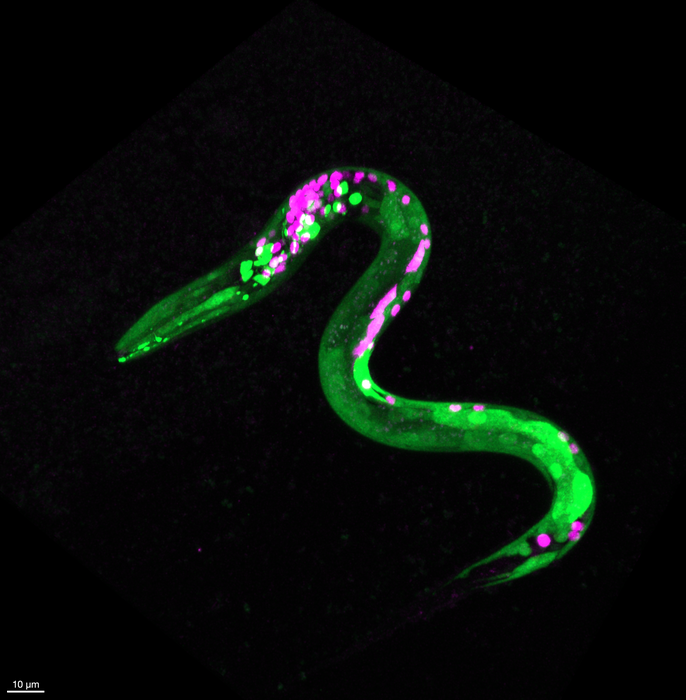
Credit: Stacy Levichev
Marijuana (cannabis) is well known for giving people the “munchies.” Not only does it make people want to eat more, but it also makes them crave the tastiest, most high-calorie foods. Now a new study in the journal Current Biology on April 20 shows that well-studied nematode worms (C. elegans) react to those chemicals known as cannabinoids in precisely the same way.
“Cannabinoids make nematodes hungrier for their favored foods and less hungry for their non-favored foods,” says Shawn Lockery from the University of Oregon in Eugene. “Thus, the effects of cannabinoids in nematodes parallels the effects of marijuana on human appetites.
“Nematodes diverged from the lineage leading to mammals more than 500 million years ago,” he added. “It is truly remarkable that the effects of cannabinoids on appetite are preserved through this length of evolutionary time.”
Lockery explained that the new study was inspired in 2015, when cannabis became legal in Oregon. “At the time, our laboratory at the University of Oregon was deeply involved in assessing nematode food preferences as part of our research on the neuronal basis of economic decision-making,” he said. “In almost literally a ‘Friday afternoon experiment’—read: ‘let’s dump this stuff on to see what happens’—we decided to see if soaking worms in cannabinoids alters existing food preferences. It does, and the paper is the result of many years of follow-up research.”
Cannabinoids are known to act by binding to cannabinoid detector proteins called cannabinoid receptors in the brain, nervous system, and other parts of the body. Those receptors in the body normally respond to related molecules that are naturally present in the body, known as endocannabinoids. The endocannabinoid system plays important roles in eating, anxiety, learning and memory, reproduction, metabolism, and more.
At the molecular level, the cannabinoid system in nematodes looks a lot like that in people and other animals. It begged the question as to whether the so-called hedonic feeding effects of cannabinoids also would be conserved across species.
In the new study, the researchers first showed that worms react to the endocannabinoid anandamide by eating more. They also ate more of their favorite food. The researchers found that those effects of the endocannabinoids depended on the presence of the worms’ cannabinoid receptors.
In further studies, they genetically replaced the C. elegans cannabinoid receptor with the human cannabinoid receptor to see what would happen, and they found that the animals responded normally to cannabinoids. The discovery emphasizes the commonality of cannabinoid effects in nematodes and humans, the researchers say. They report that the effects of anandamide also depend on neurons that play a role in food detection.
“We found that the sensitivity of one of the main food-detecting olfactory neurons in C. elegans is dramatically altered by cannabinoids,” Lockery said. “Upon cannabinoid exposure, it becomes more sensitive to favored food odors and less sensitive to non-favored food odors. This effect helps explain changes in the worm’s consumption of food, and it is reminiscent of how THC makes tasty food even tastier in humans.”
The findings in worms are not only entertaining, Lockery says, but they also have significant practical implications.
“Cannabinoid signaling is present in the majority of tissues in our body,” he said. “It therefore could be involved in the cause and treatment of a wide range of diseases. The fact that the human cannabinoid receptor gene is functional in C. elegans food-choice experiments sets the stage for rapid and inexpensive screening for drugs that target a wide variety of proteins involved in cannabinoid signaling and metabolism, with profound implications for human health.”
The researchers note that big outstanding questions remain, including how cannabinoids change the sensitivity of C. elegans olfactory neurons, which don’t have cannabinoid receptors. They’re also curious to study the effects of psychedelics on nematodes.
“Perhaps we can find a new set of similarities between humans and worms, now in the case of drugs that alter perception and psychological well-being,” Lockery says.
####
Author note:
Our research builds on the pioneering work of Richard Komuniecki at University of Toledo who demonstrated that the human cannabinoid receptor is functional in C. elegans. We are grateful to the organization that funded this research (National Institute of Drug Abuse).
Current Biology, Levichev et al. “The conserved endocannabinoid anandamide modulates olfactory sensitivity to induce hedonic feeding in C. elegans” https://www.cell.com/current-biology/fulltext/S0960-9822(23)00301-9
Current Biology (@CurrentBiology), published by Cell Press, is a bimonthly journal that features papers across all areas of biology. Current Biology strives to foster communication across fields of biology, both by publishing important findings of general interest and through highly accessible front matter for non-specialists. Visit http://www.cell.com/current-biology. To receive Cell Press media alerts, contact [email protected].
Journal
Current Biology
DOI
10.1016/j.cub.2023.03.013
Method of Research
Experimental study
Subject of Research
Animals
Article Title
The conserved endocannabinoid anandamide modulates olfactory sensitivity to induce hedonic feeding in C. elegans
Article Publication Date
20-Apr-2023