Successful precision cancer diagnosis through an AI analysis of multiple factors of prostate cancer. Potential application of the precise diagnoses of other cancers by utilizing a urine test
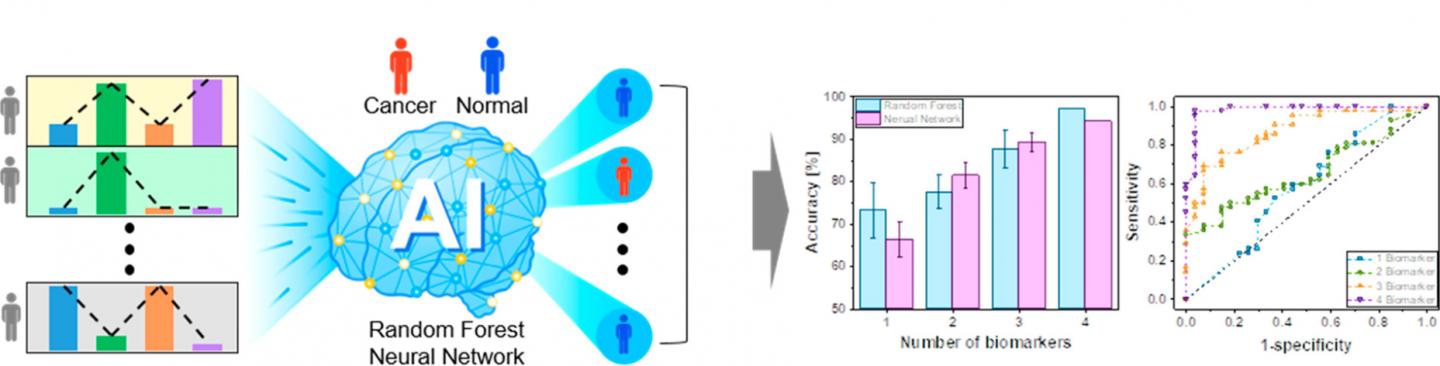
Credit: Korea Institute of Science and Technology(KIST)
Prostate cancer is one of the most common cancers among men. Patients are determined to have prostate cancer primarily based on *PSA, a cancer factor in blood. However, as diagnostic accuracy is as low as 30%, a considerable number of patients undergo additional invasive biopsy and thus suffer from resultant side effects, such as bleeding and pains.
*Prostate-Specific Antigen (PSA): a prostate-specific antigen (a cancer factor) used as an index for the screening of prostate cancer.
The Korea Institute of Science and Technology (KIST) announced that the collaborative research team led by Dr. Kwan Hyi Lee from the Biomaterials Research Center and Professor In Gab Jeong from Asan Medical Center developed a technique for diagnosing prostate cancer from urine within only twenty minutes with almost 100% accuracy. The research team developed this technique by introducing a smart AI analysis method to an electrical-signal-based ultrasensitive biosensor.
As a noninvasive method, a diagnostic test utilizing urine is convenient for patients and does not need invasive biopsy, thereby diagnosing cancer without side effects. However, as the concentration of cancer **factors is low in urine, a urine-based biosensor has been utilized for classifying risk groups rather than for precise diagnosis thus far.
**Cancer Factor: a cancer-related biological index that can measure and evaluate drug reactivity objectively for a normal biological process, disease progress, and a treatment method.
Dr. Lee’s team at the KIST has been working toward developing a technique for diagnosing disease from urine by utilizing the electrical-signal-based ultrasensitive biosensor. An approach utilizing a single cancer factor associated with a cancer diagnosis was limited in increasing the diagnosis accuracy to over 90%. However, to overcome this limitation, the team simultaneously utilized different kinds of cancer factors instead of using only one to enhance the diagnostic accuracy innovatively.
The team developed an ultrasensitive semiconductor sensor system capable of simultaneously measuring trace amounts of selected four cancer factors in urine for diagnosing prostate cancer. They trained AI by using the correlation between the four cancer factors, which were obtained from the developed sensor. The trained AI algorithm was then used to identify those with prostate cancer by analyzing complex patterns of the detected signals. The diagnosis of prostate cancer by utilizing the AI analysis successfully detected 76 urinary samples with almost 100 percent accuracy.
“For patients who need surgery and/or treatments, cancer will be diagnosed with high accuracy by utilizing urine to minimize unnecessary biopsy and treatments, which can dramatically reduce medical costs and medical staff’s fatigue,” Professor Jeong at Asan Medical Center said. “This research developed a smart biosensor that can rapidly diagnose prostate cancer with almost 100 percent accuracy only through a urine test, and it can be further utilized in the precise diagnoses of other cancers using a urine test,” Dr. Lee at the KIST said.
###
This research was supported by the Korean National Research Foundation’s Midcareer Researcher Grant program, governmental departments(the Ministry of Science and ICT, the Ministry of Trade and Industry, the Ministry of Health and Welfare, and the Ministry of Food and Drug Safety), and Korea Medical Device Development Fund, funded by the Ministry of Science and ICT (MSIT). The research results have been published in the latest issue of ACS Nano, a top international academic journal in the nano-field.
Media Contact
Do-Hyun Kim
[email protected]
Related Journal Article
http://dx.