WASHINGTON, November 23, 2021 — The perception of gender in children’s voices is of special interest to researchers, because voices of young boys and girls are very similar before the age of puberty. Adult male and female voices are often quite different acoustically, making gender identification fairly easy.
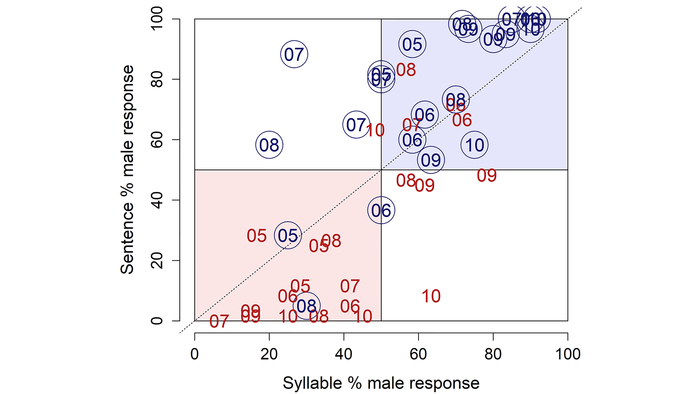
Credit: Barreda and Assmann
WASHINGTON, November 23, 2021 — The perception of gender in children’s voices is of special interest to researchers, because voices of young boys and girls are very similar before the age of puberty. Adult male and female voices are often quite different acoustically, making gender identification fairly easy.
Gender perception is much more complicated in children because gender differences in speech may emerge before sex-related anatomical differences between speakers. This suggests listeners may need to consider speaker age when guessing speaker gender and the perception of gender may depend on acoustic information not strictly related to anatomical differences between boys and girls.
In the Journal of the Acoustical Society of America, published by the Acoustical Society of America through AIP Publishing, researchers at the University of California, Davis and the University of Texas at Dallas report developing a database of speech samples from children ages 5 to 18 to explore two questions: What types of changes occur in children’s voices as they become adults, and how do listeners adjust to the enormous variability in acoustic patterns across speakers?
Listeners assess a speaker’s gender, age, height, and other physical characteristics based primarily on the speaker’s voice pitch and on the resonance (formant frequencies) of their voice.
“Resonance is related to speaker height — think violin versus cello — and is a reliable indicator of overall body size,” said Santiago Barreda, from the University of California, Davis. “Apart from these basic cues, there are other more subtle cues related to behavior and the way a person ‘chooses’ to speak, rather than strictly depending on the speaker’s anatomy.”
When Barreda and Peter Assmann, from the University of Texas at Dallas, presented listeners with both syllables and sentences from different speakers, gender identification improved for sentences. They said this supports the stylistic elements of speech that highlight gender differences and come across better in sentences.
They made two other important findings. First, listeners can reliably identify the gender of individual children as young as 5.
“This is well before there are any anatomical differences between speakers and before there are any reliable differences in pitch or resonance,” said Barreda. “Based on this, we conclude that when the gender of individual children can be readily identified, it is because of differences in their behavior, in their manner of speaking, rather than because of their anatomy.”
Second, they found identification of gender of speakers must take place jointly with the identification of age and likely physical size.
“Essentially, there is too much uncertainty in the speech signal to treat age, gender, and size as independent decisions,” he said. “One way to resolve this is to consider, for example, what do 11-year-old boys sound like, rather than what do males sound like and what do 11-year-olds sound like, as if these were independent questions.”
Their work suggests “perception of gender can depend on subtle cues based on behavior and not anatomy,” said Barreda. “In other words, gender information in speech can be largely based on performance rather than on physical differences between male and female speakers. If gendered speech followed necessarily from speaker anatomy, there would be no basis to reliably identify the gender of little girls and boys.”
The performative nature of gender has long been argued on theoretical grounds, and these experimental results support this perspective.
###
The article “Perception of gender in children’s voices” is authored by Santiago Barreda and Peter Assmann. It will appear in the Journal of the Acoustical Society of America on Nov. 23, 2021 (DOI: 10.1121/10.0006785). After that date, it can be accessed at https://aip.scitation.org/doi/10.1121/10.0006785.
ABOUT THE JOURNAL
The Journal of the Acoustical Society of America (JASA) is published on behalf of the Acoustical Society of America. Since 1929, the journal has been the leading source of theoretical and experimental research results in the broad interdisciplinary subject of sound. JASA serves physical scientists, life scientists, engineers, psychologists, physiologists, architects, musicians, and speech communication specialists. See https://asa.scitation.org/journal/jas.
ABOUT ACOUSTICAL SOCIETY OF AMERICA
The Acoustical Society of America (ASA) is the premier international scientific society in acoustics devoted to the science and technology of sound. Its 7,000 members worldwide represent a broad spectrum of the study of acoustics. ASA publications include The Journal of the Acoustical Society of America (the world’s leading journal on acoustics), JASA Express Letters, Proceedings of Meetings on Acoustics, Acoustics Today magazine, books, and standards on acoustics. The society also holds two major scientific meetings each year. See https://acousticalsociety.org/.
###
Journal
The Journal of the Acoustical Society of America
DOI
10.1121/10.0006785
Article Title
Journal of the Acoustical Society of America
Article Publication Date
23-Nov-2021