• HOME
  • NEWS
  • EXPLORE
    • CAREER
      • Companies
      • Jobs
    • EVENTS
    • iGEM
      • News
      • Team
    • PHOTOS
    • VIDEO
    • WIKI
  • BLOG
  • COMMUNITY
    • FACEBOOK
    • INSTAGRAM
    • TWITTER
Thursday, September 24, 2026
BIOENGINEER.ORG
No Result
View All Result
  • Login
  • HOME
  • NEWS
  • EXPLORE
    • CAREER
      • Companies
      • Jobs
        • Lecturer
        • PhD Studentship
        • Postdoc
        • Research Assistant
    • EVENTS
    • iGEM
      • News
      • Team
    • PHOTOS
    • VIDEO
    • WIKI
  • BLOG
  • COMMUNITY
    • FACEBOOK
    • INSTAGRAM
    • TWITTER
  • HOME
  • NEWS
  • EXPLORE
    • CAREER
      • Companies
      • Jobs
        • Lecturer
        • PhD Studentship
        • Postdoc
        • Research Assistant
    • EVENTS
    • iGEM
      • News
      • Team
    • PHOTOS
    • VIDEO
    • WIKI
  • BLOG
  • COMMUNITY
    • FACEBOOK
    • INSTAGRAM
    • TWITTER
No Result
View All Result
Bioengineer.org
No Result
View All Result
Home NEWS Science News Chemistry

Can black hole fire up cold heart of the phoenix?

Bioengineer by Bioengineer
August 31, 2020
in Chemistry
Reading Time: 2 mins read
0
IMAGE
Share on FacebookShare on TwitterShare on LinkedinShare on RedditShare on Telegram

IMAGE

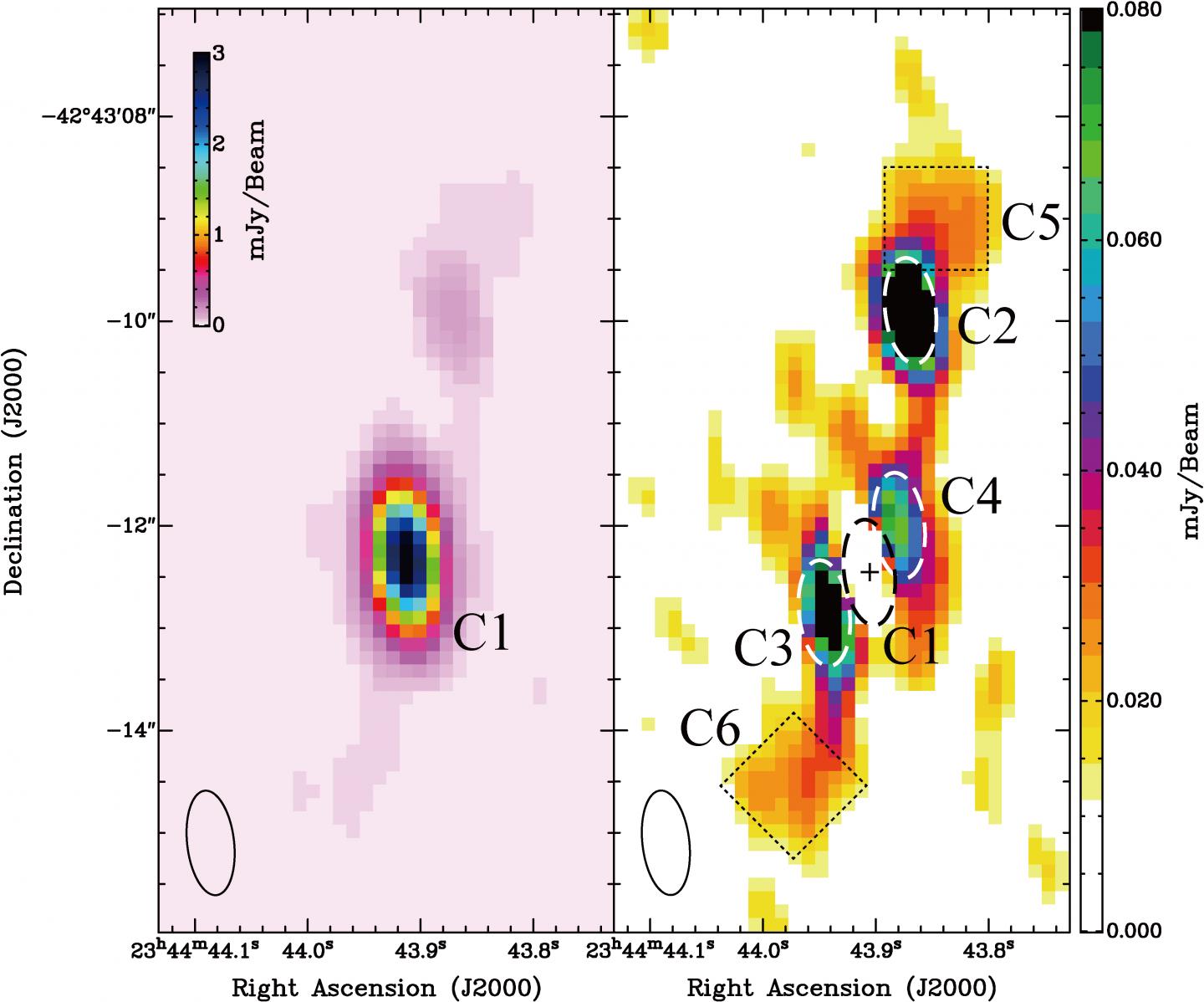
Credit: Akahori et al.

Radio astronomers have detected jets of hot gas blasted out by a black hole in the galaxy at the heart of the Phoenix Galaxy Cluster, located 5.9 billion light-years away in the constellation Phoenix. This is an important result for understanding the coevolution of galaxies, gas, and black holes in galaxy clusters.

Galaxies are not distributed randomly in space. Through mutual gravitational attraction, galaxies gather together to form collections known as clusters. The space between galaxies is not entirely empty. There is very dilute gas throughout a cluster which can be detected by X-ray observations.

If this intra-cluster gas cooled, it would condense under its own gravity to form stars at the center of the cluster. However, cooled gas and stars are not usually observed in the hearts of nearby clusters, indicating that some mechanism must be heating the intra-cluster gas and preventing star formation. One potential candidate for the heat source is jets of high-speed gas accelerated by a super-massive black hole in the central galaxy.

The Phoenix Cluster is unusual in that it does show signs of dense cooled gas and massive star formation around the central galaxy. This raises the question, “does the central galaxy have black hole jets as well?”

A team led by Takaya Akahori at the National Astronomical Observatory of Japan used the Australia Telescope Compact Array (ATCA) to search for black hole jets in the Phoenix Galaxy Cluster with the highest resolution to date. They detected matching structures extending out from opposite sides of the central galaxy. Comparing with observations of the region taken from the Chandra X-ray Observatory archive data shows that the structures detected by ATCA correspond to cavities of less dense gas, indicating that they are a pair of bipolar jets emitted by a black hole in the galaxy. Therefore, the team discovered the first example, in which intra-cluster gas cooling and black hole jets coexist, in the distant Universe.

Further details of the galaxy and jets could be elucidated through higher-resolution observations with next generation observational facilities, such as the Square Kilometre Array scheduled to start observations in the late 2020s.

###

These results appeared as Akahori, Takuya et al. “Discovery of Radio Jets in the Phoenix galaxy cluster center” in the August 2020 issue of Publications of the Astronomical Society of Japan.

Media Contact
Dr. Hitoshi Yamaoka
[email protected]

Original Source

https://www.nao.ac.jp/en/news/science/2020/20200831-mizusawa.html

Related Journal Article

http://dx.doi.org/10.1093/pasj/psaa039

Tags: AstronomyAstrophysicsSpace/Planetary Science
Share12Tweet8Share2ShareShareShare2

Related Posts

Chemists Turn CO2, Nitrite and Aldehydes Into Valuable Amino Acids Using Only Electricity

Chemists Turn CO2, Nitrite and Aldehydes Into Valuable Amino Acids Using Only Electricity

September 24, 2026
Chemists Program Crystal Frameworks Atom by Atom with a Single Versatile Molecule

Chemists Program Crystal Frameworks Atom by Atom with a Single Versatile Molecule

September 24, 2026

Nanoparticle-Coated Fabrics Promise Antibacterial, Self-Cleaning and Conductive Clothing

September 24, 2026

Bismuth Tungstate Wrapped in Conductive Polymer Yields Supercapacitor Electrode That Barely Fades Over 1,000 Cycles

September 24, 2026
Please login to join discussion

POPULAR NEWS

  • How Tumor Metabolism Decides Whether Colorectal Cancer Immunotherapy Works

    29 shares
    Share 12 Tweet 7
  • MicroRNA miR-196a Clears Toxic Huntington’s Protein Clumps by Suppressing Rad23b

    29 shares
    Share 12 Tweet 7
  • Stem Cell Screening Platform Hunts for Drugs to Halt Cardiac Fibrosis

    29 shares
    Share 12 Tweet 7
  • Sierra Leone finds outbreak response, not detection, is where precious days are lost

    29 shares
    Share 12 Tweet 7

About

We bring you the latest biotechnology news from best research centers and universities around the world. Check our website.

Follow us

Recent News

How Tumor Metabolism Decides Whether Colorectal Cancer Immunotherapy Works

MicroRNA miR-196a Clears Toxic Huntington’s Protein Clumps by Suppressing Rad23b

Stem Cell Screening Platform Hunts for Drugs to Halt Cardiac Fibrosis

Subscribe to Blog via Email

Enter your email address to subscribe to this blog and receive notifications of new posts by email.

Join 85 other subscribers
  • Contact Us

Bioengineer.org © Copyright 2023 All Rights Reserved.

Welcome Back!

Login to your account below

Forgotten Password?

Retrieve your password

Please enter your username or email address to reset your password.

Log In
No Result
View All Result
  • Homepages
    • Home Page 1
    • Home Page 2
  • News
  • National
  • Business
  • Health
  • Lifestyle
  • Science

Bioengineer.org © Copyright 2023 All Rights Reserved.