• HOME
  • NEWS
  • EXPLORE
    • CAREER
      • Companies
      • Jobs
    • EVENTS
    • iGEM
      • News
      • Team
    • PHOTOS
    • VIDEO
    • WIKI
  • BLOG
  • COMMUNITY
    • FACEBOOK
    • INSTAGRAM
    • TWITTER
Saturday, May 16, 2026
BIOENGINEER.ORG
No Result
View All Result
  • Login
  • HOME
  • NEWS
  • EXPLORE
    • CAREER
      • Companies
      • Jobs
        • Lecturer
        • PhD Studentship
        • Postdoc
        • Research Assistant
    • EVENTS
    • iGEM
      • News
      • Team
    • PHOTOS
    • VIDEO
    • WIKI
  • BLOG
  • COMMUNITY
    • FACEBOOK
    • INSTAGRAM
    • TWITTER
  • HOME
  • NEWS
  • EXPLORE
    • CAREER
      • Companies
      • Jobs
        • Lecturer
        • PhD Studentship
        • Postdoc
        • Research Assistant
    • EVENTS
    • iGEM
      • News
      • Team
    • PHOTOS
    • VIDEO
    • WIKI
  • BLOG
  • COMMUNITY
    • FACEBOOK
    • INSTAGRAM
    • TWITTER
No Result
View All Result
Bioengineer.org
No Result
View All Result
Home NEWS Science News Biology

Building a morphogen gradient by simple diffusion in a growing plant…

Bioengineer by Bioengineer
February 9, 2018
in Biology
Reading Time: 2 mins read
0
Share on FacebookShare on TwitterShare on LinkedinShare on RedditShare on Telegram
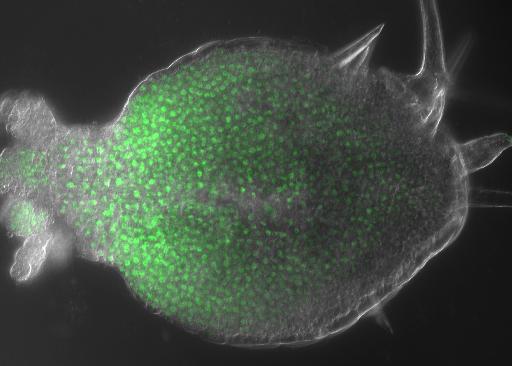
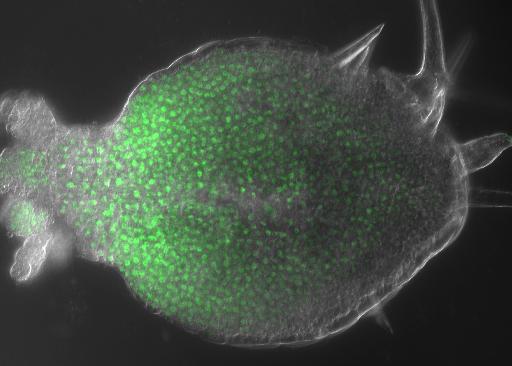
IMAGE

Credit: NIBB

In an article published on September 5th in Biophysical Journal, the team of Associate Professor Kensuke Kawade at the Okazaki Institute for Integrative Bioscience and National Institute for Basic Biology in Japan showed that a transcriptional co-activator ANGUSTIFOLIA3 (AN3) forms a signaling gradient along the leaf proximal-to-distal axis to determine cell-proliferation domain. In particular, by experimental and theoretical approaches, they demonstrated that pure diffusion in a growing tissue is sufficient to explain the AN3 gradient formation. This work provides evidence that the diffusion-based model of morphogen is viable in developmental patterning of multicellular organisms.

Spatial gradient of signaling molecules is critical for establishing developmental patterns of multicellular organisms. Around half a century ago, a seminal work proposed a theory that pure diffusion of signaling molecules from a restricted source may explain the establishment of such tissue-scale gradients (Crick, 1970). Despite the prominence of this diffusion-based model in development, quantitative studies, largely performed in animals, have not yet demonstrated this simple mechanism in multicellular tissues.

In an article published in Biophysical Journal, Dr. Kawade's team at OIBB/NIBB, in collaboration with scientists in the Institut Jacques Monod (France), Rikkyo University (Japan) and University of Tokyo (Japan), solved a long-standing argument of the diffusion-based model for morphogen gradient formation. They measured molecular transport through plasmodesmata, a unique cellular channel in plants directly connecting neighboring cells, by trans-scale FRAP (Fluorescence Recovery After Photobleaching) assays. This analyses revealed biophysical properties of diffusive molecular transport through plasmodesmata. Based on this diffusion-based framework, they succeeded in demonstrating that the AN3 gradient could be achieved solely by pure diffusion process through plasmodesmata in developing leaf primordia. Because the AN3 signaling gradient corresponds to the cell-proliferation domain, this study can explain how spatial and temporal dynamics of cell proliferation, and therefore tissue growth, is regulated during leaf development.

These discoveries provide a significant step forward in our understanding of how the simple biophysical phenomena 'diffusion' governs developmental patterning in multicellular organisms.

###

For more information: Kensuke Kawade, Hirokazu Tanimoto, Gorou Horiguchi and Hirokazu Tsukaya. Spatially different tissue-scale diffusivity shapes ANGUSTIFOLIA3 signaling gradient in growing leaves. Biophysical Journal. Published online 5th September, 2017.

Contacts: Kensuke Kawade at OIIB/NIBB
e-mail: [email protected]
tel: +81-564-59-5883

Media Contact

NIBB Office of PR
[email protected]

http://www.nins.jp/english/

Related Journal Article

http://dx.doi.org/10.1016/j.bpj.2017.06.072

Share12Tweet8Share2ShareShareShare2

Related Posts

Uncovering C. elegans Immunity via Genetic Screens — Biology

Uncovering C. elegans Immunity via Genetic Screens

May 16, 2026
Single mother must adapt swiftly — the survival of her colony depends on it — Biology

Single mother must adapt swiftly — the survival of her colony depends on it

May 15, 2026

Why Are Nearly Everyone Right-Handed? It Might Be Linked to How We Learned to Walk

May 15, 2026

Excessive Neuronal Activity Initiates Severe Autoimmune Brain Disorder

May 15, 2026
Please login to join discussion

POPULAR NEWS

  • Research Indicates Potential Connection Between Prenatal Medication Exposure and Elevated Autism Risk

    844 shares
    Share 338 Tweet 211
  • New Study Reveals Plants Can Detect the Sound of Rain

    730 shares
    Share 291 Tweet 182
  • Salmonella Haem Blocks Macrophages, Boosts Infection

    62 shares
    Share 25 Tweet 16
  • Breastmilk Balances E. coli and Beneficial Bacteria in Infant Gut Microbiomes

    58 shares
    Share 23 Tweet 15

About

We bring you the latest biotechnology news from best research centers and universities around the world. Check our website.

Follow us

Recent News

Flexible Framework Optimizes Data Center Site Planning

Short-Term Home Cognitive & Physical Training Tested in Seniors

Stress Evolution and Time Control in Retreat Roadways

Subscribe to Blog via Email

Enter your email address to subscribe to this blog and receive notifications of new posts by email.

Join 82 other subscribers
  • Contact Us

Bioengineer.org © Copyright 2023 All Rights Reserved.

Welcome Back!

Login to your account below

Forgotten Password?

Retrieve your password

Please enter your username or email address to reset your password.

Log In
No Result
View All Result
  • Homepages
    • Home Page 1
    • Home Page 2
  • News
  • National
  • Business
  • Health
  • Lifestyle
  • Science

Bioengineer.org © Copyright 2023 All Rights Reserved.