• HOME
  • NEWS
  • EXPLORE
    • CAREER
      • Companies
      • Jobs
    • EVENTS
    • iGEM
      • News
      • Team
    • PHOTOS
    • VIDEO
    • WIKI
  • BLOG
  • COMMUNITY
    • FACEBOOK
    • INSTAGRAM
    • TWITTER
Sunday, May 10, 2026
BIOENGINEER.ORG
No Result
View All Result
  • Login
  • HOME
  • NEWS
  • EXPLORE
    • CAREER
      • Companies
      • Jobs
        • Lecturer
        • PhD Studentship
        • Postdoc
        • Research Assistant
    • EVENTS
    • iGEM
      • News
      • Team
    • PHOTOS
    • VIDEO
    • WIKI
  • BLOG
  • COMMUNITY
    • FACEBOOK
    • INSTAGRAM
    • TWITTER
  • HOME
  • NEWS
  • EXPLORE
    • CAREER
      • Companies
      • Jobs
        • Lecturer
        • PhD Studentship
        • Postdoc
        • Research Assistant
    • EVENTS
    • iGEM
      • News
      • Team
    • PHOTOS
    • VIDEO
    • WIKI
  • BLOG
  • COMMUNITY
    • FACEBOOK
    • INSTAGRAM
    • TWITTER
No Result
View All Result
Bioengineer.org
No Result
View All Result
Home NEWS Science News Chemistry

Bristol scientists shine light on tiny crystals behind unexpected violent eruptions

Bioengineer by Bioengineer
September 23, 2020
in Chemistry
Reading Time: 2 mins read
0
IMAGE
Share on FacebookShare on TwitterShare on LinkedinShare on RedditShare on Telegram

IMAGE

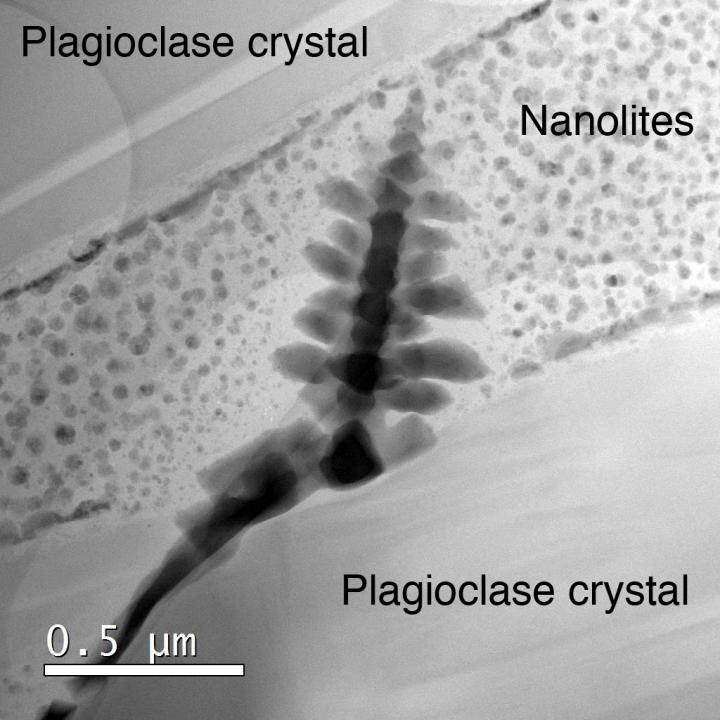
Credit: Brooker/Griffiths/Heard/Cherns

In a new study of volcanic processes, Bristol scientists have demonstrated the role nanolites play in the creation of violent eruptions at otherwise ‘calm’ and predictable volcanoes.

The study, published in Science Advances, describes how nano-sized crystals (nanolites), 10,000 times smaller than the width of a human hair, can have a significant impact of the viscosity of erupting magma, resulting in previously unexplained and explosive eruptions.

“This discovery provides an eloquent explanation for violent eruptions at volcanos that are generally well behaved but occasionally present us with a deadly surprise, such as the 122 BC eruption of Mount Etna,” said Dr Danilo Di Genova from the University of Bristol’s School of Earth Sciences.

“Volcanoes with low silica magma compositions have very low viscosity, which usually allows the gas to gently escape. However, we’ve shown that nanolites can increase the viscosity for a limited time, which would trap gas in the sticky liquid, leading to a sudden switch in behaviour that was previously difficult to explain.”

Dr Richard Brooker also from Earth Sciences, said: “We demonstrated the surprising effect of nanolites on magma viscosity, and thereby volcanic eruptions, using cutting-edge nano-imaging and Raman spectroscopy to hunt for evidence of these almost invisible particles in ash erupted during very violent eruptions.”

“The next stage was to re-melt these rocks in the laboratory and recreate the correct cooling rate to produce nanolites in the molten magma. Using the scattering of extremely bright synchrotron source radiation (10 billion times brighter than the sun) we were able to document nanolite growth.”

“We then produced a nanolite-bearing basaltic foam (pumice) under laboratory conditions, also demonstrating how these nanolites can be produced by undercooling as volatiles are exsolved from magma, lowering the liquidus.”

Professor Heidy Mader added: “By conducting new experiments on analogue synthetic materials, at low shear rates relative to volcanic systems, we were able to demonstrate the possibility of extreme viscosities for nanolite-bearing magma, extending our understanding of the unusual (non-Newtonian) behaviour of nanofluids, which have remained enigmatic since the term was coined 25 years ago.”

The next stage for this research is to model this dangerous, unpredictable volcanic behaviour in actual volcanic situations. This is the focus of a Natural Environment Research Council (UK) and National Science Foundation (US) grant ‘Quantifying Disequilibrium Processes in Basaltic Volcanism’ awarded to Bristol and a consortium of colleagues in Manchester, Durham, Cambridge and Arizona State University.

###

Paper:
In situ observation of nanolite growth in volcanic melt: A driving force for explosive eruptions by Di Genova, D; Brooker, R et al in Science Advances.

Media Contact
Shona East
[email protected]

Tags: Earth ScienceGeophysics/GravityPlate Tectonics
Share12Tweet8Share2ShareShareShare2

Related Posts

Miniature Sensor Uses Light to Detect Touch — Chemistry

Miniature Sensor Uses Light to Detect Touch

May 8, 2026
Iron Minerals Determine Whether Dissolved Organic Matter Fuels Microbes or Becomes Long-Term Carbon Storage — Chemistry

Iron Minerals Determine Whether Dissolved Organic Matter Fuels Microbes or Becomes Long-Term Carbon Storage

May 8, 2026

Kate Evans Appointed Associate Lab Director for Biological and Environmental Systems Science at ORNL

May 8, 2026

Advancing Multiscale Modeling and Overcoming Operational Challenges in Autothermal COâ‚‚-to-Methanol Reactors

May 8, 2026
Please login to join discussion

POPULAR NEWS

  • Research Indicates Potential Connection Between Prenatal Medication Exposure and Elevated Autism Risk

    840 shares
    Share 336 Tweet 210
  • New Study Reveals Plants Can Detect the Sound of Rain

    727 shares
    Share 290 Tweet 181
  • Scientists Investigate Possible Connection Between COVID-19 and Increased Lung Cancer Risk

    68 shares
    Share 27 Tweet 17
  • Salmonella Haem Blocks Macrophages, Boosts Infection

    61 shares
    Share 24 Tweet 15

About

We bring you the latest biotechnology news from best research centers and universities around the world. Check our website.

Follow us

Recent News

Evaluating Digoxin Use in Patients with Symptomatic Rheumatic Heart Disease

Evaluating the Effectiveness and Safety of Digitalis Glycosides in Treating Heart Failure

Urdu Fall Risk Questionnaire Adapted for Elderly

Subscribe to Blog via Email

Success! An email was just sent to confirm your subscription. Please find the email now and click 'Confirm' to start subscribing.

Join 82 other subscribers
  • Contact Us

Bioengineer.org © Copyright 2023 All Rights Reserved.

Welcome Back!

Login to your account below

Forgotten Password?

Retrieve your password

Please enter your username or email address to reset your password.

Log In
No Result
View All Result
  • Homepages
    • Home Page 1
    • Home Page 2
  • News
  • National
  • Business
  • Health
  • Lifestyle
  • Science

Bioengineer.org © Copyright 2023 All Rights Reserved.